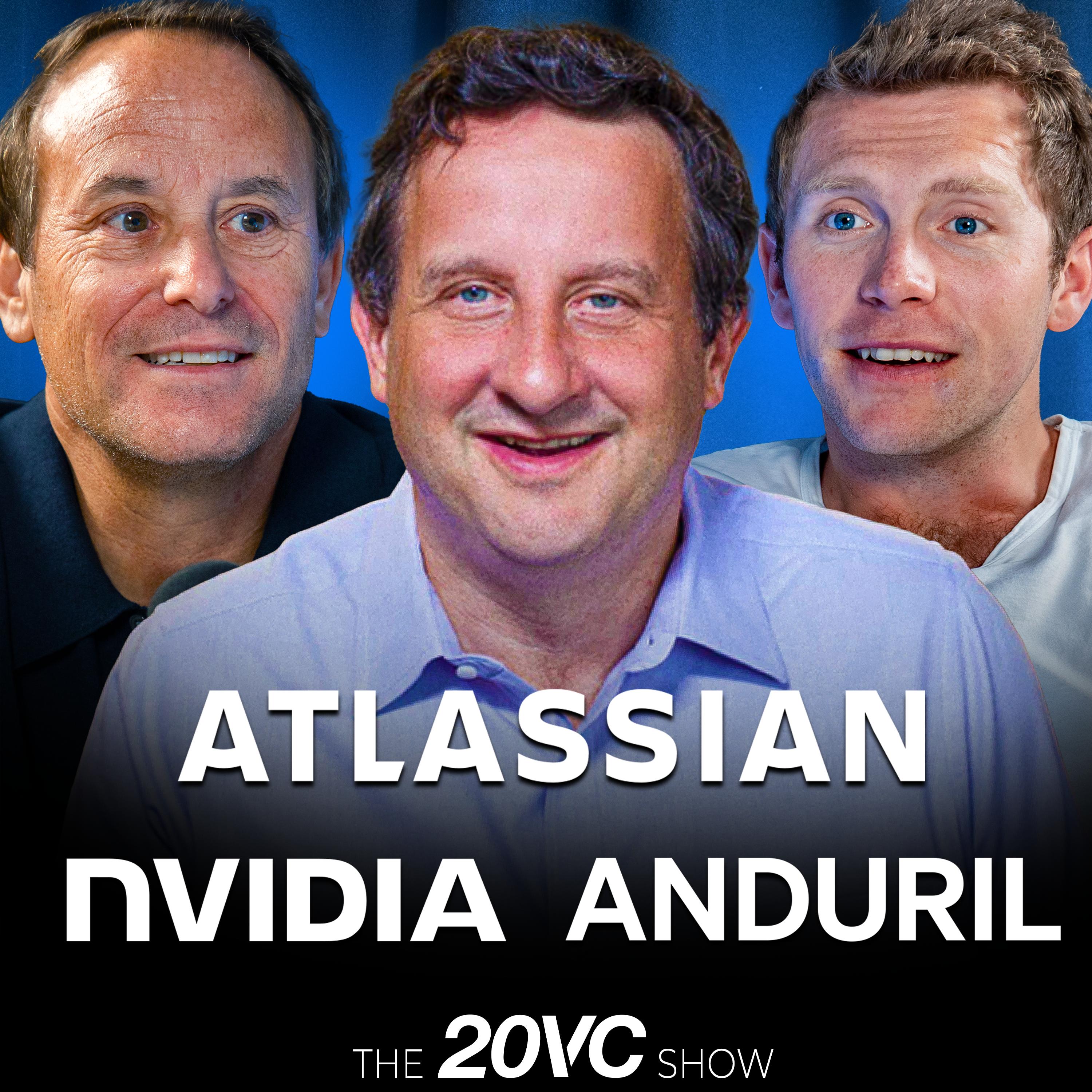
Overview of 20VC: The Return of Travis Kalanick (episode)
This episode of 20VC (host Harry Stebbings with guests Jason Lemkin and Rory O’Driscoll) reviews major tech headlines and investment implications: NVIDIA’s GTC announcements and trillion‑dollar bookings rhetoric, industry layoffs and the reshaping of talent in the AI era, Anduril’s $20B Army contract, why many seed funds may struggle, Travis Kalanick’s comeback with Atoms/robotics and the claim Uber would be a $1T company under him, and Adobe’s unexpected CEO exit. The discussion mixes market math, practical hiring advice, and venture strategy adjustments for AI’s acceleration.
News highlights — what was covered
- NVIDIA / GTC
- NVIDIA forecasted extremely large demand (soundbites suggesting $1T in cumulative demand/bookings over a multi‑year period). Market reaction: stock barely moved because much of this was already priced in.
- Key takeaway: NVIDIA expects very high CapEx to continue 4–5 years; inference consumption could explode but price-per-token math matters (more tokens × lower price per token ≠ automatic revenue growth).
- Jensen’s moves: NemoClaw (open models), partnerships, Grok integration — all pushing more inference consumption.
- Industry layoffs & talent reshaping
- Layoffs at Atlassian, rumored big cuts at Meta — framed as purposeful re‑engineering: many orgs are deciding they don’t need prior headcount mix, or need different skill sets.
- “Compute eats jobs” — capital reallocated to compute/AI changes hiring needs and economics.
- Anduril (misspelt in transcript as Andrew/Anduril)
- Awarded a ~10‑year, ~$20B Army contract consolidating 120+ procurement actions into an enterprise contract; validates Anduril’s Lattice connectivity and systems‑level position in defense procurement.
- Seed funds & fund sizing
- Argument: $50–100M seed funds may underperform this vintage because fund size pushes investors to chase “big outcomes” and pay up in crowded markets (power‑law pressure).
- Travis Kalanick / Atoms
- Kalanick surfaced with Atoms (robotics) after stealth years. Thesis: focus on wheeled, task‑specific industrial robots (more efficient than humanoids) and autonomy for industrial use cases (mining, logistics).
- Bold claim: Travis‑run Uber would be a $1T company today (five years further ahead on product/market moves).
- Adobe CEO exit
- Surprise resignation announced alongside earnings beat; no named successor. Market interpreted this oddly — stock fell. Raises questions about succession planning and AI‑era growth risks for creator tools.
Main takeaways & implications
- NVIDIA’s announcement is a capex-powered thesis: if enterprises and cloud providers maintain the pace of GPU/CapEx spending, NVIDIA (and the ecosystem) benefit massively — but it’s a high‑stakes, multi‑year bet with real downside probability.
- AI is forcing rapid talent reshuffles: companies want AI‑fluent people (not just brute-force headcount). Roles, org design and hiring bar are changing fast.
- Practical AI adoption matters more than model hype: enterprise value comes from implementing, training, and integrating AI into messy legacy workflows (Invisible example).
- Defense procurement can create giant TAMs via systems lock‑in and long enterprise contracts (Anduril example): that changes how startups and VCs should think about TAM and go‑to‑market.
- Fund sizing and strategy matter: larger funds must hunt for much larger winners and are increasingly biased toward chasing power laws; smaller, classical seed approaches may struggle when investors pay premium prices for non‑blockbuster TAMs.
- Founder vs. manager decisions are hard: swapping founders is a high‑friction move and should be rare; some past founder replacements were justified by capital markets and stage needs at the time.
Notable quotes & soundbites
- “Compute eats jobs.” — on the workforce impact of shifting dollars to compute/AI.
- “You do not need to be technical to win with AI agents in Q2 of ‘26. You do not need to be even 1% technical.” — about agent adoption for non‑technical roles.
- “Agentic deployment expert (ADE).” — coin for the new must‑have skill: someone who can deploy and train agents in an organization.
- “If you give [Wall Street] growth, they leave you alone. If you don’t give them growth, you better give them profitability.” — hiring and performance calculus for public companies.
Concrete advice / action items
For founders and execs
- Hire for AI fluency: during interviews, ask “What commercial AI tool did you bring into your organization this month?” — evidence of experimentation and deployment matters.
- Be an ADE: prioritize agent deployment, training, and operationalizing AI in product and go‑to‑market — not prompt‑engineering theatrics.
- Train agents continuously: treating agent onboarding and ongoing training as operational work is required to realize ROI.
- Branding tip: consider .tech for tech startups (practical recommendation from host).
- If you’re in a niche TAM, make sure you can articulate TAM expansion paths and why AI will grow the market, not replace it.
For investors
- Reassess fund strategy by size:
- Small/seed funds: be cautious about paying “power‑law prices” for mid‑sized TAMs — dilution and exit math changed.
- Growth funds: advantage in waiting for proof points and deploying large checks once scale/traction is visible.
- Evaluate opportunities on three axes: TAM size, TAM velocity (how fast will it expand), and defensibility/dominance potential.
- Look for founders who can clearly show operational AI adoption milestones (tools introduced, training regimes, agent ROI).
For public company boards/CEOs
- Anticipate investor and market pressure to reallocate headcount vs. compute; plan transitions and communications carefully (succession timing matters).
- Don’t let public messaging create confusion — if a CEO exit is imminent, coordinate announcement with succession to avoid stock/perception shocks.
Layoffs taxonomy (as discussed)
- Over‑hiring / unnecessary roles — companies using AI as an excuse.
- Growth collapse: used to grow fast (20%) now growing slowly (2%), so cut for profitability.
- AI efficiencies: tasks that required many humans can now be done with fewer people via AI.
- CapEx shift: spending shifting from people to compute (e.g., Meta) forces reallocation.
- Talent reshuffle / rehire for AI skills: replace many lower‑value employees with fewer higher‑skill AI‑native hires (deck cleaning).
Risks & open questions to watch
- CapEx risk: if hyperscalers and enterprises don’t keep spending at current pace, the NVIDIA trillion‑dollar bookings pathway could underdeliver.
- Token economics: inference usage growth vs. falling price-per-token — net revenue impact is non‑trivial.
- Talent market volatility: rapid reskilling needs could cause churn and execution gaps for many companies.
- Fund return dispersion: increased capital chasing big TAMs could produce many zeros and widen performance variance between funds.
Quick summary bullets (for skimming)
- NVIDIA expects sustained multi‑year CapEx demand; market mostly priced it in.
- AI adoption is changing hiring: hire AI‑fluent deployers, not brute‑force teams.
- Anduril’s $20B Army contract validates defense systems‑layer plays.
- Seed fund returns may suffer if funds pay up for non‑blockbuster TAMs.
- Travis Kalanick’s Atoms bets on wheeled industrial robots; argument that his leadership could have accelerated Uber to a $1T company.
- Adobe CEO exit was announced oddly (no immediate successor), signaling governance/strategy questions amid AI disruption.
If you want to act on this episode: prioritize operational AI deployments this quarter (pick one agentic tool, train it, measure P&L impact) and re‑score your hiring bar for AI fluency.