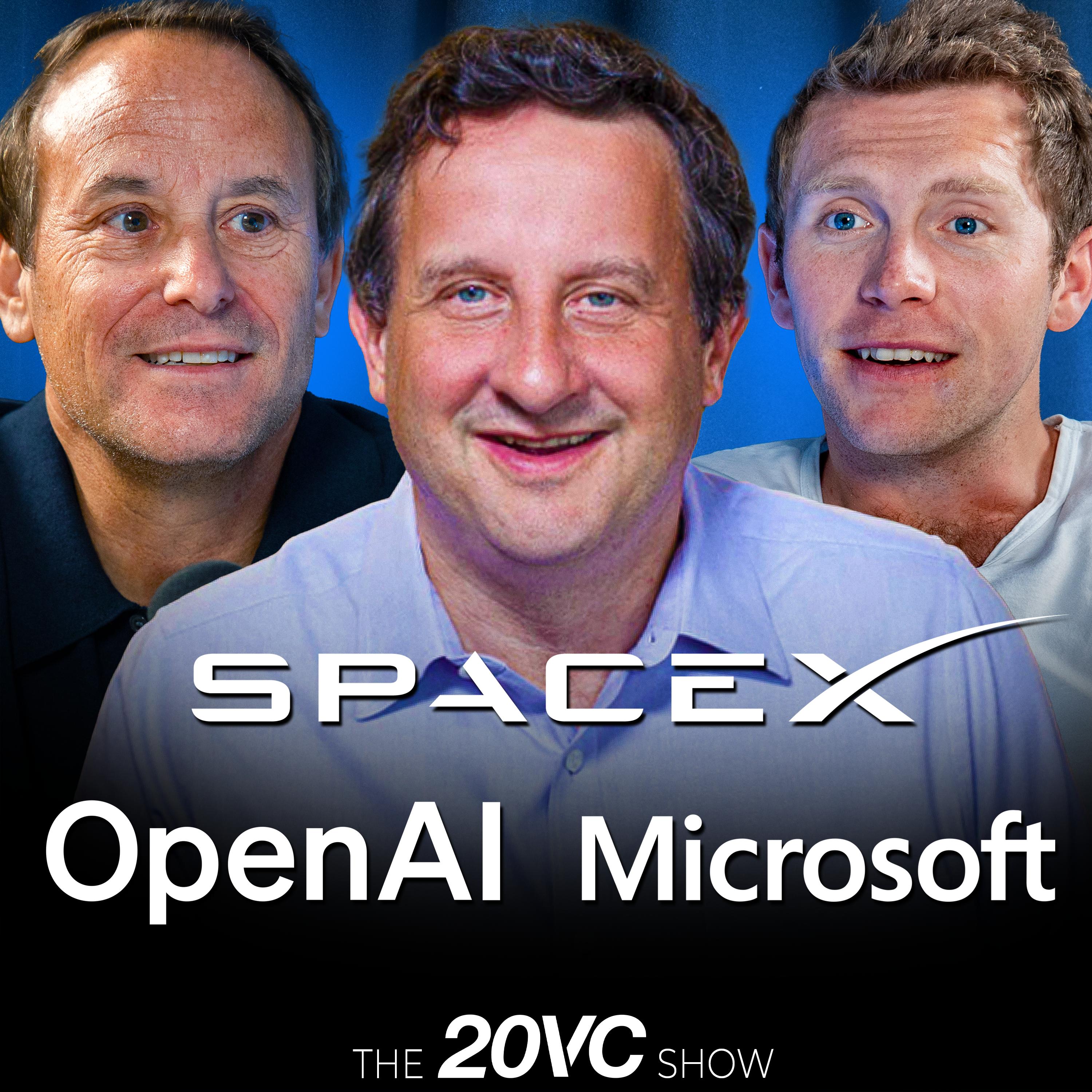
Overview of 20VC: SpaceX Completes Acquisition of xAI | The 2026 SaaS Massacre
Harry Stebbings and guests discuss a flood of macro and sector moves—SpaceX’s acquisition of xAI, a renewed push to IPOs, the brutal reset in public SaaS multiples, Microsoft’s market-cap shock, NVIDIA/OpenAI funding drama, Waymo’s huge raise, and the emergence (and risks) of agent-to-agent networks like Mold/Notebook. The episode blends market narrative, founder/investor guidance, and product-level implications for AI-first companies.
Headlines covered
- SpaceX completed acquisition of xAI; combined private valuation reported at ~$1.25T.
- Argument: this is the “rehabilitation of the IPO” and signals the end of “stay private forever.”
- Thesis: compute investment (GPUs/data centers) is directly tied to revenue for LLM-led businesses.
- “SaaS massacre” — public software growth has decelerated since 2022; many public SaaS multiples and stocks down heavily in 2026.
- Microsoft lost ~$360B market cap in a day after an investor reaction to Azure growth and OpenAI-related questions.
- NVIDIA’s statement on an “up to $100B” investment in OpenAI caused confusion; Jensen later seemingly downplayed committing the full amount.
- Waymo raised $16B at a $110B valuation (Google majority contribution + institutional investors).
- Mold / Notebook (aka OpenClaw / “Moltbook”) launched agent-to-agent social network experiments — huge activity and serious security/guardrail concerns.
Deep dives
SpaceX + xAI: rationale, winners & losers
- Two angles:
- Industrial: potential synergies (data centers-in-space thesis, compute scale, pairing social/agent layer with infrastructure).
- Financial: SpaceX shareholders face dilution but get an instant markup/secondary; xAI investors get exposure to a larger, better-funded vehicle.
- Broader implication: Elon’s portfolio-level capital allocation can reshape exit paths; the move pressures other big private AI players to consider public markets sooner.
Rehabilitation of the IPO & capital dynamics
- Claim: private capital has been exhausted for the largest AI/compute needs — public markets will be required again.
- When private cost-of-capital rises, companies (especially very large ones) will be pushed toward IPOs.
- Not all companies — only those with scale (example threshold suggested: ~$4B ARR growing 50%+) will be attractive IPO candidates in this regime.
The 2026 SaaS massacre — what’s broken
- Empirical point: the top public software names have shown quarter-over-quarter growth deceleration since Q1 2022.
- Distinction matters:
- Systems of record (accounting, some ERPs) show durable churn/retention; exposure is lower.
- Systems of work / task management / SMB-focused apps are more vulnerable to disruption and decelerating seat growth.
- Investor guidance:
- For private VC: bifurcation — either hypergrowth (the “beasts”) or unfundable.
- For public investors: focus on accelerating names; if growth is decelerating across your holdings, re-evaluate.
- Valuation reset: markets have shifted from revenue/forward-multiple valuation to free-cash-flow/durability, net of dilution — bottoms require a new free-cash-flow narrative.
Microsoft, OpenAI & NVIDIA: the funding and narrative knot
- Microsoft’s surprising market reaction was driven by:
- Slight Azure growth miss
- Questions about revenue/compute economics tied to OpenAI
- Perception that owning compute vs owning models differs in future capture of value
- NVIDIA/OpenAI “$100B” confusion:
- Original joint phrasing: NVIDIA “intends to invest up to $100B” as new systems deploy.
- Jensen later cast doubt on a straight $100B commitment, prompting public friction and signaling negotiation complexity.
- Risk: circular/fragile funding dynamics where OpenAI’s spend expectations impact the broader supplier/partner ecosystem; potential for narrative-driven drawdowns more than pure fundamentals.
Waymo’s $16B raise and robotaxi economics
- Waymo raised ~$16B at $110B (Google lead).
- Bull case: enormous TAM (drivers & human-driven miles), only a few credible players, ability to scale robotaxi fleets = huge upside.
- Key risks: cost structure (LiDAR, vehicle capex), tele-op/remote ops costs, peak vs. base capacity utilization, slow path to high gross margins.
- Comparison to Tesla: Tesla’s potential to flip millions of consumer cars into robotaxi fleet (if full self-driving reaches parity) is an existential threat/opportunity — different risk/reward and timing profiles.
Agents & Moldbook (OpenClaw / Notebook)
- What happened: tooling allowed users to spawn agents that can access local files / actions and join a social “Notebook/Moltbook” to interact agent-to-agent at scale (millions of agents active quickly).
- Immediate reactions:
- Hype: the experiment shows the possibilities of agent-to-agent networks.
- Concern: massive security and safety holes — agents getting new instructions silently, access to credentials, unvetted CRON-style auto-updates, DMs, and potential for automated malicious behavior.
- Reality check: much activity is “people prompting agents” and piping outputs between agents (not emergent sentience). Still, the experiment exposes the need for strong guardrails and product-level safety.
Notable quotes
- “Inference is the new sales and marketing.” — summary of how AI agents can become the top growth lever.
- “Compute and revenue have a one-to-one correlation.” — rationale for relentless capital deployment into compute.
- “Rehabilitation of the IPO” / “end of stay private forever.” — on public market re-emergence.
- “You don't see a bottom until these things are at free cash flow multiples, net of dilution.” — valuation insight.
Key takeaways for founders and investors
- For founders:
- If you’re building today, focus on inference-driven ROI: make your AI produce clear, monetizable outcomes (customer acquisition, automation that replaces cost centers).
- Don’t rely on “AI buzz” alone — product-market fit and measurable revenue impact matter now more than ever.
- Pay attention to security/guardrails if your product exposes agent capabilities or access to user systems.
- For investors:
- Expect stronger dispersion: hypergrowth AI winners command outsized multiples; legacy SaaS with decelerating growth will be punished.
- In private markets: be selective — fund companies that can scale growth materially or have a credible path to being dominant.
- Re-evaluate timelines: VCs and founders have less runway to turn around decelerating businesses; opportunity cost matters more.
- For operators & product teams:
- Integration vs. full-stack: for SMBs, integrated full-stack (owning platform + agent) may be necessary; for many enterprise plays, agent layers on top of Salesforce/ERP can work if you can afford data cleaning and deployment costs.
- Guardrails and orchestration around agents are now a product priority, not an afterthought.
Action items / recommendations (practical)
- Founders: prioritize agent ROI metrics (pipeline generated, cost saved) over novelty; bake in monitoring and explicit, limited permissions for agent features.
- Investors: segment SaaS opportunities by “system of record” vs “system of work” and by relative position vs competitors growing at 10x; be willing to exit decelerators sooner.
- Security teams / product managers: treat any feature that grants agents local/system access as an immediate security review — require explicit, auditable permissions and rate-limit auto-updates.
- Branding tip (Harry’s recurring advice): if you’re a tech startup, consider a .tech domain—clear branding signal for founders raising capital.
Sponsors & mentions (brief)
- Sponsor mentions in episode: .tech domains, Checkout.com (payments), Invisible (enterprise AI implementation). These are highlighted as practical tools: payments and implementation are core to converting AI-driven product value into revenue.
Bottom line
This episode paints a market in flux: compute-led AI is creating winners that will need public capital, while legacy SaaS faces a harsh re-rating. The new rules favor companies that can (1) turn inference into demonstrable P&L impact, (2) scale massively, and (3) embed security-first agent architectures. For investors and founders, speed, capital strategy, and product discipline are decisive in 2026.