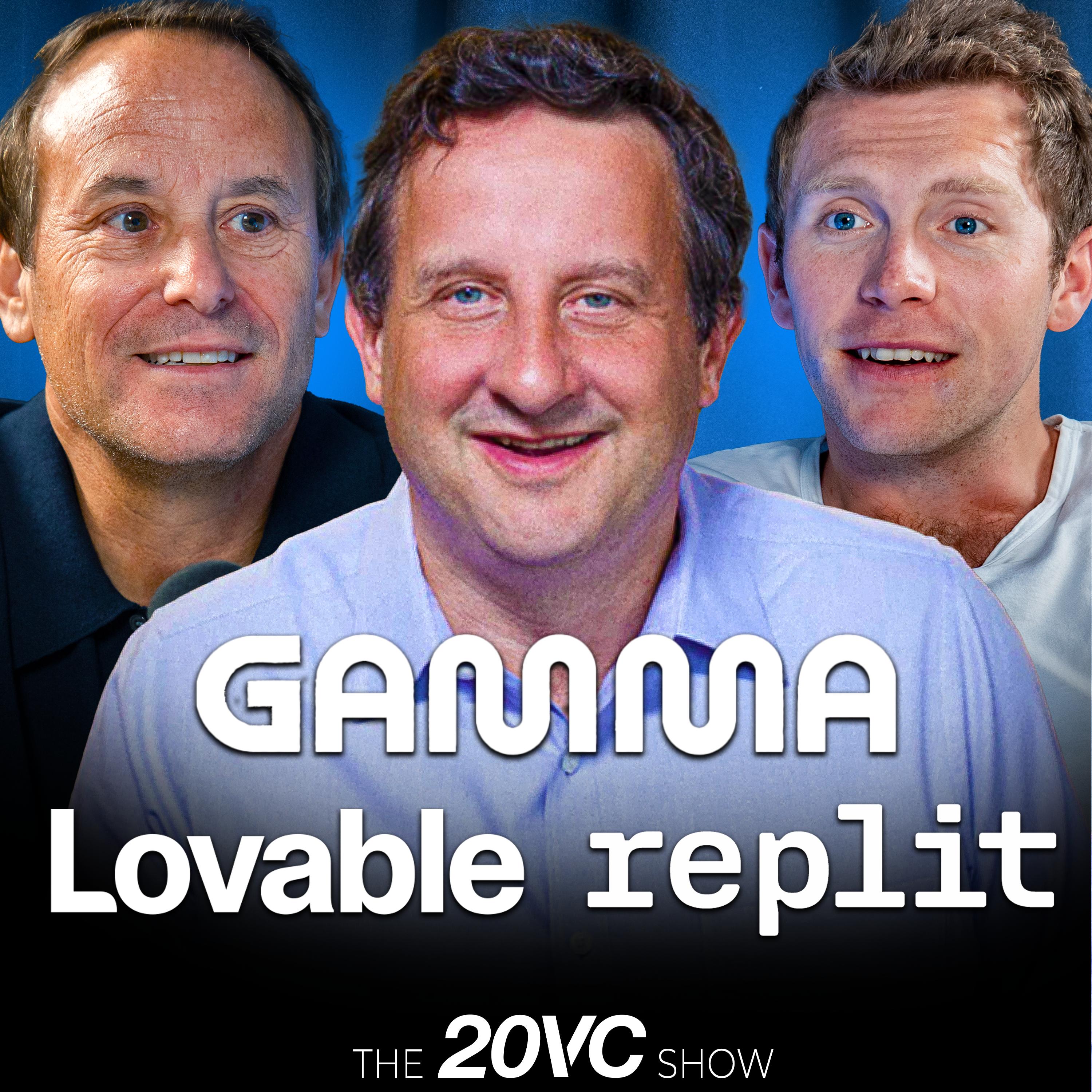
Overview of 20VC: Sequoia's Leadership Transition | Michael Burry Shorts NVIDIA and Palantir | Gamma Raises $100M at $2BN | Has Defensibility Died in a World of AI | Datadog Surges as Duolingo Plummets: What is Happening
Harry Stebbings hosts a wide-ranging conversation with Rory and Jason on how AI is rewriting venture math, company defensibility, and go-to-market playbooks. Major news items (Sequoia leadership shuffle; Michael Burry’s high-profile short; Gamma’s $100M raise at ~$2.1B after reaching $100M ARR; Datadog and Duolingo stock moves) serve as springboards to debate: are moats dying in AI, how to evaluate timing vs. conviction (shorts and options), what “AI as part of your team” really means, and how founders and VCs should change behavior (processes, fund sizing, diversification, and product strategy).
Key topics & main takeaways
- Sequoia leadership change
- Roelof Botha moves out of stewardship; Pat Grady and Alfred Lin step into leadership roles.
- Interpreted as a sign that top firms feel pressure to evolve faster for the AI era—firms are re-optimizing leadership for new competitive priorities.
- Michael Burry’s short on NVIDIA and Palantir
- Burry’s short exposed market fragility but underlines how difficult it is to profit from timing short bets: options require precise timing and magnitudes.
- Betting against AI CapEx is intellectually plausible, but risk/reward and timing make it hard for most investors.
- Gamma — product, traction, and valuation
- Raised $100M at ~$2.1B after hitting $100M ARR with ~50 people.
- Example use-case: automated, dynamic sales collateral pulled from Salesforce/HubSpot — a stealth TAM expansion (companies paying for “better PowerPoint”) and potential to scale to $1B ARR if they can build GTM and enterprise functionality.
- Agents vs. copilots vs. tools
- Shift: copilots were productivity tools; agents (e.g., Replit V3) are becoming autonomous team members with long context and task execution.
- When an AI can own and execute high-value workflows end-to-end (join meetings, prepare collateral, act on calendars/CRMs), it becomes “part of your team” and unlocks significant revenue expansion.
- Defensibility in AI
- Early-stage defensibility is weaker for horizontal AI products because cloning and speed of iteration compress the time to parity.
- Durable moats still possible: vertical specialization + proprietary data that improves with scale (domain-specific models, usage data, prediction feedback loops).
- At seed: bet on exceptional founders; don’t assume early product defensibility. As companies scale, moats can accrue (but the “stable” period comes later than it used to).
- Fund construction & portfolio strategy
- Faster change and higher variance suggest either (a) more diversification (more, smaller checks) or (b) larger funds with reserve capacity—tradeoffs depend on your fund model and expected outcome sizes.
- If outcome sizes increase (bigger winners), you can justify lower entry ownership; if not, you may need larger funds or higher ownership to preserve returns.
- Fundraising dynamics and process
- The best founders cultivate relationships so funding rounds feel like a “non-process” — three or so pre-warmed VCs ready to act when the founder is ready.
- In the current environment the market is more binary: AI-native winners and capital-efficient businesses attract capital; middle-growth legacy SaaS deals are finding it harder.
- Public market signals
- Datadog surged (+~23%) by capturing AI/compute-attached customers — illustrating the payoff of “sell to the people building AI” (attach to compute budgets).
- Duolingo fell (~25%) after guidance miss/growth concerns — example of an incumbent app using AI to enhance product (but not necessarily capturing compute budgets or replacing human labor).
Notable quotes & insights
- “Sell shit to the people who are making AI.” — Practical GTM advice: if your customers are building AI infrastructure or models, you’ll ride their spend.
- “When the AI is part of your team, for real, not VC talk.” — Crucial distinction between an AI tool (copilot) and an autonomous AI agent that executes business-critical workflows.
- “The pace of evolution is so fast. If what you knew six months ago is still useful, you’re probably wrong.” — On the need to constantly update technical and market knowledge.
- “The cynics sound smart and optimists get rich.” — On stance toward megatrends: lean into massive structural trends like AI.
Company/news highlights (quick bullets)
- Sequoia: leadership transition (Roelof Botha out; Pat Grady + Alfred Lin in) — read as organizational response to competitive/AI pressures.
- Michael Burry: disclosed a large short (~$1.1B position) on NVIDIA & Palantir — spotlighted timing difficulties and risk of option/put strategies.
- Gamma: raised $100M at a ~$2.1B valuation after reaching $100M ARR with ~50 employees — signal of rapid AI-native monetization; potential path to $1B ARR.
- Replit: V3 agent used internally; described as “part of the team” — example of agent workflow integration unlocking productivity and revenue.
- Datadog: stock jumped ~23% — benefited from AI/compute customers buying observability products.
- Duolingo: stock down ~25% — investor reaction to guidance/growth concerns; debate over whether Duolingo attaches to compute budgets or just improves product with AI.
- Hummingbird: notable seed fund success with a very high-return IPO outcome — raises questions about fund strategy and ownership preservation.
Actionable recommendations (for founders & investors)
For founders
- Build to attach to compute / AI budgets or replace high-cost human labor — those buyers will unlock new budget lines and higher valuations.
- Focus on being capital-efficient and showing real revenue traction if you’re pre-seed/seed: capital-efficient companies are winning.
- Nurture investor relationships early — the best raises feel like “non-process” because VCs were kept updated and primed.
- If horizontal, accept higher competition/cloning risk: prioritize speed, distribution, and relentless focus on product experience and depth (vertical edges where possible).
For investors
- Re-evaluate defensibility assumptions at seed — prefer exceptional founders and clear paths to scale rather than pre-assumed moats in horizontal tooling.
- Revisit fund construction and reserve strategies: increased variance and bigger outcome sizes may require different diversification or larger funds.
- Use domain knowledge + up-to-date technical understanding — the technology frontier moves fast; stale priors are costly.
- Be intentional about entry price and ownership vs. concentration trade-offs. Smaller funds can target higher MOIC with concentrated bets; large funds need different playbooks.
Market implications & conclusion
- AI is creating both enormous opportunity and new types of risk: winner-take-most dynamics may form later and faster cloning reduces early-stage moats.
- The strongest GTM pattern today: sell into AI builders (attach to compute) or build products that materially replace humans in expensive workflows.
- Agents that become autonomous team members (not just tools) will be a major inflection in 2025–2026: companies that embed agents into workflows will unlock disproportionate value.
- For VCs and founders, the mandate is clear: update assumptions constantly, pick teams that can move fast, be deliberate about fund construction, and focus on product-market scenarios that capture new AI-driven budgets.
If you want a one-line synthesis: AI is rewriting how value is created and captured — build (or invest in) products that either attach to AI/compute budgets, materially replace human labor, or leverage vertical data moats at scale.