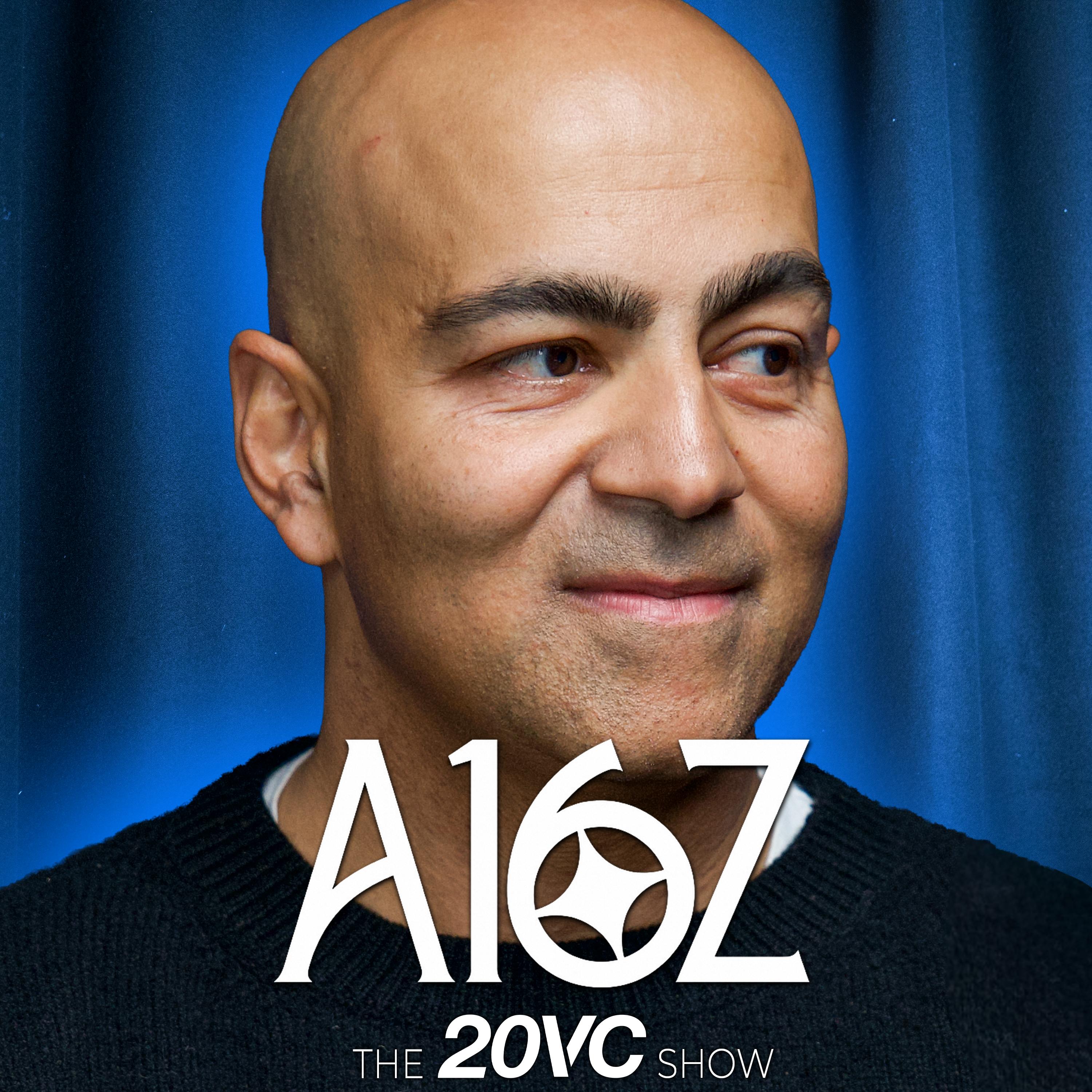
Overview of 20VC: Is SaaS Dead in a World of AI | With Anish Acharya (a16z)
Anish Acharya (General Partner, Andreessen Horowitz) joins Harry Stebbings to evaluate how generative AI is reshaping SaaS, developer tooling, go-to-market, defensibility and investing frameworks. The conversation cuts across whether traditional SaaS is overvalued, how margins and pricing should be thought about in AI-native businesses, where value accrues in the AI stack (models vs. apps), agent hype vs. reality, open vs. closed models, and practical advice for founders and VCs.
Guest & context
- Guest: Anish Acharya — GP at Andreessen Horowitz; leads consumer & fintech investing at Series A. Early investor / board experience with Runway, Deal, Mosaic, Clutch, Titan, and others. Founder/ex-founder of startups acquired by Credit Karma and Google.
- Host: Harry Stebbings — 20VC podcast.
- Format: Long-form interview covering market structure, product strategy, and investing philosophy in the AI era.
Main topics discussed
- Is SaaS “dead” or oversold in an AI world?
- Incumbents vs. startups: Can incumbents acquire innovation before startups win distribution?
- Where value will accrue: foundation models vs. applications (aggregation & vertical apps).
- Competition in developer tooling: Cursor vs. Claude Code (and the multi-model orchestration layer).
- Margins, pricing, and the new economics of AI-native products.
- Agents: realistic timelines and the need for humans in the loop.
- Defensibility: which moats persist, which are eroded (networks, live proprietary data).
- Open vs. closed models and tradeoffs (capability, cost, product characteristics).
- Investing practice: Series A focus, sizing markets, “area under the curve” companies, and VC-founder dynamics.
- Societal use cases: companionship, senior care, education, and digital twins.
Key takeaways
- Software is oversold in some narratives. Rebuilding core ERP/payroll/CRM with AI is often low ROI — enterprises spend only ~8–12% on SaaS today, so many gains will come from extending businesses or addressing non-software spend (human labor).
- Switching costs are falling. Coding agents and orchestration reduce migration friction (less “hostages, more customers”), increasing churn risk but also enabling more competitive markets.
- Apps matter. With multiple competing foundation models (closed and open), most real-world value will be captured by apps that aggregate models, own workflows/tools/data, and provide productized feature surfaces.
- Multi-model specialization leads to fragmentation: users will want orchestration layers (apps) to combine model capabilities (e.g., frontend vs. backend coding models, creative aesthetics).
- Margins and pricing dynamics are changing: many SaaS companies raised prices post-ChatGPT (mean ~8–12% with some >25%). Power users now pay much more (subscriptions of $200–$300+), and “inference is the new sales & marketing” — usage can convert high-value customers organically.
- Agents are powerful but overhyped in the maximalist sense. Practical deployments need humans for exception handling; agents will remove low-NPS tasks and expand what people can attempt.
- Defensibility persists: networks remain the gold standard. Live, proprietary data (continuous, unique signals) is an increasingly strong moat.
- Open vs. closed models: product decisions balance ambition and cost; closed providers still often win on speed-to-capability and features, while open models can produce unique product characteristics.
- Not a bubble (Anish’s view): demand is absorbing capacity, prices are rising, and supply increases are largely spoken for — unlike prior overbuild cycles.
Notable quotes
- “Software is completely oversold.”
- “Some companies have hostages, not customers.” (on legacy incumbent lock-in)
- “Price is a measure of product-market fit.”
- “Inference is the new sales and marketing.”
- “Networks are the gold standard.”
- “We have to see 100% of the deals in our domain and that we win 100% of the deals that we go after.” (on a16z’s internal mindset)
Metrics & benchmarks mentioned
- SaaS as ~8–12% of enterprise spend.
- Post-ChatGPT price increases: 75% of public SaaS companies; mean price raise 8–12%, many >25%.
- Power-user subscriptions: examples cited — Grok Heavy $300/month, ChatGPT $200/month, Gemini Ultra $250/month.
- Retention heuristics: M12 retention ~50% considered solid; 60–70% excellent.
- For Series A diligence focus: differentiate M1 (organic/free top-of-funnel) vs. M2 (first paid month), and analyze durable margins on paying users rather than blended trial-sponsored margins.
Practical advice — founders & product teams
- Build and use the products: investors must be product-native; founders must iterate with new models daily to build intuition.
- Focus on retention and power-user economics: separate acquisition/trial costs from durable margin profile; aim for strong M12 retention.
- Own tools, workflow and data for agent-first products: to win with agents you need access to live data and control of the operational stack.
- Be clear about PMF. Don’t rationalize weak early traction; be intellectually honest about whether product-market fit exists.
- Leverage investors that “do stuff”: pick VCs who add more than capital (introductions, co-selling, brand-lending); talk to their founders to validate.
- Pricing & model hygiene: free trials/subsidized entry are fine if they convert into high-LTV, paying power users — but have a plan for business model early.
Practical advice — investors & VCs
- Series A is the sweet spot for information / ownership: product shipped + early revenue provides better signal than seed.
- Decide the risk profile you want: competitive risk (can you win the deal?), pricing risk (did you overpay?), team risk, geographic risk, fundraising risk.
- Be product-native: operators and VCs must try new models and instruments regularly to maintain conviction.
- Avoid investing in direct competitors when your firm materially supports portfolio companies (resource conflicts).
Predictions & outlook
- Incumbents will improve core products and will often be capable winners in their verticals, but native AI categories (that didn’t exist pre-AI) are likely to be owned by startups.
- Apps and aggregation layers will capture substantial value because models will remain multi-provider and specialist in parts.
- The market will see many specialized winners (especially in large industries like legal, finance, healthcare) rather than single-category monopolies; TAMs will often be larger than initial estimates.
- The “agentization” of work will increase productivity and ambition — more tasks will be attempted; jobs will evolve rather than be fully eliminated in the near term.
- Anish expects we are not in a destructive bubble; demand is strong, prices are rising, and large tech is subsidizing model availability in a way that accelerates product experimentation.
Action items / recommendations (for listeners)
- If you’re a founder: ship a real, model-powered product and instrument retention; separate trial CAC from durable margin metrics; own your data and workflow if building agentic features.
- If you’re an investor: become product-native — use models daily, build simple experiments to test hypotheses, and demand strong retention signals in diligence.
- If you’re a product manager/engineer: consider multi-model orchestration (orchestration layer) rather than building on one foundation model; think about where specialization matters for UX and output quality.
- For enterprise GTM: think of agents as a way to re-bundle functions (support, sales, collections) into more efficient outcomes — focus on outcome-based pricing where appropriate.
Quick summary
Anish argues that while AI materially changes software economics and creates massive new opportunities, it doesn’t make SaaS obsolete — it reshapes product, pricing and competition. The biggest winners will be apps that aggregate models, own workflows and live data, and build defensible networks. Agents are transformative but not autonomous panaceas; humans remain in the loop for ambiguity. For investors and founders, product-native rigor, retention focus, and data ownership matter more than ever.