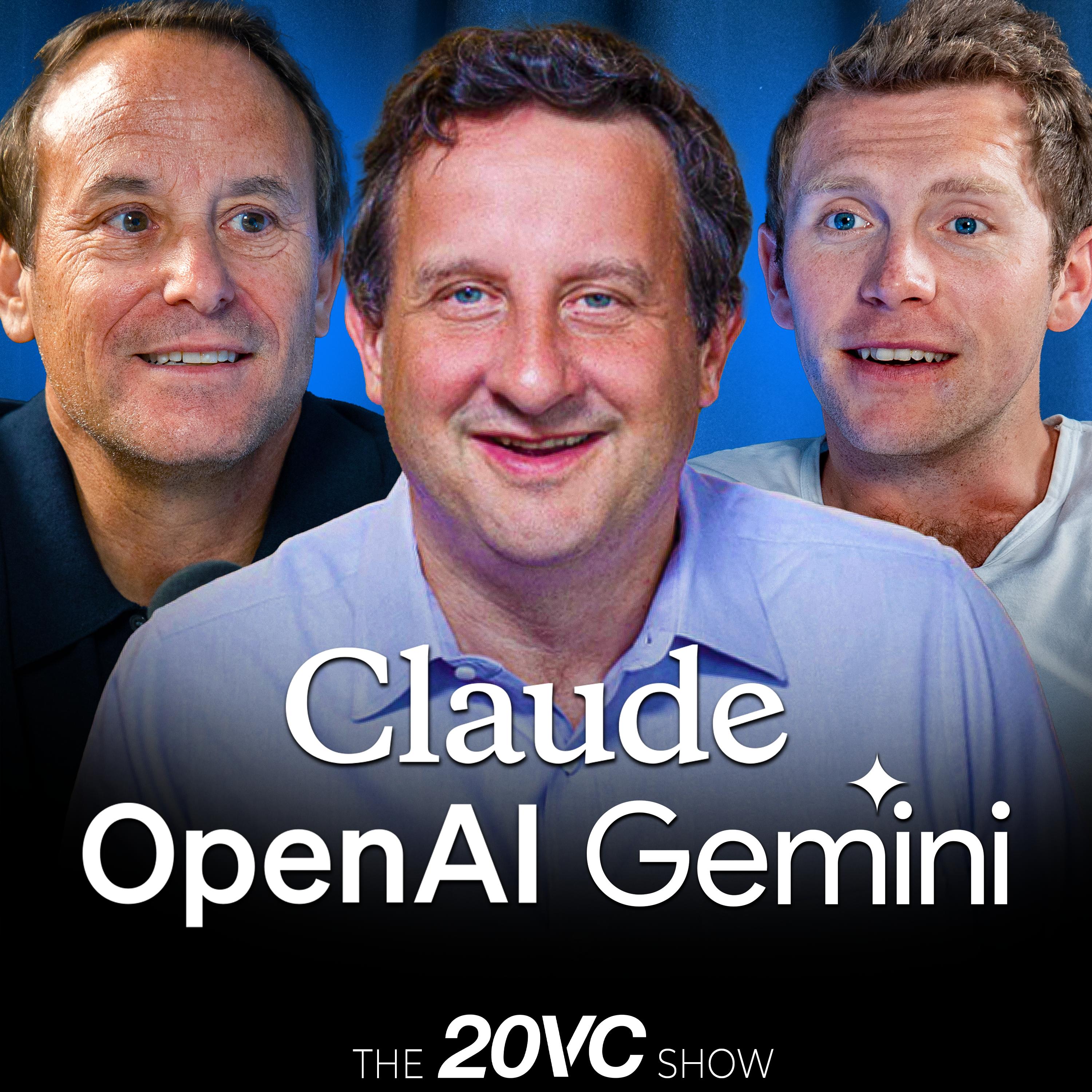
Overview of 20VC (Harry Stebbings) — episode with Jason Lemkin & Rory O’Driscoll
This episode analyzes the latest mega-rounds and fundraising trends in AI and venture: Anthropic’s reported $10B raise (~$350B private valuation), X.AI and a16z’s $15B raise, implications for OpenAI’s competitive position, the impact on standalone products (Cursor, GitHub Copilot, Replit), substitution risks for API businesses (11Labs, voice), and the broader structural shifts in VC (big platform funds vs focused boutiques). The conversation blends valuation math, market structure, investor strategy, and policy risk (California’s “entrepreneur tax”).
Key topics covered
- Anthropic’s $10B round and valuation dynamics (growth→valuation math; unit economics).
- Anthropic’s product strategy: API dominance, Claude Code (coding product), and Claude “workspaces” for non-coders.
- Competitive implications for coding tools (Cursor, GitHub Copilot, Replit) and platform control risks (cutting or degrading partner access).
- OpenAI risks: competition (Anthropic, Gemini), capital needs, short model half-lives and a tail risk scenario of collapse.
- Andreessen Horowitz’s $15B raise: can large platform funds scale profitably? market share math and strategic advantages.
- The “middle” of VC: boutique firms vs mega-platforms; whether the middle will hollow out.
- Late-stage valuation risk vs early-stage uncorrelated business risk: correlated downside of big late-stage bets.
- Substitution risk in AI APIs/products (e.g., ElevenLabs, Replit): ease of switching, pricing pressure and fragility despite product excellence.
- Public policy risk: California “entrepreneur’s tax” (wealth tax implications), founder migration and economic consequences.
- Broader macro/social implications of AI-driven wealth concentration and labor impact.
Deep dives & notable analysis
Anthropic
- Reported growth trajectory cited in the episode: ~$100M ARR (end of ’23) → ~$1B (end of ’24) → ~$9–10B (end of ’25). If growth continues, valuation multiples can look reasonable; one-year sustained hypergrowth can justify very high private caps.
- Product expansion: Claude API (enterprise), Claude Code (coding product capturing more revenue per developer), and Claude Workspaces (knowledge-worker product) — positioning Anthropic as more than an API provider.
OpenAI: risk profile
- Two explicit scenarios:
- Bull: continue leading, monetize consumer/subscriptions and enterprise, remain dominant.
- Bear: short model half-life, capital markets disruption, inability to raise required capital → rapid deterioration (analogy: frozen product, Detroit/AOL).
- Overall view: non-zero existential risk exists (low probability but real). Management must prioritize capital runway (rule of thumb: keep >2 years OPEX cash).
Andreessen Horowitz ($15B)
- Raised a very large platform fund; represents a significant slice of new venture capital.
- Two-part question addressed: (1) Is there enough exit value in the market to support such funds? (2) Can a single firm both maintain top-tier founder brand and deploy that much capital well?
- Conclusion: industry-level math suggests it can work (if top exits continue), but execution risks include partner quality at scale, top-deal dependency, and concentration risk (top outcomes drive returns).
Boutique vs Platform debate
- Mega-funds offer advantages: brand, ability to fund later rounds, “price elasticity” in early-stage deals, and capability to cover misses with large winners.
- Boutique/focused funds can survive if they have a distinctive insight or domain expertise; Andreessen’s internal segmentation (multiple ~$1B+ sub-funds) mimics boutiques inside a platform.
- The “middle” (funds that are neither highly specialized nor able to scale) faces pressure, but focused mid-sized funds can still win.
Substitution & unit-economics risk (example: 11Labs)
- ElevenLabs built a best-in-class voice API; adoption is fast and easy — but that also makes substitution possible if competitors undercut price or match quality.
- Large spend concentration (few big customers) increases fragility; highly distributed spending is more defensible.
- Key point: early-stage products face “uncorrelated business risk”; late-stage companies face “100% correlated valuation risk.”
California entrepreneur/wealth tax
- Discussed as a growing policy risk: potential triggers for founder/employee migration, erosion of Silicon Valley talent and capital.
- Concern that initial measures could be step one toward recurring annual taxes and lower thresholds (e.g., $25–50M), creating long-term relocation incentives.
- Practical outcome: if enacted or perceived likely, founders/investors may accelerate relocation decisions (leave after fundraising milestones, etc.).
Main takeaways (actionable signals)
- For founders:
- Build defensible unit economics and multi-channel distribution (don’t be overly dependent on a single upstream model/API).
- Maintain a long runway (target multiple years of OPEX cash in capital-intensive AI businesses).
- Expect rapid competitive changes; prioritize execution and product differentiation (hard-to-copy UX, distribution, and stickiness).
- Factor policy/tax risk into domicile planning if you have material paper wealth tied to private rounds.
- For investors:
- Early stage = idiosyncratic (uncorrelated) bets; late stage = market/valuation bets (highly correlated downside).
- Mega funds can win by owning market share of top deals, but top-heavy return profiles mean missing a few top exits is catastrophic; scale demands strong internal processes and top-quality partners.
- Diversify defensively: be aware of substitution risk for API providers and pricing compression risk as adoption scales.
- Consider hybrid strategies: capture early-stage flow, but be mindful of whether you can credibly support winners later (or partner with firms that can).
- For operators/teams building on third‑party models:
- Hedge dependency risk (multi-model, multi-vendor capability) and plan for potential access restrictions or throttling from upstream providers.
Notable quotes & soundbites
- “In the early stage, you're taking uncorrelated business risk. And in the late stage, you're taking 100% correlated valuation risk.”
- “If the growth is there for one more year, it looks cheap.”
- “OpenAI has existential risk. It is a bet that the best of times lasts at least a decade.”
- “You can be promiscuous at the A if you have enough late stage stuff to cover it up.”
- “Can you still find a $10 billion gem outside of the boundaries of this system or not?” (central meta-question about market efficiency)
Quick numbers & context called out
- Anthropic: reported raise ~$10B; cited revenue progression from ~$100M (end-’23) → ~$1B (end-’24) → ~$9–10B (end-’25).
- a16z: $15B raise; cited as >20% of VC funds raised in 2025 (conversation framing).
- X.AI: reported $20B raise (headline context).
- ElevenLabs: ~ $11B private valuation; cited revenue run-rate ~$330M (rapid adoption).
- Industry exit context: a cited “~$300B exits” year (variable over time) and a 3.6T total private value figure used to reason about macro capacity for large funds.
Risks highlighted
- Late-stage valuation compression if growth rates slow — correlated downside across large funds.
- Platform control risk: model providers can throttle or cut access to partners (the “scorpion stings the frog” analogy).
- Substitution risk: excellent products can be swapped if cheaper/equally good alternatives appear.
- Capital shock scenarios: capital availability drying up could imperil capital-intensive AI firms (OpenAI cited as exposed if market access collapses).
- Policy/tax risk: wealth/entrepreneur tax in California could cause founder/employer migration and long-term ecosystem impact.
Recommendations / checklist (for quick reference)
- Founders:
- Secure >12–24 months cash runway; consider 24 months for heavy AI compute businesses.
- Build multi-provider integrations to mitigate upstream access risk.
- Monitor concentration of revenue: diversify large customers where possible.
- Evaluate domicile/tax plans if paper wealth may trigger new taxes.
- Investors:
- Assess whether you are betting on idiosyncratic execution (early stage) or market/valuation (late stage) and price portfolio exposures accordingly.
- For larger funds: design sub-fund “sandboxes” (domain-focused teams) and guardrails to maintain selection quality.
- Stress-test late-stage holdings for valuation/exit sensitivity (what if multiples compress 50%?).
- Operators building integrations:
- Build vendor-agnostic architecture; measure cost impact under multiple pricing scenarios.
People, companies & products mentioned
- Hosts/guests: Harry Stebbings, Jason Lemkin, Rory O’Driscoll.
- Companies: Anthropic (Claude), OpenAI (ChatGPT), Google Gemini, X.AI, Andreessen Horowitz (a16z), Cursor, GitHub Copilot, Replit, Harvey, Lovable, Databricks, ElevenLabs, Replit, WorkOS, Clerk, Stripe, Nuance.
- Policy: California “entrepreneur tax” (wealth/one-time vs annual wealth tax debate).
Summary conclusion This episode is a high-level, pragmatic walkthrough of where AI-powered venture and product markets stand right now: rapid scaling and enormous raises (Anthropic, a16z, X.AI) are reshaping power dynamics, but they also concentrate correlated valuation risk and introduce substitution and platform-control vulnerabilities. Founders must prioritize unit economics, runway, and multi-vendor resilience; investors must decide whether to play scale (platform) or focus (boutique) and account for top-exit dependency and late-stage multiplicative risks. The political/tax environment adds a new, non-technical variable that could materially affect geography and capital flows.