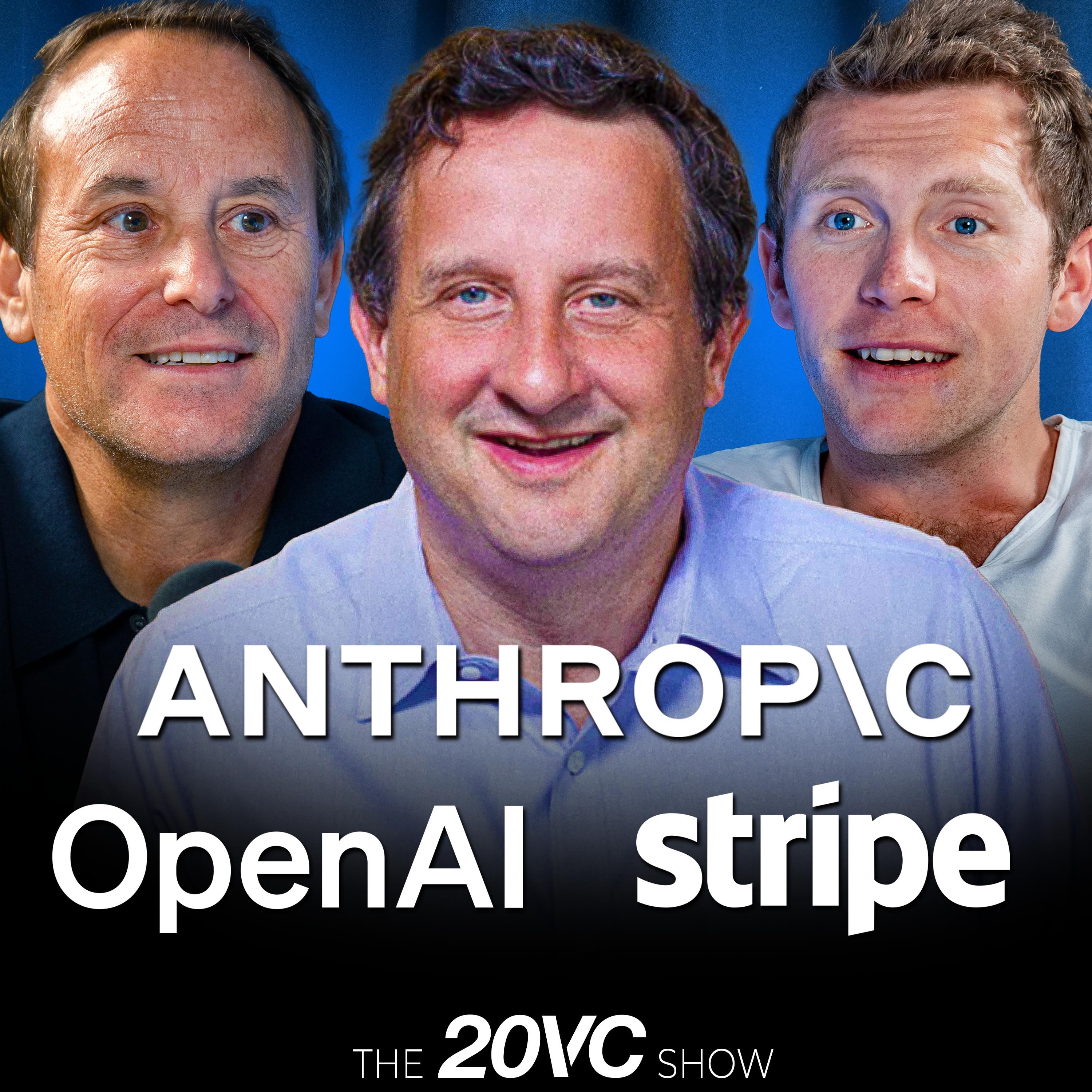
Overview of 20VC: Anthropic Raises $30BN at $380BN Post | Harry Stebbings with Rory O’Driscoll & Jason Lemkin
This episode reviews the biggest tech and AI headlines of the week and unpacks what they mean for founders, investors and public markets. Major items: Anthropic’s massive $30B raise at a $380B post-money valuation, Thrive’s $10B vehicle, OpenAI acquiring an open-source agent (OpenClaw) and hiring its creator, the Stripe vs Adyen valuation gap, the rapid rise of autonomous agents, and whether public SaaS names like Figma, Shopify and Monday are buys or sells in an AI-first market.
Key topics covered
- Anthropic’s $30B round and what momentum vs. fundamentals means in today’s AI funding climate
- The surge of capital into a tiny set of AI winners and the contraction in appetite for traditional SaaS
- Thrive’s new $10B fund and the structural need for larger funds to back mega-private rounds
- OpenAI’s acquisition of an open-source agent (OpenClaw) and the fast-developing agent ecosystem
- Stripe ($~140B private valuation) vs Adyen (much smaller public market cap) — why the gap exists
- Product disruption: Figma, Replit/Lovely (AI-first product tooling), and the danger of missing adjacent AI use cases
- Public SaaS: Monday, Shopify, Workday and the broader “is SaaS dead?” debate
- Practical implications: guardrails, enterprise ROI expectations, sequencing of bets, and portfolio construction
Main takeaways and analysis
- Market momentum is concentrated: A handful of AI companies are capturing outsized capital and narrative attention. Anthropic’s round is emblematic — investors are willing to pay up for platform-level growth and momentum even with capital-intensive economics.
- Unprecedented growth drives valuation tolerance: Anthropic’s ARR growth trajectory (soundbite: three years of ~10x year-over-year run-rate increases) is historically unusual and explains investor willingness to underwrite huge valuations despite negative cash flow and high compute costs.
- Narrative dominates short-term pricing: Wall Street and private capital have reallocated from “old-school” SaaS to AI narratives. That shift causes severe multiple compression for many public SaaS names even if they have decent underlying revenue growth.
- Enterprise will “will” AI into existence: Boards and corporate leaders are making AI a top agenda item and will likely spend heavily in 1–2 years even before clear ROI is universally demonstrated — that supports near-term demand for AI infrastructure and application vendors.
- Agents are accelerating fast: OpenClaw (open-source autonomous agent) galvanized developers and showed how quickly autonomous use-cases can proliferate. This raises both huge product opportunity and serious safety/security concerns.
- Valuation divergence is rational, not just hype: Stripe vs Adyen highlights the tradeoff investors make between growth and profitability, and how communication (narrative) and private vs public status affect pricing.
- Product adjacencies matter: Public companies closest to tasks the models automate (coding, content generation, support, product prototyping) are most exposed. Figma is a prime example — its core is solid, but adjacent AI tools (Replit, “Lovable”) have grabbed product use-cases it might have owned.
- There will be a retrenchment risk: Over-investment and misallocated capex could trigger a retrenchment in 2–3 years if promised labor-productivity gains do not materialize.
Notable quotes & insights
- “You’ve never seen a company grow 10x in gap revenue and run rate year on year for three years.” — on Anthropic’s growth
- “Wall Street fell in love with AI and to do that had to fall out of love with SaaS.” — framing the narrative rotation
- “Corporate America has decided they’re going to make this bet.” — meaning enterprises will adopt/force AI programs even if ROI is imperfect
- “At some point people will overbet and overinvest and you will have a retrenchment period two plus years from now.” — cautionary note on pacing and long-term ROI
Company-by-company notes (concise)
- Anthropic
- $30B raise at $380B post-money (upscaled from an initial $10B).
- Exceptional momentum and growth profile; capital-intensive (compute/capex) and not yet profitable — fragility around compute spend.
- Investors placing small ownership stakes to capture upside; narrative is the current driver.
- OpenAI & OpenClaw
- OpenAI acquired/hired the creator of an open-source agent (referred to in the episode as OpenClaw).
- Agents spurred developer enthusiasm, but also immediate safety and guardrail controversies; Anthropic initially pushed back on the agent approach for safety reasons.
- Autonomous agents raise new inference, cost and security dynamics (local model hosting, lighter models vs large models, scheduling).
- Thrive Capital
- Closed a $10B vehicle (split: $1B early, $9B growth) — indicative of mega-fund growth to service multi-billion financing needs.
- As rounds scale ($100B+ private valuations), fund sizes naturally expand to remain meaningful investors.
- Stripe vs Adyen
- Stripe valued privately at ~$140B; Adyen is a much smaller public market cap.
- Differences explained by scale (Stripe revenue ~2.5x Adyen), growth expectations, public vs private status, margins and messaging/communication to market.
- Investors choose between growth (Stripe/private) and profitability/clarity (Adyen/public) depending on risk appetite.
- Figma
- Still growing fast and with solid ARR, but missed opportunities in next-gen prototyping/AI-first workflows (third-party tools like Replit / Lovable grabbed share).
- Example of a public SaaS firm that can be “maimed” if it doesn’t quickly capture adjacent AI-driven use-cases.
- Shopify, Monday, HubSpot, Salesforce, ServiceNow
- Public SaaS names compressed as capital rotates; some (Shopify) argued to be oversold but still exposed to narrative risk if conversational/agentic commerce bypasses current platforms.
- Durability question: companies with long contracts, high GRR (ServiceNow) are more insulated than SMB-focused platforms (fast churn).
- Workday
- Founder/previous CEO boomerang (Anil) suggests boards are seeking founders to drive rapid transformation in face of AI and product roadmap shifts.
What to watch / indicators to track
- Enterprise ROI signals: evidence that AI implementations reduce labor cost or materially increase productivity at scale.
- Compute and capex trajectory: whether companies are hitting sustainable cost curves as models scale.
- Customer spending patterns: are companies increasing seat counts or cutting headcount and buying AI instead?
- Agent security & guardrails: regulation, vendor tooling, and independent guardrail solutions (who’s accountable if an agent exfiltrates data).
- Product adoption sequencing: which verticals adopt faster (coding, support, legal, healthcare) vs slower (some established financial HR systems).
- Public SaaS metrics: ARR growth, net revenue retention (real, not price-driven), free cash flow profile — these will drive where valuation floors form.
Actionable recommendations (for founders & investors)
- For founders:
- Prioritize building AI-adjacent features if your use-case maps to model strengths (language, code, image generation).
- Treat agent security and guardrails as first-class product requirements if exposing enterprise data/actions.
- Sequence wins: target sectors where customers are “willing it into existence” (legal, healthcare, large enterprises with exec buy-in).
- Brand tip from the episode: consider .tech domain (sponsor mention) to signal a modern tech-first company.
- For investors:
- Decide whether you’re allocating to momentum (large, private AI winners) or value (public, profitable payments and infra).
- Consider lifecycle funding needs: if backing companies in capital-intensive spaces, be ready for larger follow-on reserves or larger fund sizes.
- Use a sequencing playbook: identify which verticals will adopt AI first and back founders who can execute through transition windows.
- Monitor near-term customer spend and ROI — early signs of a retrenchment will be visible in enterprise budgets.
Risks & open questions raised by the episode
- Sustainability of hypergrowth valuations when the business model is compute-heavy and loss-making.
- The timeline for meaningful labor savings from AI (ROI); risk of a multi-year retrenchment if ROI lags.
- Security, compliance and legal liability for agent-led automation (who’s accountable? vendor, deployer, or data owner?).
- Will public markets ever become a comfortable place for transitional companies that must both invest heavily in AI and show profitability?
Sponsor & production notes
- The host plugged .tech domains and sponsor products (Checkout.com and Invisible) as resources for founders building modern commerce and AI implementations.
Summary judgment: short term — momentum and narrative favor AI winners (Anthropic, OpenAI, other model/platform plays). Medium term — fundamentals (ROI, compute economics, product-market fit with AI) will determine which public and private companies survive and thrive. Investors and founders should sequence bets, build robust agent safety/guardrails, and watch enterprise ROI and spending behavior closely.
If you want a distilled checklist (investor/founder) or a one-page decision matrix for evaluating public SaaS names vs AI-platform winners from this episode, I can provide it.