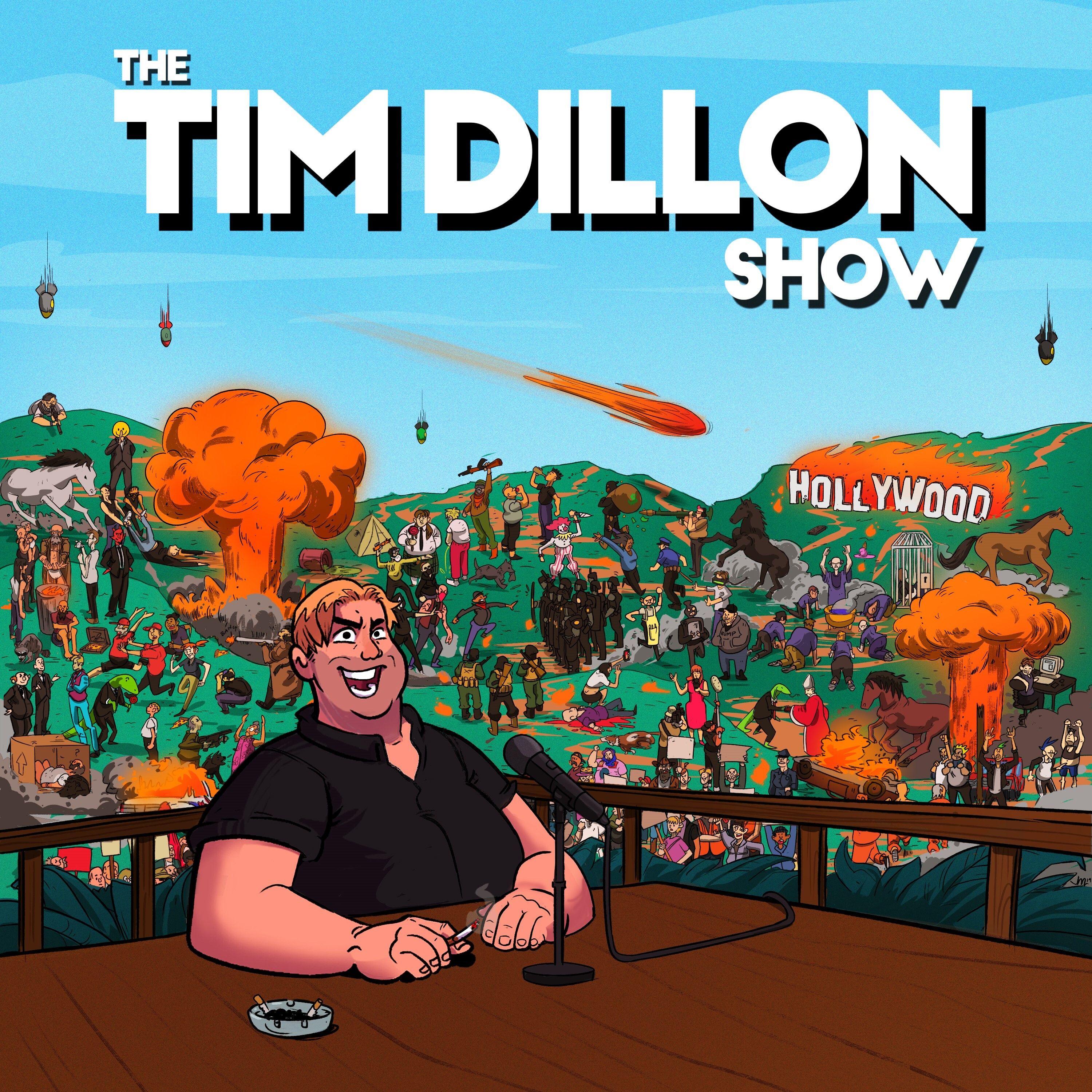
Overview of The Tim Dillon Show — Episode 500
Episode 500 is a satirical, sprawling monologue that jumps from fake ad reads to political commentary, with Tim Dillon using absurdist humor to skewer J.D. Vance, the MAGA movement, U.S.-Iran policy, AI, Big Tech, and the decline of American institutions. The episode frames current events as a series of “endings” and “new eras,” arguing that America is losing its ability to shape reality while powerful elites pivot to saving themselves.
Major Topics Discussed
J.D. Vance, faith, and political rebranding
- Dillon mocks Vance’s new book and media tour, joking that it reads like a divine endorsement of his presidential ambitions.
- He riffs on Vance as a “striver” who will say whatever is politically necessary to advance.
- The episode portrays Vance as trying to reposition himself after the Iran conflict and before future elections.
Iran, war, and the alleged “deal”
- A long section satirizes a fictional U.S.-Iran agreement, presented as though the U.S. had lost leverage and was now backing away from escalation.
- Dillon argues the conflict exposed the limits of American power and made Iran stronger, not weaker.
- He frames Iran as having entered its “bad baddie era” or “bad girl era,” while the U.S. is forced into a humiliating retreat.
- Israel, neoconservatives, and hawks are portrayed as wanting deeper conflict, while the broader public wants out.
MAGA as a cultural finale
- Dillon compares MAGA’s cultural peak to the “final party” of a movement, with the White House UFC event and related spectacle treated as a symbolic end point.
- He suggests the movement has become more about pageantry, branding, and entertainment than governance.
Big Tech, AI, and surveillance
- The second half shifts toward technology and the rise of AI.
- Dillon critiques the idea that AI won’t cause mass unemployment, mocking Vance’s claim that there’s “no evidence” for it.
- He says the real risk is mass inequality, mass surveillance, and the consolidation of power by tech firms.
- He also points to data centers as the new infrastructure obsession: workers are being trained to build the systems that may eventually replace them.
The decline of everyday life and entry-level jobs
- Dillon laments the disappearance of human-centered commerce and service work:
- fast food kiosks replacing workers,
- Amazon replacing local shopping,
- kids no longer getting starter jobs at McDonald’s or movie theaters.
- He links this to broader social breakdown, teen violence, clout-chasing, and a culture shaped by algorithmic fame rather than responsibility.
Social media, youth, and political control
- He argues that restrictions on phones and social apps for minors are less about mental health and more about limiting exposure to anti-state or anti-establishment ideas.
- The point, in his view, is to give institutions more time to shape young people before they encounter dissent.
Key Takeaways
- America no longer acts like an unquestioned superpower; Dillon argues its ability to “create reality” has eroded.
- The Iran conflict is framed as a defeat in all but name, forcing a retreat masked as diplomacy.
- MAGA is treated as a spectacle movement, with its peak already behind it.
- Big Tech and AI are presented as the next power center, but one that may produce surveillance and inequality rather than broad prosperity.
- Modern life feels more automated, less human, and more extractive, from kiosks to data centers to social platforms.
Style and Tone
- The episode is highly satirical, exaggerated, and intentionally provocative.
- Dillon mixes political criticism with analogies from The Sopranos, fake scripture, and absurd “quotes” to dramatize his points.
- The overall tone is apocalyptic but comedic: America is depicted as tired, hypocritical, and trapped between declining empire and emerging tech domination.
Notable Running Ideas
- “Iran is in its bad girl era” — Dillon’s phrase for Iran’s perceived strategic advantage.
- Carmela Soprano as America — used to represent a country benefiting from power while pretending innocence.
- Data centers as the new destiny — a symbol of labor being reorganized around AI rather than human flourishing.
- The “final party” metaphor — used for both Hollywood’s cultural decline and MAGA’s peak spectacle.