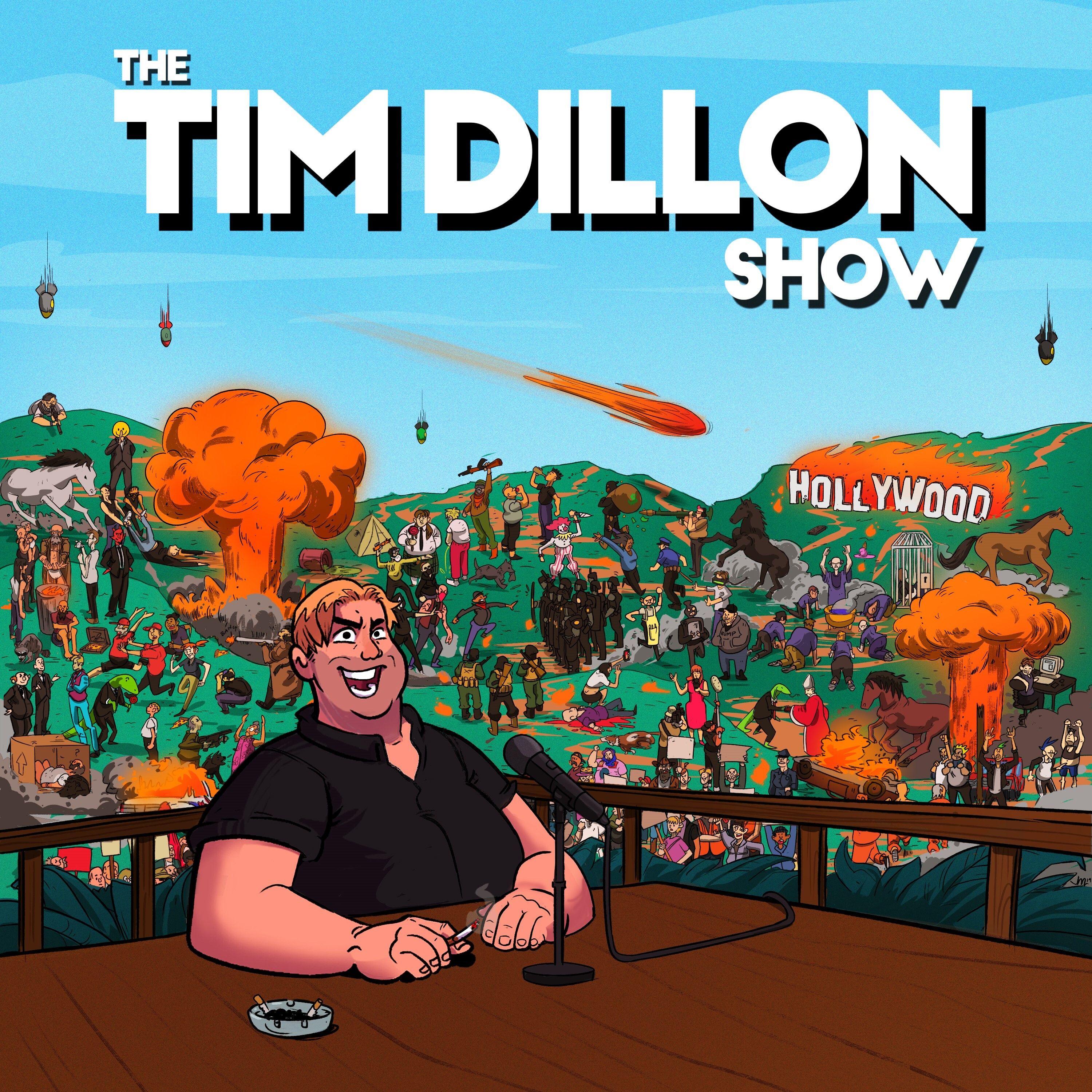
Overview of The Tim Dillon Show — “499 - Iran Forever, Belfast Riots, & College Commencement”
This episode is a fast-moving, highly satirical monologue that moves from geopolitics to immigration unrest, sports violence, college speeches, media power, and internet absurdity. Tim Dillon argues that modern wars are increasingly unwinnable and economically driven, mocks American delusion and performative rhetoric, and uses recent riots, viral personalities, and commencement speeches as examples of a culture he sees as chaotic, unserious, and increasingly unstable.
Main Topics Discussed
Iran, war, and the limits of military power
- Dillon opens with a long riff on the Iran conflict, arguing that:
- wars are no longer “winnable” in any meaningful sense,
- the Strait of Hormuz matters more economically than isolated military strikes,
- and the U.S. tends to threaten force without a coherent endgame.
- He suggests America’s best move is often to declare victory and leave, even if the reality is closer to failure or humiliation.
- He frames the modern global order as one where economic leverage matters more than brute military force.
American delusion and the “star of my own movie” mentality
- Dillon contrasts American self-importance with people he encountered in England, saying Americans are uniquely inflated, theatrical, and irrational.
- He mocks the way many people talk about their lives as if they are always “building an empire” or “assembling the right team.”
- His broader point: American culture rewards grandiosity even when reality is collapsing.
Belfast riots, immigration, and social instability
- A major segment focuses on violent unrest in Belfast, tied to immigration tensions and a graphic street attack.
- Dillon uses the footage to argue that:
- immigration can become destabilizing when public consent and screening are absent,
- people need to feel they have some democratic control over their countries,
- and the UK/EU model of centralized decision-making is fueling resentment.
- He emphasizes that violence against innocent people is wrong, but insists the broader migration issue is being ignored or morally bludgeoned rather than solved.
- His takeaway: migration should add value to a country, not create fear and disorder.
Sports fandom, tribalism, and violence
- He digresses into the psychology of sports devotion, saying he envies the intensity of people who are so invested in teams that they can become violent.
- He describes the irrational thrill of sports crowds and the way people treat wins and losses as life-or-death events.
- This becomes another example of his larger theme: humans are tribal, emotional, and often absurd.
Commencement speeches and elite cultural self-importance
- Dillon rips on Noah Baumbach’s Vassar commencement speech, calling it self-pitying and overly polished.
- He contrasts that with a real community-college speech he finds unexpectedly bleak and compelling.
- He imagines what his commencement speech would sound like:
- brutally honest,
- about AI, money, economic despair, and social breakdown,
- and aimed at students entering a harsh, unaffordable world.
- He repeatedly mocks elite institutions for celebrating mediocrity and grievance while pretending it’s profound.
Barry Weiss, CBS, CNN, and media power
- Dillon jokes that Barry Weiss is being isolated in a secure office while taking over major media institutions.
- He frames her as a symbol of corporate media consolidation and elite control.
- The bit escalates into absurdity, imagining her running networks from a bunker/silo-like command center.
Elon Musk, trillionaires, and wealth concentration
- He comments on Elon Musk’s reported trillionaire status, using it to question:
- the scale of wealth accumulation,
- the influence of tech billionaires,
- and whether democracy can remain healthy under such concentration of power.
- The bit is less policy analysis than a satirical jab at the normalization of extreme wealth.
Bonnie Blue, porn culture, and moral decline
- Dillon reacts to the controversial internet/porn figure Bonnie Blue, especially her pregnancy and attention-seeking behavior.
- He uses her as a symbol of what he sees as:
- porn culture gone too far,
- moral confusion,
- and the erosion of basic boundaries around sex, pregnancy, and public behavior.
- This leads into broader criticism of how far sexual politics and online culture have drifted.
Body positivity, cult behavior, and social decay
- He closes with a story about a “body positivity” community for plus-size women that turns dark through allegations against its founder.
- He treats it as another example of how modern communities, whether ideological, sexual, or political, often mask instability, fetishism, or manipulation.
- The episode ends on his recurring joke that society is on a countdown toward collapse.
Key Takeaways
- War is increasingly framed as economic disruption, not strategic victory.
- Public resentment over migration grows when governments appear unresponsive.
- Tim’s central worldview here is that institutions are failing, elites are detached, and everyone is pretending the situation is normal.
- He sees modern culture as dominated by performative seriousness, grievance, and delusion.
- The episode blends politics and culture into one long argument that civilization is becoming harder to govern.
Sponsors and Ad Reads Mentioned
- Trajan Wealth
- Ultra Pouches
- Morgan & Morgan
- Hims
- HexClad
- Helix Sleep
Tone and Style
- Satirical, confrontational, and intentionally provocative
- Heavy on exaggeration, profanity, and cultural mockery
- Mixes geopolitical commentary with absurdist comedy and social criticism