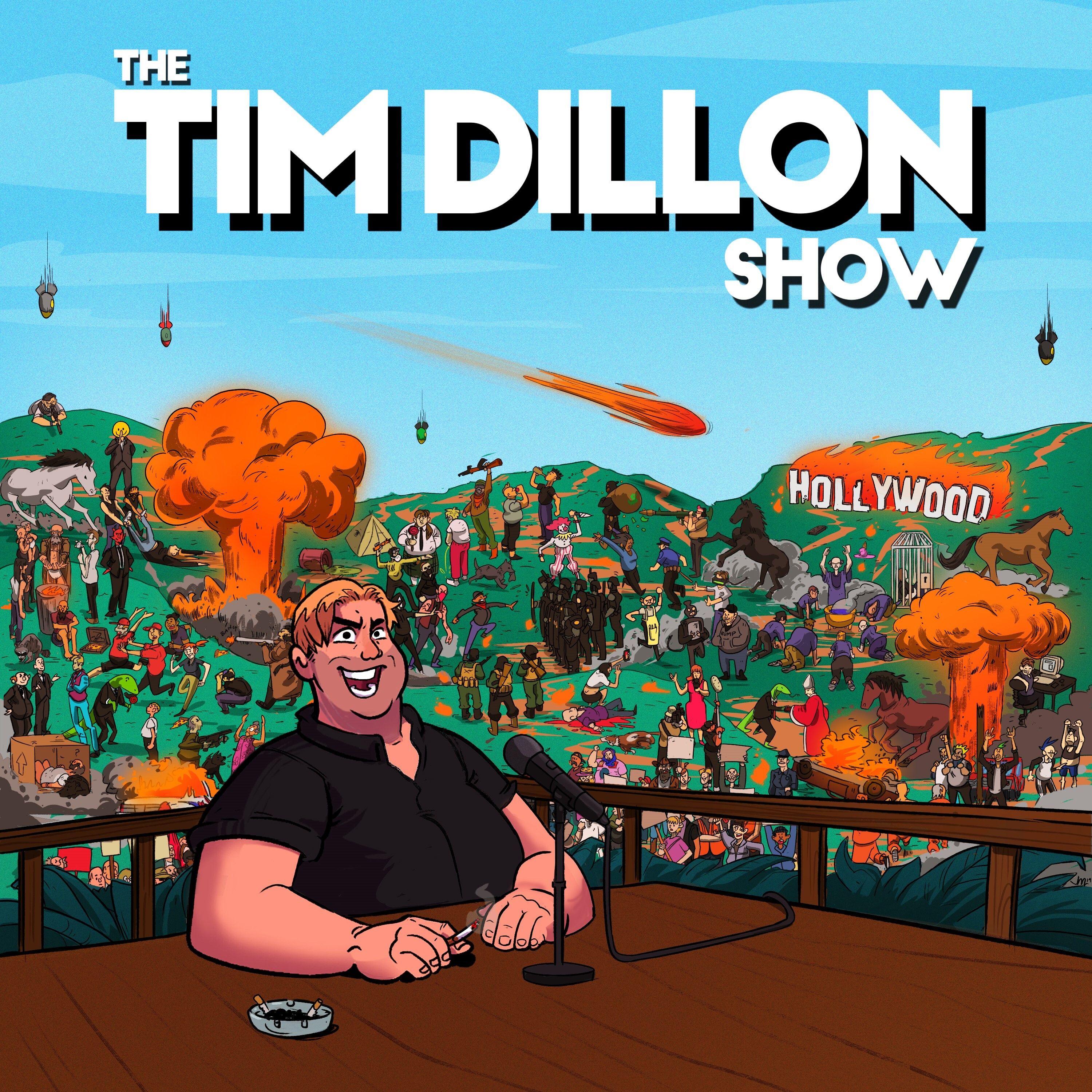
Overview of The Tim Dillon Show — “Alien Invasion & Trapped Trump”
Tim Dillon spends most of this episode satirizing the sudden wave of UFO and “interdimensional being” disclosures, arguing that the government is using alien talk to distract, unsettle, and maybe even panic the public while bigger issues like war, inflation, and trust in institutions continue to deteriorate. He frames Trump’s handling of the moment as pure reality-TV politics: good at spectacle, bad at serious conflict, and increasingly trapped by events in Iran and the need to keep the audience engaged. The episode also veers into Trump’s White House ballroom project, a bizarre security/legacy obsession, and Dillon’s criticism of Erica Kirk’s highly visible public grieving and political presence.
UFOs, Aliens, and Government Distrust
The core argument
- Dillon treats the current UFO/UAP “disclosure” wave as suspicious timing rather than sincere transparency.
- He repeatedly asks why this is being revealed now, when:
- the public doesn’t trust the government,
- the Epstein material is unlikely to go anywhere,
- prices and geopolitical tensions are still rising.
- His main point: no one is actually clamoring for UFO answers, and the public response has been far more muted than officials seem to expect.
What he mocks
- Claims about:
- underwater alien bases,
- interdimensional beings,
- demons/time travelers,
- recovered alien bodies.
- The idea that this information would “blow people’s minds” or cause mass hysteria.
- The notion that the public will somehow be “unified” by alien disclosure.
Dillon’s skeptical takeaway
- He suggests the government may be trying to create confusion, fear, or even psychosis.
- He argues that if a fake alien event were ever staged, it would be obvious, embarrassing, and politically corrosive rather than unifying.
- His refrain throughout: “Nobody cares” — at least not in the way politicians and media figures seem to think they should.
Trump, Iran, and the “Reality TV” Presidency
Trump as entertainer, not statesman
- Dillon says Trump is at his best when politics feels like television:
- confrontation,
- spectacle,
- insults,
- viral moments.
- He contrasts that with the Iran situation, which he sees as:
- expensive,
- unclear,
- humiliating,
- and not entertaining enough to sustain public attention.
Main criticism
- Trump appears, in Dillon’s telling, stuck in a conflict he can’t easily “produce” into a satisfying narrative.
- Dillon argues this is why alien disclosures may be useful politically: they offer a new storyline to replace a war that isn’t playing well.
Broader point
- The episode frames Trump’s problem as one of attention management:
- when the story is exciting, he thrives;
- when it becomes messy and painful, the audience checks out.
The White House Ballroom and Security Theater
The incident
- Dillon references a man who rushed toward the White House Correspondents’ Dinner area, using it as a setup for Trump’s ballroom/security rhetoric.
- Trump’s response: a “safe ballroom” with bulletproof glass and high security.
Dillon’s read
- He treats the ballroom as a symbol of:
- legacy-building,
- image control,
- and a strange mix of vanity and security fetish.
- He jokes that if aliens really existed, a bulletproof ballroom would somehow still be treated as a serious answer to the chaos.
The joke underneath
- The episode repeatedly points out the absurdity of discussing:
- alien bases,
- world-ending conspiracies,
- and a luxury ballroom
- all at the same time, as if all of it were normal governance.
Erica Kirk and Public Grief
Dillon’s reaction
- He criticizes Erica Kirk for remaining constantly visible in the public eye.
- He says her grief presentation feels unusual and overly political, and that she should step back for a while.
His advice
- Take time away from the spotlight.
- Re-emerge later, when the public has had time to reset.
- He suggests that overexposure is making the backlash worse.
Tone
- He is careful to say he is not denying her loss or minimizing what happened.
- But he is plainly uncomfortable with how the public persona is being managed.
Key Takeaways
- Alien disclosure is treated as a distraction. Dillon believes the public is being fed UFO stories to move attention away from war, inflation, and institutional failure.
- Trust in government is near zero. His whole riff depends on the idea that people now assume almost everything is an op.
- Trump is strongest as spectacle, weakest in real conflict. He can generate headlines, but he struggles when the story becomes serious and costly.
- The show’s central joke is that everything is happening at once. Aliens, Iran, ballroom security, political theater, and public grief all collapse into one absurd media cycle.
- No one is actually being unified. If anything, Dillon thinks these stories deepen cynicism, confusion, and polarization.
Notable Lines and Running Themes
- “Nobody cares.”
- “The government is trying to drive you insane.”
- “What exactly are we supposed to do with this knowledge?”
- “Trump is a reality star, not a general.”
- “This is not a good show.”
Overall Tone
This episode is classic Tim Dillon: cynical, fast-moving, and openly absurdist. He treats contemporary politics as a collapsing entertainment product, with alien disclosures, military conflict, and personal tragedy all being packaged into one relentless feed. His main message is less about whether aliens exist and more about how little faith he has in the people telling us what to think about them.