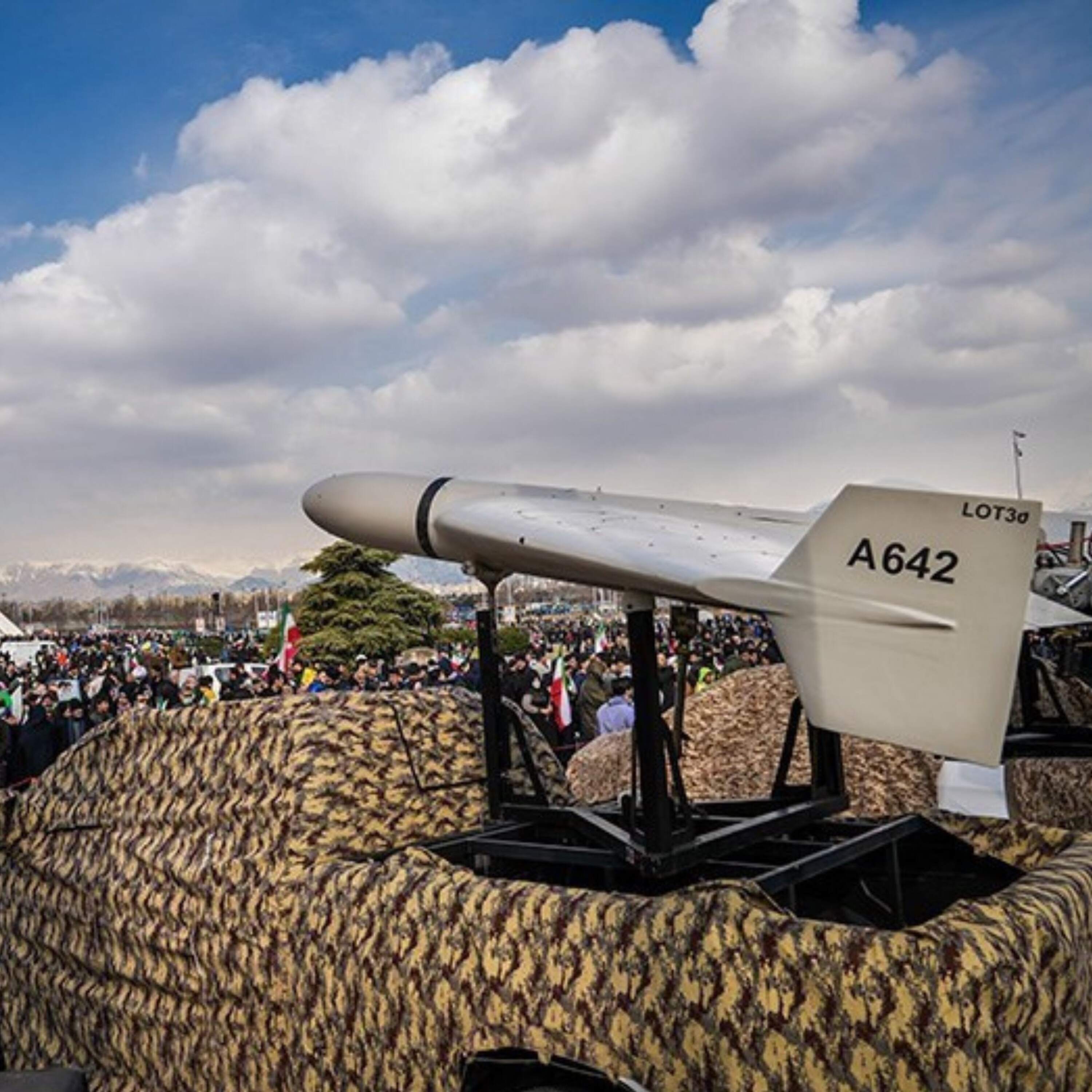
Overview of How Iran is wasting American resources
This episode of The Indicator (Planet Money, NPR) examines the economic asymmetry in the U.S.–Iran exchanges of the current war: Iran fields large numbers of inexpensive, locally produced strike drones (notably the Shahed‑136), while the U.S. responds with far costlier, “exquisite” missiles and defensive systems. The mismatch is depleting U.S. munitions and forcing a shift in procurement and tactics.
Key points and main takeaways
- Iran uses low‑cost strike drones at scale to impose high per‑engagement costs on the U.S., which relies on expensive missiles and interceptors.
- Cost asymmetry: Iranian drones are estimated to cost roughly $4,000–$50,000 each; many U.S. weapons (Tomahawk cruise missiles, Patriot interceptors) cost millions apiece.
- Quantity matters: Iran’s industrial approach (multiple factories and redundant sites) enables mass production and export (e.g., to Russia and Sudan).
- The U.S. has begun adapting: deploying cheaper countermeasures (guns/cannons, cheaper drones like the $35,000 “Lucas” copy) and pursuing a large drone buy (200,000 drones by 2027).
- Structural problem: U.S. procurement and industrial base are optimized for high‑end “exquisite” weapons that take years and high unit costs to produce—making rapid scale‑up difficult.
What Iran is doing (strategy and scale)
- Iran has launched thousands of munitions in the conflict; estimates cited in the episode say Iran fired more than 2,000 traditional missiles early in the war.
- Shahed‑136 (often reported as “Shahed” or spelled variably): a small, propeller‑driven loitering munition (~go‑kart size) that navigates by GPS and crashes into its target.
- Iran manufactures these in local factories with backup facilities, enabling resilience to strikes and enabling exports.
- The economics favor Iran: low unit cost × large volume creates disproportionate resource drain on better‑equipped opponents.
U.S. response and supply problems
- The U.S. has used Tomahawk cruise missiles and Patriot interceptors extensively; early in the conflict the U.S. reportedly expended about 10% of its Tomahawk inventory in the first three days.
- The Pentagon has reallocated missile‑defense assets (e.g., from South Korea and Indo‑Pacific deployments) to the Middle East to address shortages.
- Counter‑drone measures now include kinetic guns/cannons and drone‑vs‑drone approaches; these are cheaper per engagement than launching high‑end missiles.
- The Pentagon’s “Lucas” drone (~$35,000), modeled on Shahed‑type designs, and a “drone dominance” initiative (aiming for 200,000 drones by 2027) are signposts of adaptation.
Expert view and recommendations (Jerry McGinn, CSIS)
- Problem diagnosis: U.S. bias toward high‑end, low‑volume weapons leaves it exposed to low‑cost swarm tactics.
- Recommendations:
- Prioritize quantity and producibility for lower‑cost munitions (mass munitions strategy).
- Encourage multiple companies to produce low‑cost weapons to increase resilience and competition.
- Enable multi‑year funding/contracting for lower‑value munitions so companies can invest in scalable production (current multiyear authority is mostly for higher‑value systems).
- Treat capacity expansion like insurance—pay more in peacetime to be able to scale rapidly in crisis.
Notable figures and claims
- Iran reportedly fired >2,000 missiles (early period referenced).
- Shahed‑136 unit cost range cited: $4,000–$50,000 (wide estimate range across sources).
- U.S. Tomahawk/Patriot missiles: unit costs in the millions.
- Estimated U.S. Tomahawk inventory depletion: ~10% in the first three days of fighting.
- Lucas drone price: ~$35,000.
- Pentagon drone buy target: 200,000 drones by 2027.
- Casualty note: the episode references an NPR interview (off‑the‑record U.S. official) saying a Tomahawk strike on an Iranian girls’ school killed at least 165 civilians; this is reported attribution, not independently verified in the episode.
Practical implications / action items for policymakers & military planners
- Rebalance procurement priorities to include mass‑produced, lower‑cost munitions and counter‑drone systems.
- Create multi‑year funding pathways for high‑volume, low‑cost munitions to spur industry investment and scale.
- Invest in affordable, layered defenses (non‑kinetic and kinetic short‑range systems, cheaper interceptors, and drone‑vs‑drone capabilities).
- Expand and harden distributed production capacity (redundant factories/sites) to avoid single‑point vulnerabilities.
- Monitor and adapt doctrine to account for swarm and attrition warfare economics rather than only precision, high‑value strikes.
Production credits (from the episode)
- Produced by Cooper Kassmer‑Kim; engineering by Robert Rodriguez; fact‑checked by Sierra Juarez; edited by Kate McCannan. The Indicator is an NPR production.
If you want a one‑sentence summary: Iran’s low‑cost, mass‑produced drones are forcing the U.S. to spend millions per intercept and prompting a strategic shift toward cheaper, higher‑volume munitions and counter‑drone systems.