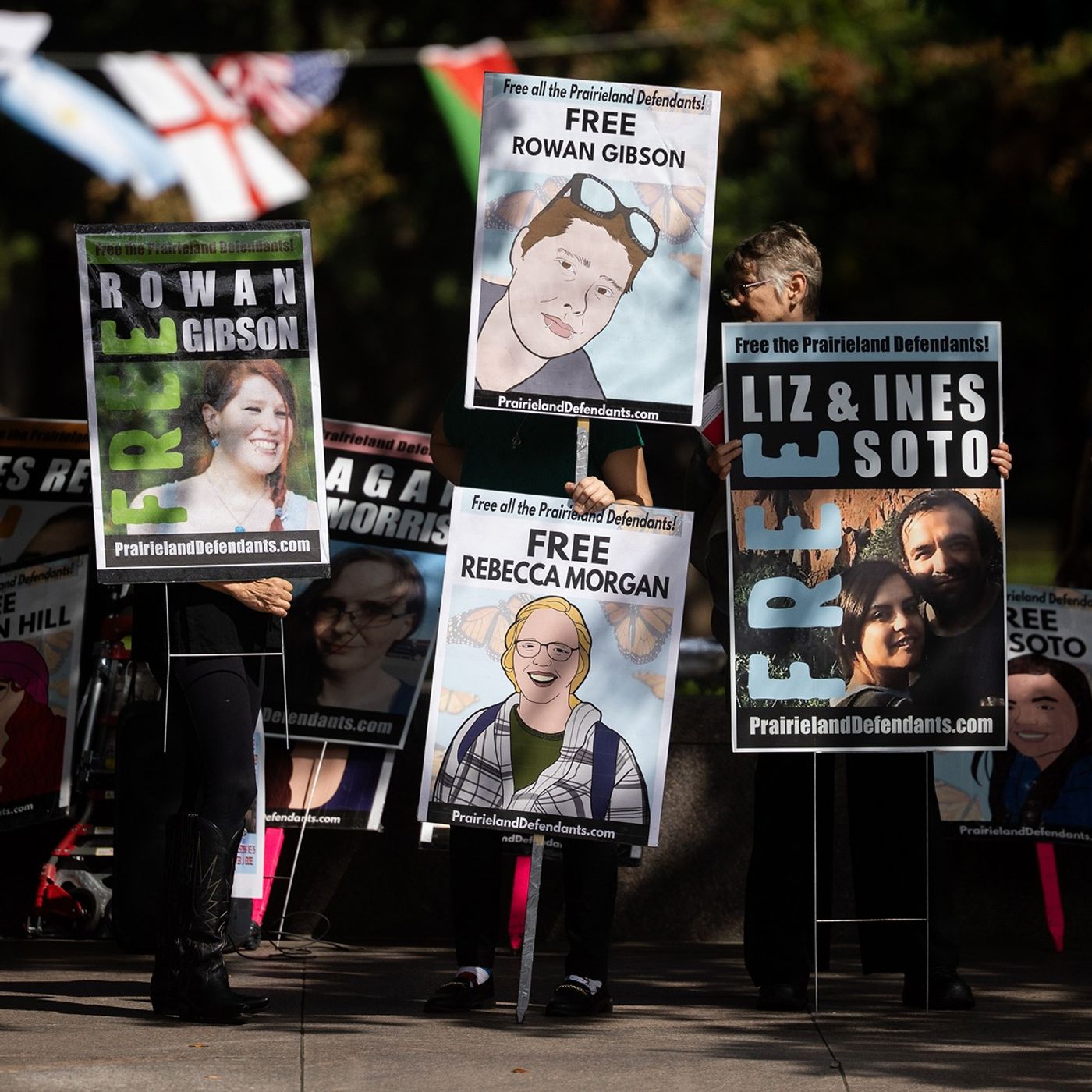
Overview of The Daily: They Protested ICE. Now They’ve Been Convicted of Terrorism.
This episode examines the Prairieland Detention Center case in Texas, where a group of left-wing activists gathered for an anti-ICE protest that escalated into vandalism and a shooting of a local police lieutenant. What began as a noisy demonstration outside a federal immigration facility ultimately became, in the government’s telling, the first major U.S. prosecution of an alleged “Antifa cell” under terrorism-related charges. Reporter Janet Reitman argues the case raises major questions about how the Trump administration redefined domestic protest as terrorism.
What Happened at Prairieland
- On July 4, 2025, protesters gathered outside the Prairieland ICE detention center near Dallas-Fort Worth.
- The group wore black, used masks, walkie-talkies, and aliases, and set off fireworks in a planned protest meant to signal solidarity with detainees.
- One participant also vandalized property with anti-ICE graffiti.
- When police and security responded, a local police lieutenant, Thomas Gross, was shot in the shoulder during a brief exchange of gunfire.
- Ben Song, a central figure in the group, was identified by prosecutors as the shooter and later went on the run before being arrested.
How the Group Formed
Janet Reitman describes the activists as part of a loose, decentralized left-wing scene in Dallas-Fort Worth rather than a formal organization.
Key background factors:
- Texas’s aggressive conservative policies on immigration, abortion, and trans rights heightened fear among local activists.
- The 2021 winter storm, which caused widespread deaths and power failures, intensified the sense that the state could not protect its residents.
- Some activists began focusing on self-defense and mutual aid, including through the Socialist Rifle Association.
- Ben Song, a Marine veteran and activist with experience in Hong Kong protests, became an informal leader and firearms instructor for the group.
Why the Case Became a Terrorism Prosecution
The episode emphasizes that this was not just a standard protest case. It became a political and legal flashpoint because of the way the Trump administration reclassified left-wing activism.
Key turning points:
- After the assassination of Charlie Kirk, Trump and top officials framed political violence as a left-wing problem.
- Trump issued an executive order symbolically designating Antifa as a terrorist organization, despite no formal legal mechanism for doing so.
- A follow-up directive pushed law enforcement to pursue domestic terror cases against people linked to anti-American, anti-capitalist, anti-Christian, and anti-fascist views.
The Legal Strategy
Federal prosecutors in Texas used an unusually broad theory to charge the defendants with material support for terrorism.
How they built the case:
- Prosecutors argued the group had committed acts that could qualify as terrorism:
- vandalism of government property
- fireworks treated as explosives
- attempted murder of a law enforcement officer
- The government also leaned heavily on ideology, online chats, books, zines, and activist affiliations to argue intent.
- Prosecutors presented the group as an “Antifa cell,” even though Antifa is not a formal organization in the traditional sense.
Why the Trial Was So Controversial
Reitman argues the case stretched terrorism law in a way that could have broad consequences.
Major concerns:
- Material support statutes are usually used against foreign terrorist groups, not protesters.
- Using them against domestic activists risks criminalizing speech and association.
- The government relied on a broad, elastic definition of Antifa, including black clothing, masks, aliases, and encrypted messaging as evidence of extremism.
- The prosecution’s logic was highly circular: if the group looked like Antifa, that was treated as proof of terrorism.
Verdicts and Sentences
The jury convicted all of the defendants on terrorism-related charges.
Outcomes:
- Ben Song: convicted of attempted murder and sentenced to 100 years.
- One organizer/protester who helped plan the action and shouted “Esperanza”: sentenced to 70 years.
- Several others received sentences around 50 years.
- A husband who was not present but had leftist materials in his car received 30 years.
Reitman notes that these sentences are far harsher than what most people convicted of material support for terrorism receive, and that the punishment seems to reflect the defendants’ ideology as much as their conduct.
Main Takeaways
- The Prairieland case may be a precedent-setting example of the government treating protest activity as terrorism.
- The shooting of a police officer gave prosecutors a “bad fact” that allowed them to build a much broader and more punitive case.
- The episode warns that once the government establishes a framework for labeling disfavored political activism as terrorism, that same logic could later be used against the right or any other movement.
- Reitman’s core concern is that “terrorism” becomes subjective — defined by the beholder rather than by a stable legal standard.
Notable Insight
“Terrorism is in the eye of the beholder” — the episode’s central warning about how political power can reshape legal definitions of violence.
Related Context
- Janet Reitman also promotes her book, The Inheritance: An American Tragedy in Five Acts, which deals with the long-term consequences of the U.S. war on terror.
- The episode closes by connecting this case to broader concerns about how fear, ideology, and executive power can reshape criminal law in America.