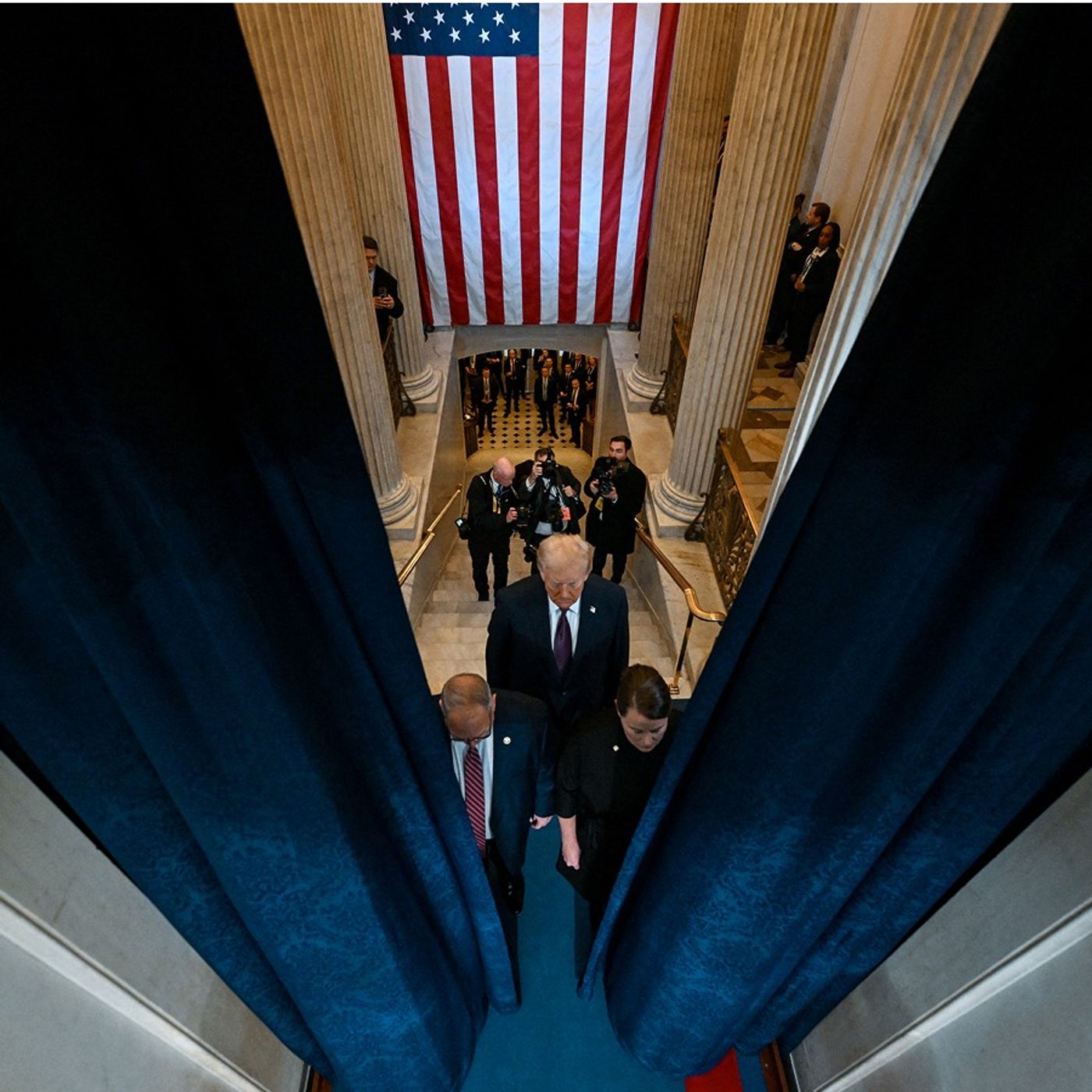
Overview of Trump 2.0: A Year of Unconstrained Power
This special episode of The Daily (New York Times) marks roughly one year of President Trump’s second term. Host Michael Barbaro speaks with reporters Maggie Haberman, Jonathan Swan and Charlie Savage to evaluate how Trump has consolidated and personalized presidential power at home and abroad — often in ways that bypass norms, test legal boundaries, and reshape institutions. The conversation covers the defining themes of the year, notable moments that reveal the administration’s approach, how courts and Congress have (or haven’t) checked that power, and what remains on Trump’s agenda.
Key takeaways
- Central thesis: Trump’s second term is defined by an aggressive, personalized expansion of executive power — “extravagant” and often unprecedented in scope.
- Personalization and reparations: Trump treats institutions as instruments to settle perceived grievances, build his legacy, and reward/penalize allies and enemies.
- Institutions weakened: Congress has largely not checked him; the judiciary — especially the Supreme Court — has often allowed or not blocked expanded presidential action.
- Foreign uses of power: The administration’s overseas moves mix conventional diplomacy/force with legally dubious actions (e.g., labeling drug smugglers as combatants, raid in Venezuela).
- One-way ratchet: Expanded executive tools are likely to become part of the baseline for future presidents, making rollback difficult.
- Unfinished priorities: Domestic prosecutions, interior immigration sweeps, and certain legacy projects remain ongoing objectives.
Major themes and frameworks discussed
- Extravagant executive power
- Jonathan Swan: A second term built on sweeping uses of executive authority across immigration, trade (tariffs), regulatory pressure, and DOJ politicization.
- Many agencies previously treated as independent have been subordinated to presidential will.
- Personalization of the presidency
- Maggie Haberman: Power is wielded as compensation/revenge for perceived slights — e.g., demands for DOJ settlements, renaming institutions, building monuments/ballrooms.
- Corporate donations and public honors are treated as part of that personalization cycle.
- Institutional erosion and the role of courts
- Charlie Savage: With a Congress largely in thrall and a Supreme Court that has, in many cases, permitted Trump’s actions, legal checks are weakened. Much litigation remains unresolved.
- Executive power as a one-way ratchet
- Growth of executive authority is likely to persist and be adopted/expanded by successors of either party; norms are difficult to restore.
Foreign policy and use of force — conventional vs. extraordinary
- Conventional actions (still consequential): negotiating ceasefires/hostage deals, pressuring NATO partners to spend more, diplomatic initiatives.
- Extraordinary/legal gray areas:
- Reclassifying drug traffickers as combatants to justify lethal force at sea.
- Special operations into Venezuela (ground raid) resulting in mass casualties and regime change — treated as law-enforcement or counterdrug action to avoid war-authorizing constraints.
- Broader signaling: threats about Greenland/Cuba and other overtures toward spheres of influence.
- Short-term gains vs. long-term costs:
- Tactical successes (no US casualties in some operations; NATO spending increases) may produce strategic erosion of allied trust and set risky precedents.
Notable moments highlighted by the reporters
- Maggie Haberman: Handling of the Jeffrey Epstein files — showed a gap between Trump and parts of his base and illustrated personalization of issues.
- Charlie Savage: Public release of classified footage (Venezuela strike) on Truth Social — emblematic of his informal, personalized presentation of state power.
- Jonathan Swan: Tech billionaires on the inauguration stage and the elevation of AI-friendly policy — potential long-term structural impact (and lasting legacy).
- The assassination of commentator Charlie Cook: traumatic event that the administration may leverage to justify crackdowns on left-leaning organizations.
Domestic politics, approval, and supporters
- Polling: Despite the expanded uses of power, Trump’s approval across issues (economy, immigration, foreign interventions) has declined.
- Explanation: Reporters suggest Trump’s behavior reflects diminished concern about public approval — he is acting on personal priorities, craving praise but insulated by supportive media and donors.
- Political durability: Reporters disagree whether Trump’s charisma and coalition are transferable to a conventional successor — raising questions about the movement’s future cohesion.
What remains “unfinished” / likely next moves
- Prosecutions and legal retribution: Continued pressure to use DOJ to pursue perceived enemies; frustration about courts and career prosecutors that resist overreach.
- Immigration: Escalation of interior enforcement and mass sweeps aimed at large-scale deportations.
- Legacy and symbolism: Continued efforts to stamp his name/brand on institutions and public spaces.
- Global order reconfiguration: Potential push for hemispheric or global spheres of influence arrangements (more room for autoritarian powers in their neighborhoods).
Implications to watch (practical signals and red flags)
- Legal battles at the Supreme Court about unilateral authority (tariffs, executive actions) — outcomes will shape future executive reach.
- DOJ investigations/prosecutions targeting state/local officials and civil-society groups — signals of politicized law enforcement.
- Expansion of military/legal doctrines (e.g., labeling non-state actors as lawful targets, extra-judicial strikes) and the composition/role of military legal advisers (JAG).
- Interior immigration enforcement operations and federal deployments to cities — potential for escalatory conflicts.
- Corporate political behavior: donor patterns and corporate concessions in response to threats or favor-seeking.
Notable quotes and lines
- “Power belongs to Donald Trump and any checks upon his power are illegitimate and ought to be bulldozed.” — Jonathan Swan (paraphrase of his framework)
- Trump’s purported restraint: “Is there anything that could stop you? … Yeah, there's one thing, my own morality.” — (quoted in transcript as Trump’s line)
- On executive power’s durability: the panel stresses the “one-way ratchet” — it’s easier to expand executive power than roll it back.
Bottom line
The first year of Trump’s second term is characterized by an assertive, personalized redefinition of presidential power at home and abroad. Reporters argue this is not merely an episodic spike but a structural shift: institutional checks have been weakened, legal boundaries tested, and new precedents set that are likely to outlast his presidency. The result is a more volatile domestic political environment and a reconfigured — and less predictable — US posture in global affairs. Listeners and observers should focus on DOJ moves, Supreme Court rulings, immigration enforcement patterns, military/legal doctrine changes, and corporate-political responses as bellwethers of how permanent these changes may be.