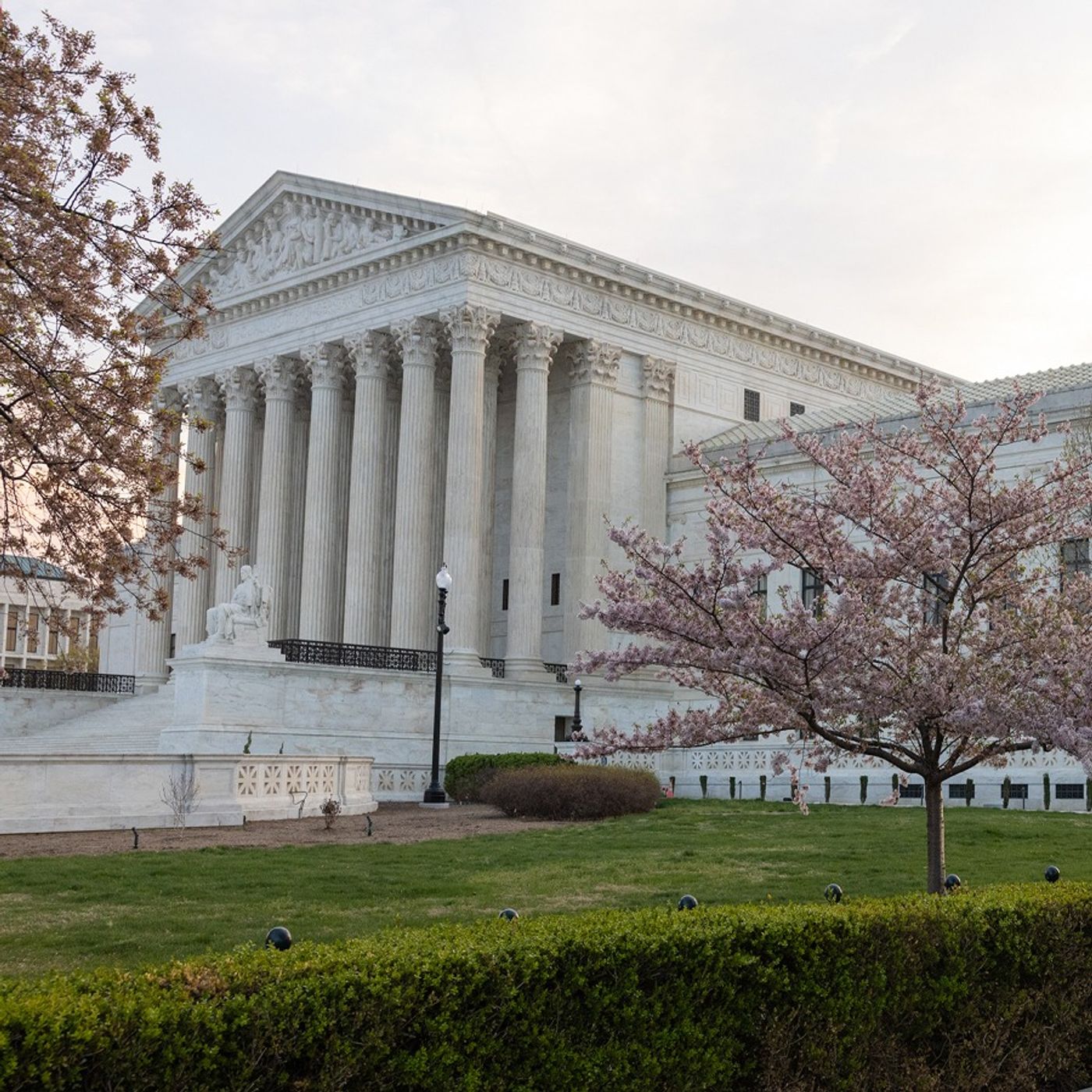
Overview of The Daily — "The Supreme Court Takes On Birthright Citizenship"
This episode of The Daily (The New York Times) reports from inside the Supreme Court for oral arguments over President Trump’s effort to limit birthright citizenship. Reporters Anne Marimow and Sandra E. Garcia summarize the arguments, the courtroom atmosphere (including President Trump’s rare in‑person attendance), and the justices’ questioning of both sides. The central legal dispute is how to interpret the Citizenship Clause of the 14th Amendment—specifically the phrase “subject to the jurisdiction thereof”—and whether long‑standing precedent (notably United States v. Wong Kim Ark, 1898) requires full birthright citizenship for virtually anyone born on U.S. soil.
Key arguments
Administration (Solicitor General John Sauer)
- Core claim: The Citizenship Clause should be read according to its “original meaning.” “Subject to the jurisdiction thereof” excludes children of illegal immigrants and many temporary visitors because those parents are not fully subject to U.S. jurisdiction (they lack lawful domicile and full political allegiance).
- Emphasis on Wong Kim Ark: Sauer argued that Wong Kim Ark was narrowly about children of parents “lawfully domiciled” here, and that later broad readings misapplied that decision.
- Framing: Birthright citizenship as an extraordinary gift that should not extend to children of those who do not owe full allegiance to the U.S.; stressed historical sources and 19th‑century statements.
Challengers (ACLU — Cecilia Wang)
- Core claim: The plain text of the 14th Amendment—“all persons born … in the United States … are citizens”—establishes a broad rule. Wong Kim Ark affirms that rule and does not support the administration’s domicile/allegiance restriction.
- Historical and practical rebuttals: Cited decades of consistent interpretation, State Department regulations, and examples (e.g., children born to detained Japanese nationals during WWII) showing broad application of birthright citizenship.
- Strategic point: The administration conceded it was not asking the Court to overrule Wong Kim Ark—Wang argued that concession is fatal to the administration’s case because Wong Kim Ark controls.
How the justices reacted — notable exchanges
- Chief Justice John Roberts repeatedly pressed the administration on how the narrow examples in the 14th Amendment’s exceptions (children of ambassadors, hostile invaders, Native Americans pre‑citizenship acts) logically expand to cover the vast group of undocumented immigrants—calling parts of the government’s theory “quirky.”
- Conservative justices gave significant pushback:
- Justice Neil Gorsuch warned the Solicitor General against overly relying on Wong Kim Ark in a way that twists precedent.
- Justice Amy Coney Barrett raised practical questions about how parents’ status would be determined at birth.
- Justice Samuel Alito posed hypotheticals (e.g., a child of an Iranian father with foreign obligations) to probe the role of parental allegiance.
- Liberal justices (notably Elena Kagan) challenged the administration’s use of obscure historical sources and noted the absence of discussion about parents in the 14th Amendment debates.
- Both sides grappled with the word “domicile” and whether it was central in Wong Kim Ark or merely part of that case’s facts; the justices were skeptical of sweeping historical claims from either side.
Courtroom atmosphere and political context
- President Trump attended parts of the argument—the first sitting president to be in the courtroom for an oral argument—sitting in the public gallery because he is a party to the case and not counsel. His presence was described as highly symbolic.
- Trump left partway through the proceedings and later posted on social media criticizing birthright citizenship, calling the U.S. “stupid enough” to allow it (an inaccurate claim about global practice).
- Reporters noted the political theater and the president’s attempt to signal the issue’s importance; his early departure and social media comments suggested unease about the likely direction of the Court.
Likely outcome and implications (as reported)
- Reporters observed skepticism from a majority of the justices, including several conservatives. Anne Marimow concluded the administration’s executive order is likely to be struck down.
- If the Court were to adopt the administration’s view, consequences would be profound: millions of U.S.-born children could be denied automatic citizenship, raising legal, administrative, and humanitarian problems (possible statelessness, complications for newborn registration, and constitutional upheaval).
- If the Court reaffirms the prevailing interpretation (as many commentators expect), birthright citizenship will remain broadly protected under the 14th Amendment and Wong Kim Ark.
Takeaways — what matters next
- Central legal question: how to interpret “subject to the jurisdiction thereof”—as a broad rule covering virtually everyone born here, or as a narrower rule excluding children of non‑domiciled/foreign‑allegiant parents.
- Precedent matters: Wong Kim Ark is pivotal; whether the Court treats it as controlling (broad rule) or limited (domicile requirement) will determine the decision.
- Watch for: the Court’s opinion (timing unknown) and how it frames reliance on historical sources vs. textual and precedent‑based interpretation. The practical consequences of any change would be immediate and far‑reaching.
- Political dimension: the case is highly symbolic and politically charged; the president’s in‑court attendance underscored that.
Notable short quotes from the episode:
- The legal hinge: “subject to the jurisdiction thereof.”
- Chief Justice Roberts on the government theory: “quirky.”
- President Trump (post‑court): the U.S. is “stupid enough” to allow birthright citizenship (claim noted as factually incorrect).
Produced by The New York Times’ The Daily; reporters on the ground were Anne Marimow and Sandra E. Garcia.