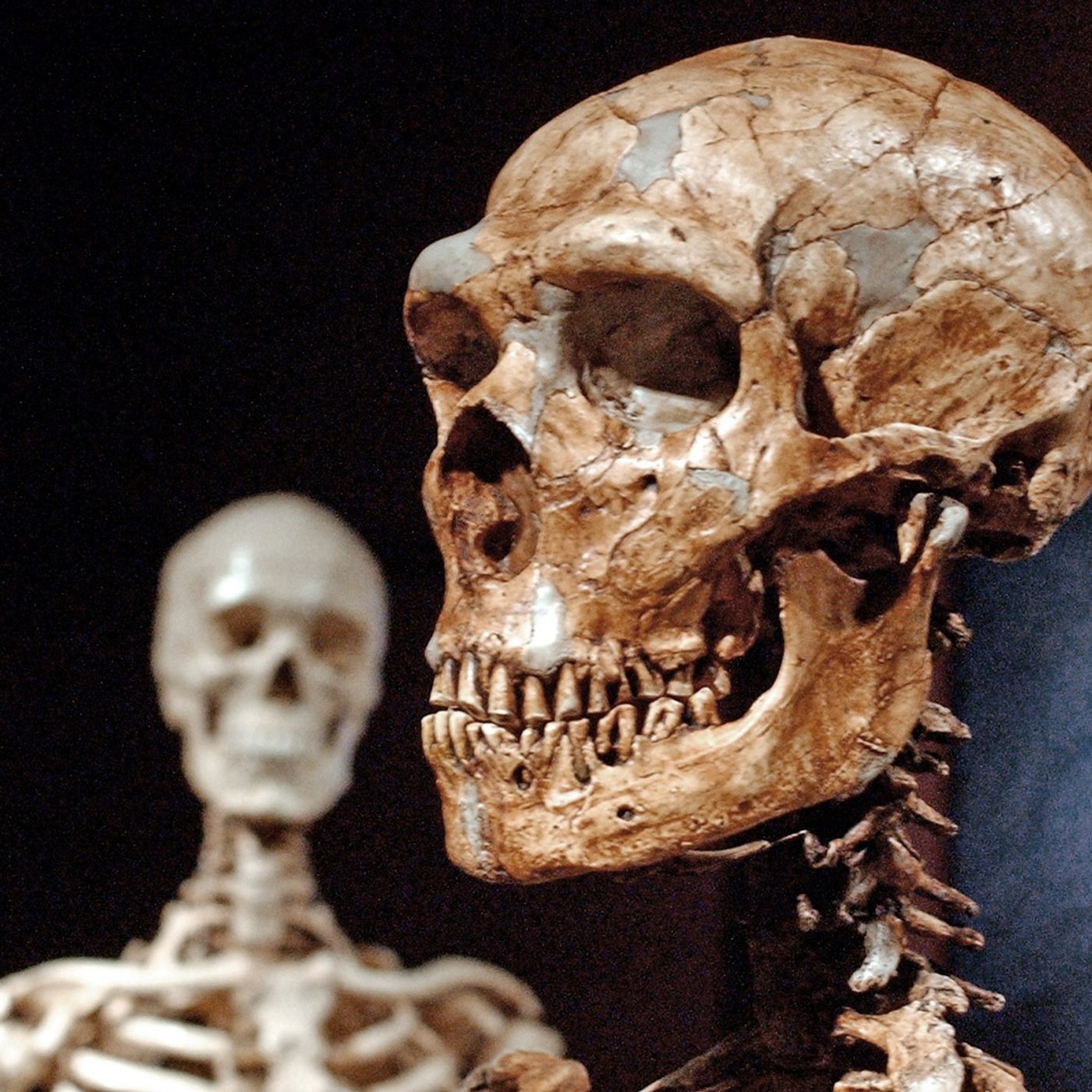
Overview of The Sunday Daily: We Underestimated the Neanderthal
Episode from The New York Times' The Sunday Daily (host Michael Barbaro) — air date: January 25. Guests: science journalists Carl Zimmer and Franz Litz. The episode reviews how recent genetic and archaeological research has overturned long‑standing caricatures of Neanderthals (and revealed other extinct human lineages such as the Denisovans), arguing that we’ve seriously underestimated the intelligence, culture, and complexity of our closest ancient relatives.
Key takeaways
- The traditional image of Neanderthals as brutish, stooped, hair‑covered cavemen arose from early misinterpretations (notably the La Chapelle-aux-Saints reconstruction) and was cemented by popular culture.
- Advances since the late 1990s—especially extraction of Neanderthal DNA and the sequencing of a full Neanderthal genome (~2010)—have shown that Neanderthals were closely related to Homo sapiens, interbred with us, and passed on genes still present in modern people.
- Archaeology and genomics now depict Neanderthals as capable: large brains, shared brain‑related genes, controlled use of fire, complex tools (including adhesives), burial practices (sometimes with flowers), jewelry (e.g., eagle‑talon necklaces), pigments/crayons and possible symbolic art, and likely language and social rituals.
- A distinct third lineage, the Denisovans (identified from DNA in Siberia’s Denisova Cave), lived across much of Asia. They, too, interbred with modern humans and contributed DNA to present‑day populations (notably Oceania and parts of Asia).
- Genomic evidence suggests additional “ghost” archaic lineages remain to be discovered; human evolution is a braided, reticulated tree rather than a simple march toward “modernity.”
- The story invites a reassessment of what it means to be human and warns against dehumanizing biases that echo social injustices.
Background — where the old view came from
- 1856 Neander Valley fossil: first identified as a primitive human; early interpretations were influenced by 19th‑century expectations.
- La Chapelle-aux-Saints (“Old Man”) reconstruction: a damaged, arthritic skeleton was reconstructed as stooped and apelike, fueling the enduring “caveman” stereotype.
- Popular media (films, advertising, jokes) reinforced the caricature; some scientific communities also defaulted to attributing “good” artifacts to modern humans and simpler ones to Neanderthals.
What recent science has revealed
Genetics
- Neanderthal DNA: fragments initially, then full genome(s) by ~2010. Result: clear evidence Neanderthals and Homo sapiens interbred.
- Modern humans outside Africa typically carry 1–4% Neanderthal DNA; small amounts exist in Africa due to back‑migration from the Near East.
- Neanderthals share many brain‑related genes with modern humans, consistent with complex cognition.
Archaeology and behavior
- Burials with possible ritual elements (e.g., floral placement).
- Mastery of fire and ability to kindle/use fire at will.
- Complex tool use and technology (including adhesives to haft spear points).
- Personal ornamentation (eagle‑talon necklaces) and evidence of symbolic behavior.
- Cave markings and pigments; recent finds include pigment “crayon” dated ~42,000 years that may reflect deliberate art.
- Studies have even suggested behaviors like kissing — indicators of social/affective life.
Denisovans and other archaic humans
- Denisovans discovered from DNA in small fossils found in Denisova Cave (Siberia); initially known only from a pinky bone and teeth.
- Subsequent analyses find Denisovan signatures across Asia (Tibet, Taiwan, Southeast Asia) and in modern populations (Papua New Guinea, Philippines, parts of East Asia).
- Physical reconstructions (from a recently identified skull) suggest large heads, big teeth, tall/slender bodies—distinct from Neanderthals and modern humans.
- Genomic patterns hint at additional, as‑yet‑undetected archaic lineages that contributed to the modern human gene pool.
Broader implications and social commentary
- The new picture blurs strict boundaries between “us” and “them”: many cognitive, social, and cultural traits once viewed as uniquely human appear in Neanderthals and other archaic humans.
- The episode argues that the old tendency to denigrate Neanderthals mirrors human patterns of dehumanization against different groups, with historical parallels to slavery, the Holocaust, and other atrocities.
- Scientists increasingly call Neanderthals “humans” and recommend abandoning the linear “march of progress” narrative in favor of a complex, branching, intertwined human story.
Notable quotes and insights
- “We badly underestimated the Neanderthal.” — framing line of the episode.
- “They force us to challenge ourselves about what it really means to be human.” — on how Neanderthals shift our self‑understanding.
- The “march of progress” image should be replaced by “a much richer, more complex view of humanity.”
For listeners who want to explore further (search terms)
- Neanderthal genome 2010
- Denisova Cave Denisovans
- La Chapelle-aux-Saints Old Man reconstruction
- Neanderthal burial flowers, Neanderthal jewelry, Neanderthal adhesives
- Carl Zimmer Neanderthal articles (he’s one of the guests and an author on the topic)
Final takeaway
Recent genetic and archaeological work has transformed Neanderthals from caricatured brutes into complex, culturally rich humans closely intertwined with our own ancestry. The findings broaden our view of humanity and challenge long‑held biases about what makes human behavior and cognition unique.