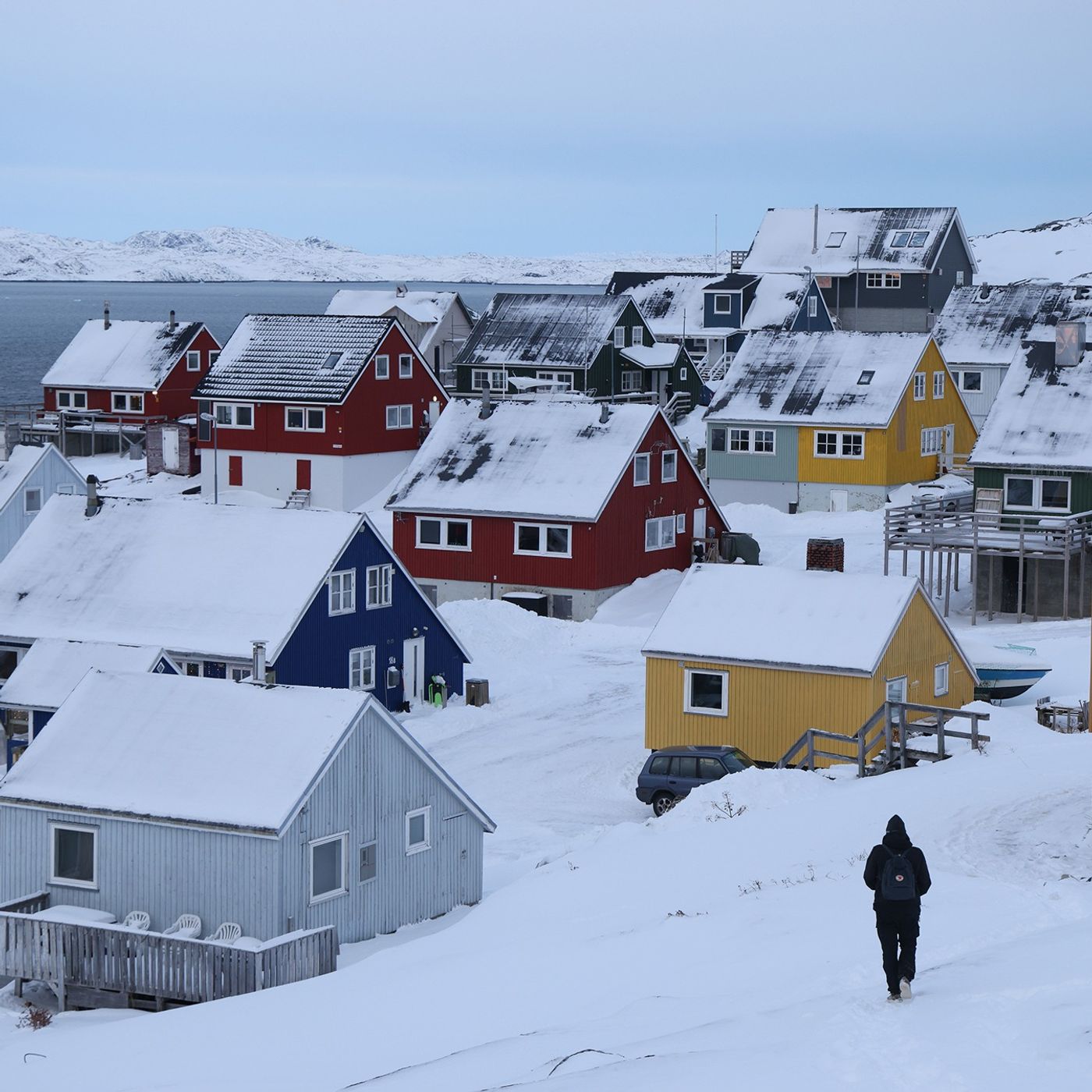
Overview of The Daily — "The Global Showdown Over Greenland"
This episode of The New York Times podcast The Daily (host Natalie Ketroff) features reporter Mark Landler explaining the week-long diplomatic crisis after President Trump publicly pushed to acquire Greenland from Denmark. The conversation covers what the president wanted, how European and NATO partners reacted (including a tense showing at Davos), the limited legal/military necessity of full ownership, the tentative off‑ramp negotiated at the moment of the broadcast, and the broader implications for NATO and the post‑war rules‑based international order.
Main narrative and sequence of events
- Trump publicly expressed a desire to "buy" or otherwise acquire Greenland, framing it as a strategic and economic necessity (minerals, Arctic positioning).
- His rhetoric escalated into threats (tariffs) and blunt talk of using "excessive strength," prompting alarm in Europe and Denmark.
- Denmark and Greenland officials pushed back; Denmark increased its own deterrence and received symbolic support from other European countries.
- At Davos, Trump’s speech reinforced a might-makes-right posture; European leaders (including Mark Carney and Emmanuel Macron) responded by framing the moment as an existential test of the rules‑based order.
- A negotiated off‑ramp emerged (as of the episode): an outline where the U.S. might obtain rights over limited patches of Greenland (likely military bases) without Denmark ceding sovereignty—details uncertain.
Key facts and context
- The U.S. already has significant access to Greenland under a 1951 defense treaty with Denmark, which allows expansion of U.S. military facilities.
- Trump argued ownership was necessary for security and economic exploitation (rare earth minerals); Landler contends the U.S. could largely secure those interests under existing arrangements.
- European reactions included diplomatic pushback, military signaling, and talk of economic countermeasures.
Major themes and takeaways
- NATO strain: A central NATO member (the U.S.) threatening a fellow member’s territory exposed a profound internal crisis for the alliance and weakened trust.
- Rules‑based order under stress: European leaders portrayed the episode as symptomatic of a larger rupture in the post‑war system that has relied on predictable U.S. leadership.
- Strategic hedging: If the U.S. becomes less reliable, middle powers (European countries, Canada) will hedge—deepening ties to China and building ad hoc security arrangements rather than relying exclusively on the U.S.
- Europe’s limits: Europe has economic and soft‑power strengths but lacks immediate capability to replace U.S. security guarantees—building independent defense capacity would take decades and political sacrifice.
- Short‑term resolution vs. long‑term damage: The apparent off‑ramp may have avoided immediate crisis, but it doesn’t undo the damage to alliance credibility or the precedent of intra‑alliance coercion.
Notable quotes and insights
- Mark Landler: “When the largest, the central, the linchpin member of the alliance now poses a direct threat to another member... that fundamentally makes NATO no longer tenable.”
- Mark Carney (quoted at Davos): “We are in the midst of a rupture, not a transition.” (Describing the end of the old rules‑based bargain.)
- Paraphrase of Thucydides’ idea highlighted as capturing Trump’s posture: “The strong do what they can; the weak suffer what they must.”
Possible measures and leverage discussed
- Military: Europe could pursue incremental, regional coalitions and boost defense spending, but building an independent pan‑European military deterrent would be long and costly.
- Economic: The EU has tools (referred to as the “bazooka”—anti‑coercion measures) to retaliate economically, but using them risks reciprocal U.S. tariffs and domestic political fallout.
- Diplomatic: Continued coalition‑building, public shaming at forums (e.g., Davos), and negotiations to codify protections for member sovereignty.
Unanswered questions / risks
- Concrete terms of the off‑ramp remained unclear at broadcast—what sovereignty, basing rights, legal status, and timeline would be included?
- Whether the episode marks a temporary blip or a durable shift toward multipolarity (more hedging with China, less reliance on U.S.) is unsettled.
- The long‑term health of NATO and the rules‑based order depends on political choices in Europe and Washington; this crisis accelerated debates but did not resolve them.
Short summary for busy readers
- Trump’s Greenland gambit triggered a rare intra‑NATO crisis, exposing deep fissures in alliance trust and prompting strong European pushback at Davos.
- The U.S. already had significant legal and practical access to Greenland; full ownership was unnecessary for many of the stated goals.
- A tentative compromise appears to give the U.S. limited basing rights while leaving Danish sovereignty intact—buying time but not repairing the alliance’s damaged norms.
- The broader implication: middle powers will likely hedge more (including with China) and pursue more autonomous security and economic strategies, accelerating a shift toward a messier, more multipolar world order.