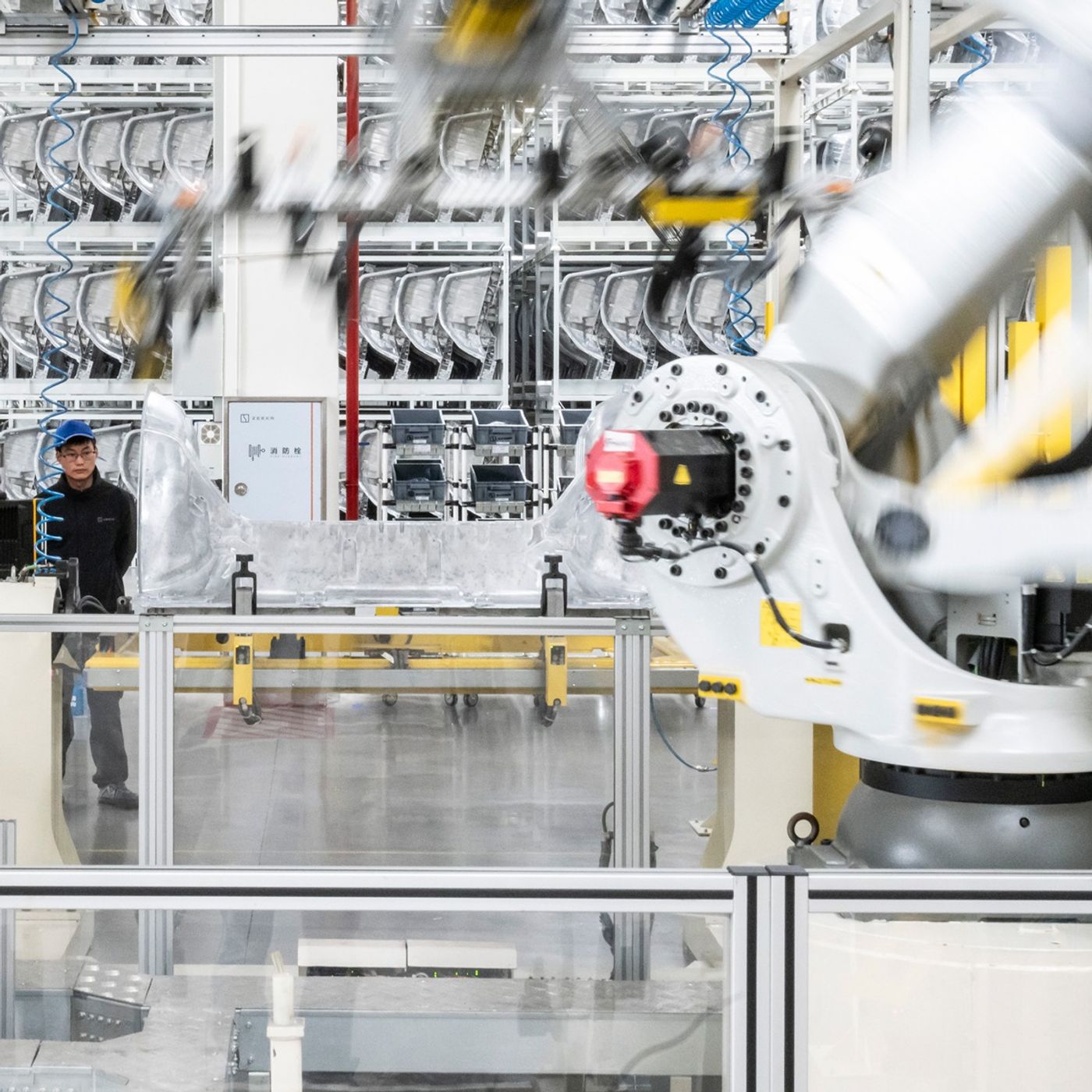
Overview of How China Made Itself Tariff-Proof
This episode of The Daily (The New York Times) explains why U.S. tariffs over the past year failed to meaningfully slow China's rise as the world’s manufacturing powerhouse. Keith Bradshaw outlines four factors—diversion to other markets, indirect exports via third countries, currency weakness, and a dramatic lead in advanced, robot-driven manufacturing—that together have made China far more resistant to tariffs than expected. The episode highlights China's policy push (Made in China 2025), large investments and acquisitions (notably KUKA), widespread factory automation (dark factories, AI quality control), and the demographic and education dynamics that accelerated automation.
Key takeaways
- China’s overall trade surplus reached about $1.2 trillion, and its manufactured-goods surplus grew even more — signaling stronger global manufacturing dominance despite U.S. tariffs.
- Four main reasons tariffs had limited effect:
- Rapid diversion of exports to other markets (Asia, Africa, Latin America, Europe).
- Increased indirect shipments: parts exported to third countries then assembled and shipped to the U.S.
- A significantly weakened Chinese currency, making Chinese exports cheaper and imports into China more expensive.
- China’s large lead in advanced automation and robotics, enabling much cheaper, high-quality production.
- China now installs more factory robots per year than the rest of the world combined and has more robots per 10,000 manufacturing workers than the U.S., Germany, or Japan.
- Automation is pervasive — from huge “dark” car factories with hundreds of robots to small workshops using inexpensive robot welders programmed by watching a human worker.
- U.S. tariffs alone haven’t revived American manufacturing; they may need to be part of a broader strategy (workforce training, tech investment, multilateral trade measures).
How China became tariff-resistant
- Market diversification: China expanded sales quickly into non-U.S. markets (Europe, Africa, Latin America, other Asian countries).
- Supply-chain fragmentation: Chinese firms export components that are assembled elsewhere, creating “pass-throughs” that bypass tariffs on finished goods.
- Currency policy: Deliberate weakening of the yuan reduced the real cost of Chinese goods abroad.
- Technological leap: A state-led push into automation and robotics allowed China to lower production costs across low- and high-tech manufacturing.
The role of automation, AI, and demographics
- Demographic pressure: The one-child policy caused a falling birth rate and a shrinking pool of young factory workers; combined with almost no immigration, China faced a labor shortfall.
- Rising education: Young Chinese are better educated, more likely to attend college, and less willing to take repetitive factory-floor jobs — increasing the incentive to automate.
- Made in China 2025: Launched as a multi-year plan focused on 10 advanced sectors (semiconductors, EVs, robotics, etc.), emphasizing building both advanced products and the manufacturing equipment to make them.
- Robotics and AI: Examples included an 820-robot “dark” car assembly line with AI-based visual quality control, and inexpensive robot systems that can be taught by cameras to replicate human welders’ motions.
- Acquisition and knowledge transfer: Chinese companies bought foreign robot makers (notably Midea’s takeover of Germany’s KUKA in 2017), transferring expertise and production to China.
Global impacts and the U.S. position
- Competitive edge: China now supplies not just finished goods but also factory automation equipment — sometimes the least expensive option globally — which other countries (including U.S. factories) buy.
- Job distribution: Automation in China has increased total output with fewer workers; job losses have been felt in other countries that lack equivalent automation investment (example: Germany losing many factory jobs).
- U.S. response: Tariffs can offer temporary protection, but by themselves haven’t restored broad manufacturing competitiveness. Economists advise combining tariffs with investments in worker training, technology adoption, supply-chain resilience, and multilateral measures to block tariff circumvention.
Notable quotes / useful phrases from the episode
- “China has essentially made itself tariff-proof.”
- “Dark factory” — factories so automated robots can run with the lights off.
- China “installs more factory robots each year than the entire rest of the world combined.”
- The KUKA acquisition: a key example of importing manufacturing expertise rather than relying on external suppliers.
Implications & recommended actions (for policymakers and industry)
- Treat tariffs as one tool among many; pair trade measures with:
- Large-scale investment in automation and factory technology.
- Workforce training and education focused on advanced manufacturing skills.
- Policies to rebuild domestic supply chains for critical technologies (semiconductors, batteries).
- International coordination to limit third-country pass-throughs and unfair trade practices.
- Invest in R&D and in the domestic production of advanced factory equipment to reduce dependence on Chinese-made automation.
- Reassess social policies (immigration, education, labor incentives) that affect the availability and composition of the workforce.
Who should listen to the full episode
- Policymakers and trade analysts looking for context on why tariffs had limited effects.
- Manufacturing and industrial strategists evaluating automation and supply-chain decisions.
- Economists and labor experts interested in how demographics and education shape industrial policy.
- General listeners curious about how China moved from low-cost manufacturing to high-tech, robot-led production.