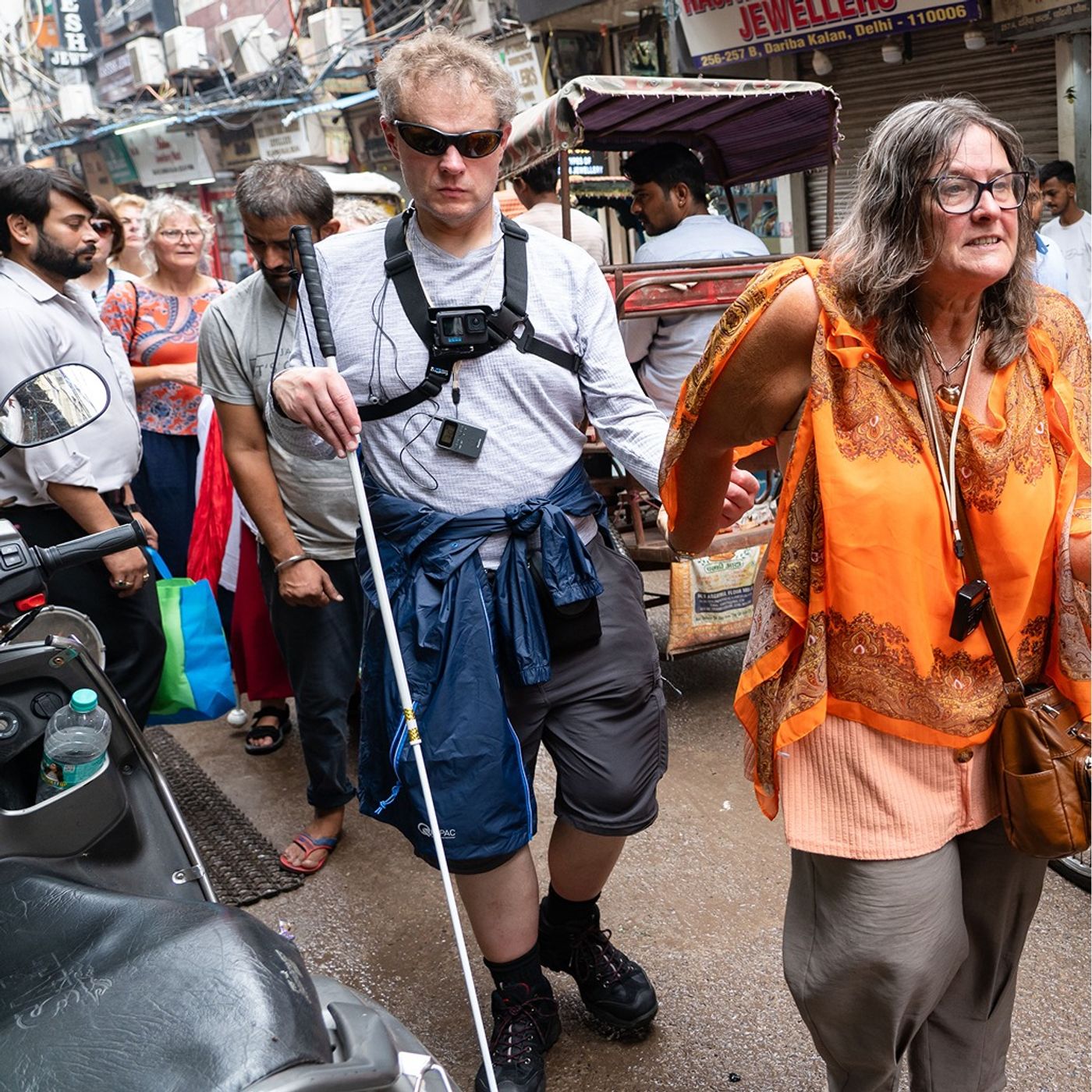
Overview of Sites Unseen: What’s Revealed by Traveling With the Blind
This New York Times Daily Sunday episode follows reporter Andy Isaacson as he joins a Travelize trip in India with blind and visually impaired travelers. The conversation explores how travel changes when it is not dominated by sight alone, and how sharing descriptions, touch, sound, smell, and spatial cues can create a fuller and more vivid understanding of a place.
What the episode is about
Andy Isaacson reflects on his long career as a world traveler and photographer, then describes a trip that challenged his assumptions about how people experience destinations. Traveling with blind companions pushed him to notice details he would normally ignore and to think more deeply about the difference between seeing a place and truly experiencing it.
The episode centers on Travelize, a company founded by Amar Latif that pairs blind and sighted travelers as equal companions rather than in a helper/client dynamic.
Key themes and takeaways
Travel is more than visual
- The episode argues that modern travel is overly focused on what can be photographed or seen.
- Blind travelers often engage more deeply with sound, texture, smell, and atmosphere.
- Sighted travelers can miss important layers of place when they rely only on visuals.
Describing a place changes how you see it
- While guiding blind travelers in Delhi and at the Taj Mahal, Andy found himself paying attention to small, ordinary details:
- curb paint
- vendor displays
- echoes in chambers
- the feel of marble and thresholds
- Describing a scene to someone else sharpened his own perception.
Blind and sighted travelers can complement each other
- Travelize’s model is built on mutual exchange, not assistance alone.
- Blind travelers contribute interpretive, sensory insight.
- Sighted travelers contribute visual description and navigation.
- Together, they create a richer shared experience.
Perspective matters more than any single viewpoint
- Andy returns to the Hindu parable of the blind men and the elephant.
- The point: no single perspective captures the whole truth.
- Understanding a place, like understanding people, requires multiple ways of perceiving it.
Notable moments from the India trip
Delhi
- Andy and Daniel move through the chaos of Old Delhi:
- uneven pavement
- rickshaws
- cows
- vendors
- horns and constant movement
- Andy realizes he is noticing overlooked details that define the city’s character.
Taj Mahal
- With Luke, Andy tries to describe one of the world’s most iconic visual landmarks.
- The blind companion helps shift the focus from the image to the experience:
- marble texture
- echoes in inner chambers
- air, sun, and spatial orientation
- The episode suggests the Taj Mahal is as much about acoustics and movement as it is about appearance.
Candy’s perspective
- Candy, who has no vision and uses prosthetic eyes, says she is less interested in “sights” than in the reality of India.
- Her most vivid memory comes from touching a child’s rough hand, which became a powerful window into the human conditions around her.
Amar Latif’s insight
Latif frames the difference between blind and sighted travel as:
- Blind travel = like reading a book
- imaginative
- interpretive
- layered through description and memory
- Sighted travel = like watching a film
- immediate
- visual
- more dependent on what is directly in view
The episode suggests that the best travel may combine both modes.
Final takeaway
Andy comes away from the trip with a changed approach to travel: he cannot turn off his visual orientation, but he now understands the value of slowing down and using all the senses. The episode’s core message is that a deeper understanding of the world comes from combining perspectives, not privileging one sense over all others.