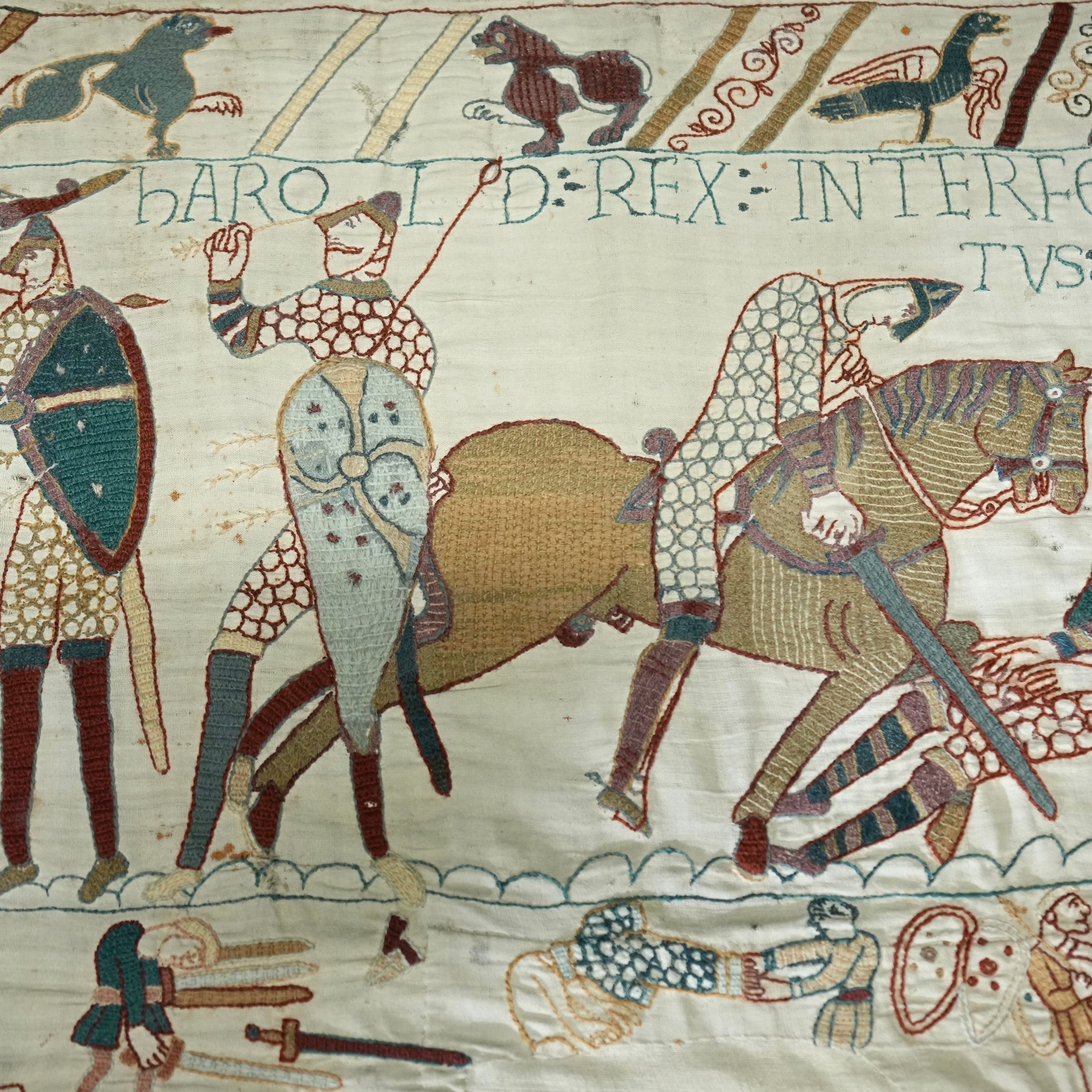
Overview of The Daily: How a 1,000-Year-Old Tapestry Took London by Storm
This episode of The Daily tells the remarkable story of the Bayeux Tapestry — more accurately, an embroidery — and how a nearly 1,000-year-old artifact became one of the hottest cultural tickets in London. The episode explains why this medieval work matters so deeply to British identity, how it depicts the Norman conquest of England in 1066, and how France finally agreed to loan it to the United Kingdom after decades of refusal.
What the Episode Is About
The conversation centers on a temporary loan of the Bayeux Tapestry from France to London, where it drew huge crowds, long queues, and intense public fascination. What might sound like a niche museum event is presented as a major cultural moment because the work sits at the heart of English history and national memory.
Why it is so famous
- It is about 220 feet long
- It is nearly 1,000 years old
- It remains unusually vibrant and well-preserved
- It depicts one of the most consequential events in British history: the Norman conquest of England
The Historical Story Depicted
The tapestry tells the story of the events leading to the Battle of Hastings in 1066:
- Edward the Confessor dies without an heir
- Harold Godwinson takes the English throne
- William of Normandy invades England after Harold allegedly breaks a promise
- The Norman army and Harold’s forces clash in a brutal battle
- Harold is killed, famously depicted as being struck in the eye by an arrow
- William becomes William the Conqueror, transforming England’s future
Why this defeat became important
Even though it depicts an English loss, the tapestry is central to British identity because the conquest changed:
- the language
- the laws
- the aristocracy
- the broader shape of English history
Why the Tapestry Stayed in France for So Long
The episode explains that Britain has wanted the tapestry on loan for decades, but France repeatedly refused because of its fragility.
Reasons it was considered too risky to move
- It has been damaged over centuries by handling, transport, and storage
- It was once moved by Napoleon, and later handled during Nazi occupation
- Conservation experts feared any long-distance move could cause serious damage
The key turning point came when Emmanuel Macron pushed for the loan as a diplomatic gesture and a symbol of Franco-British cooperation.
How the “Impossible Loan” Happened
The move from France to London was described as an extraordinary conservation and logistics effort.
Major precautions included
- A museum closure in Bayeux made transport possible
- Extensive scientific planning and conservation work
- Moving the embroidery in tiny increments with large teams
- Mounting it on specialized rails and placing it into nested crates
- Using spring-based shock protection designed to absorb road vibrations
- Testing the route in advance to identify potholes and rough patches
- Transporting it under heavy security, including French security services
The installation in the British Museum also required a custom-built, expensive display table and an extremely careful uncrating process.
Public Reaction in London
The episode emphasizes how unusual the public enthusiasm was for a medieval textile.
Visitor response
- Massive queues and sold-out access
- Visitors described being deeply moved
- Schoolchildren and adults alike reacted with awe and curiosity
- Many people saw it as a direct, visual connection to their country’s origins
The reporter notes that the tapestry’s bold imagery, humor, nudity, and narrative clarity make it feel surprisingly modern and accessible.
Why the Tapestry Resonates So Strongly
The episode suggests the tapestry’s power comes from its ambiguity and openness to interpretation.
People project many meanings onto it
It can be seen as:
- a story of national origin
- a symbol of monarchy
- an anti-war or pro-war statement
- a reflection on migration and conquest
- a celebration of creativity and craft
Because the events are so old and partially mysterious, different audiences can find very different meanings in it.
Notable Observations and Details
A few memorable details stand out from the episode:
- The tapestry contains 93 penises by one count, most of them on horses
- It has a surprisingly vivid, almost cartoon-like style
- The reporter was struck by a scene of men building boats for the invasion, seeing it as a moving depiction of ordinary labor and human effort
- The museum experience ended, fittingly, in the gift shop, where the reporter bought souvenir items including a postcard and Christmas ornament
Main Takeaway
The episode shows that the Bayeux Tapestry is more than a medieval artifact: it is a living piece of national mythology, art, and history. Its temporary return to Britain became a major event because it connects modern audiences to the foundational story of England — and because, against all odds, one of the world’s oldest and most fragile artworks was successfully moved across the Channel.