Overview of Shortwave — "A failed galaxy could solve the dark matter mystery"
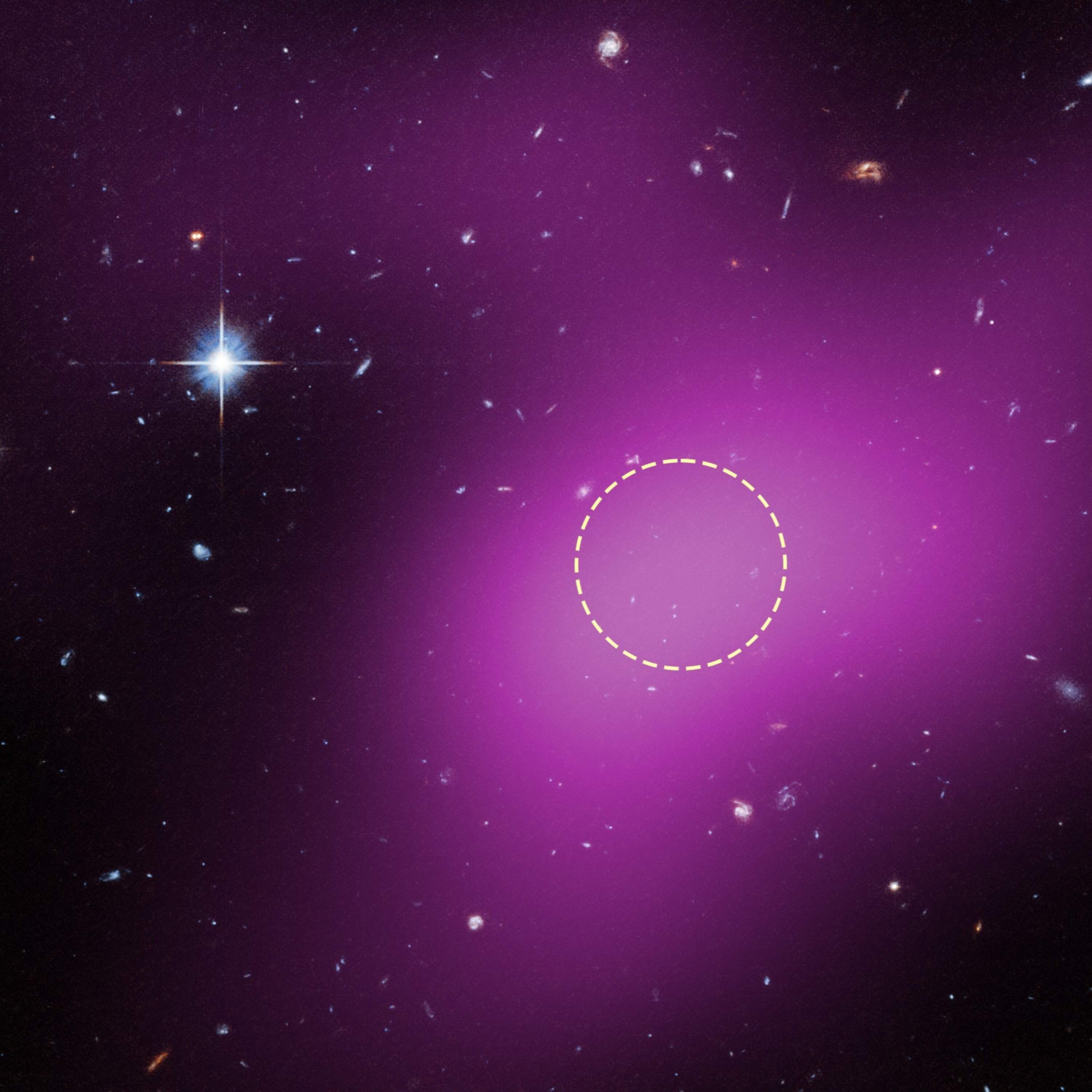
This episode of NPR's Shortwave (host Regina Barber) describes the discovery and significance of "Cloud 9," a gas-rich but starless dark matter halo found near the spiral galaxy M94. Astronomers Andrew (Andy) Fox and Gagandeep (Deep) Anand (Space Telescope Science Institute) explain how Cloud 9 confirms a prediction of the standard cosmological model (Lambda‑CDM), why a starless halo is valuable for studying dark matter, and what follow-up work could reveal about the nature of dark matter.
Key points and main takeaways
- Dark matter makes up ~85% of the universe’s mass but doesn't emit light; we infer it from gravitational effects.
- Cloud 9 is a rare observed example of a predicted category: a dark matter halo that retained gas but failed to form stars ("relic" halo).
- It was first detected in neutral hydrogen radio observations and then targeted with very deep Hubble imaging, which found no stars even after long exposures.
- Cloud 9 is roughly 1 kiloparsec (~3,000 light years) across — much smaller than the Milky Way (~50 kpc, ~150,000 light years).
- Finding Cloud 9 supports the Lambda‑CDM model prediction that many small halos exist below the mass threshold for star formation.
- Because Cloud 9 lacks bright stars, it offers a clearer laboratory to study dark-matter-dominated structure and could help constrain dark matter’s properties.
What Cloud 9 is (concise description)
- Object: A dark matter halo containing neutral hydrogen gas but essentially no stars.
- Location: Outskirts/outer halo of the spiral galaxy M94.
- Size: ≈1 kiloparsec across (≈3,000 light years).
- Why “failed galaxy”: It had enough gas to potentially form stars but did not; it sits below the critical halo mass for star formation.
How it was discovered and confirmed
- Initial detection: Radio observations (neutral hydrogen 21‑cm emission) by a team in China revealed the gas cloud.
- Follow-up: The team used deep Hubble Space Telescope imaging, expecting to find faint stellar populations. None were detected even in very long exposures.
- Interpretation: The absence of stars in deep optical imaging identifies the object as a starless, gas-rich dark matter halo consistent with Lambda‑CDM relics.
Scientific importance and implications
- Theory validation: Confirms a Lambda‑CDM prediction that many low-mass halos exist that cannot form stars — filling a gap between simulation and observation.
- Clean probe of dark matter: Without bright stars and complicated baryonic physics, Cloud 9 provides a clearer view of how dark matter is distributed on small scales.
- Constraints on dark matter models: Detailed mass mapping of Cloud 9 (and other similar objects) could rule in/out properties of dark matter particles or alternative theories.
- Population studies needed: A single discovery is important, but finding more such relic halos will strengthen statistical constraints and help test formation scenarios.
- Location matters: Cloud 9’s position in the outer halo reduces the likelihood that tidal interactions destroyed it, making it a more pristine example.
Notable quotes from the episode
- "Cloud 9, I like to think of it as a bit of an underachiever." — Jorge Moreno (introduced)
- "We found just a blank piece of sky, a completely empty cloud." — Andy Fox
- "You can think of [these clouds] as a window into a dark matter–dominated cloud, a window into the dark universe." — Andy Fox
Next steps and follow-up actions (from the researchers)
- Map Cloud 9 at higher resolution to determine its internal mass distribution and better constrain dark matter properties.
- Search for more gas-rich, starless halos to build a sample population.
- Combine radio surveys (to find neutral hydrogen) with deep optical/space imaging (to confirm absence of stars) for efficient identification of relic halos.
Who’s speaking / credits
- Host: Regina Barber (NPR Shortwave)
- Interviewees: Andrew (Andy) Fox and Gagandeep (Deep) Anand — astronomers at the Space Telescope Science Institute
- Mentioned scientist: Jorge Moreno (contextual quote at top of episode)
Bottom line
Cloud 9 is the first robustly confirmed example of a small, gas-rich dark matter halo that failed to form stars. Its discovery supports Lambda‑CDM predictions and opens a promising observational path for probing the nature of dark matter by studying systems where dark matter’s influence is relatively unmasked.