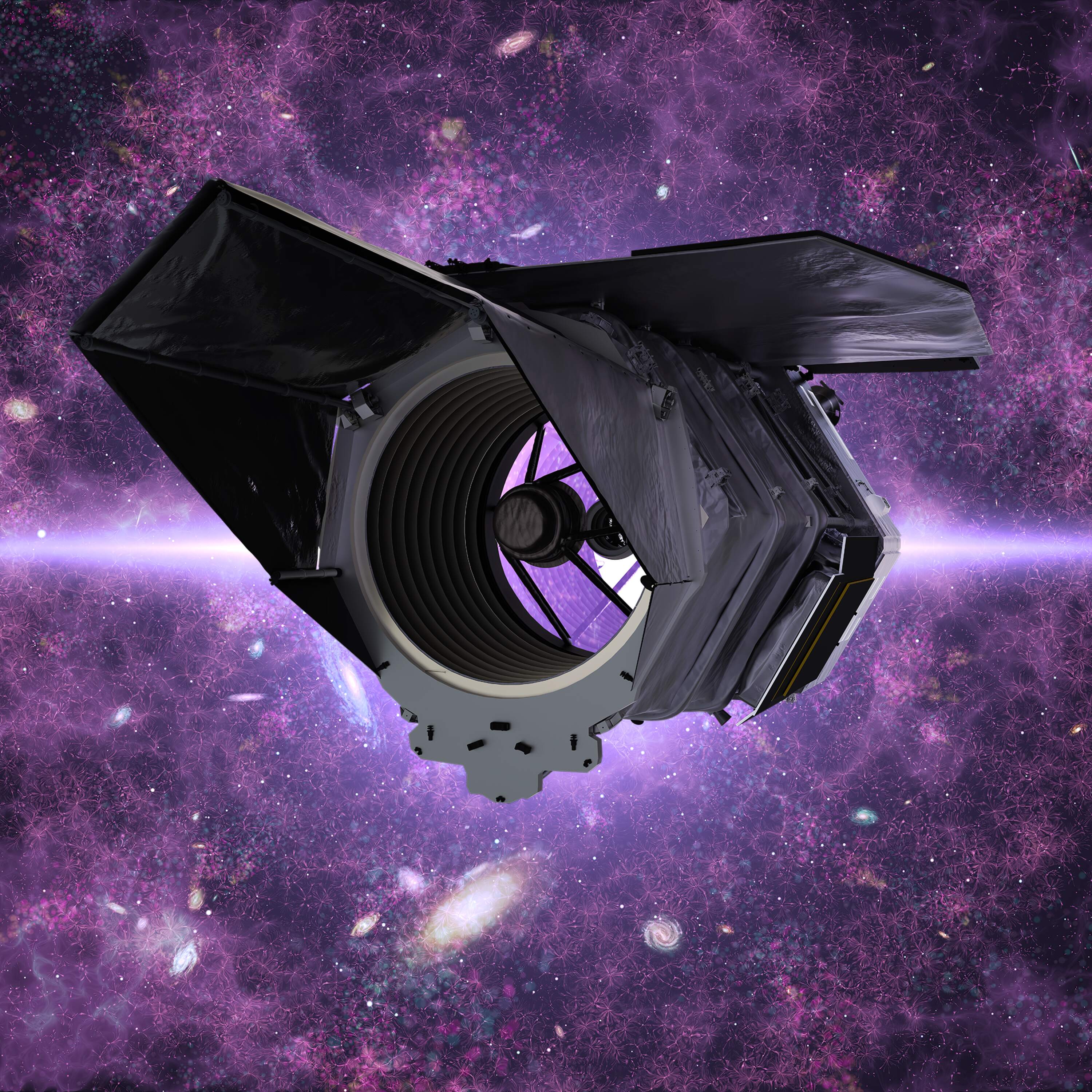
Overview of NASA's newest telescope has a top secret past
This NPR Shortwave episode previews the upcoming Nancy Grace Roman Space Telescope—often just called Roman—and explains why astronomers are excited about it. The telescope is expected to become a major new survey machine for astronomy, with the ability to study supernovas, dark matter, exoplanets, and the structure of the universe at a scale that far outpaces Hubble in sky coverage. The episode also digs into Roman’s surprising origin story: parts of it were originally built for a secret spy satellite program before NASA repurposed the hardware for science.
What the Roman Space Telescope Will Do
A new kind of survey telescope
Roman is designed to scan large areas of the sky quickly, making it ideal for astronomy that depends on broad surveys rather than narrow, targeted observations.
Main science goals
- Track Type Ia supernovas to help measure cosmic expansion
- Map galaxies and galaxy clusters to learn more about dark matter
- Search for exoplanets using gravitational microlensing
- Build huge public datasets that researchers worldwide can analyze
Key instruments
- Coronagraph: blocks a star’s light so faint nearby planets can potentially be seen
- Wide Field Instrument: a 300-megapixel infrared camera for capturing massive star fields
The Telescope’s Secret Past
One of the most notable takeaways is Roman’s unusual backstory:
- It was originally planned as a spy satellite by the National Reconnaissance Office (NRO)
- The satellite was never launched and sat unused in a hangar
- NASA later repurposed the hardware for astronomy, including the already-built main mirror
This origin gives the telescope its “top secret past” and makes Roman a rare example of military hardware turned into a flagship science mission.
Why Astronomers Are Excited
1. Better measurements of dark energy
Roman will look for Type Ia supernovas, which act as standard candles—objects with known brightness that help astronomers calculate distance. Thousands of these observations could sharpen understanding of dark energy and the universe’s accelerating expansion.
2. A huge boost for exoplanet science
Roman will use microlensing, a technique Einstein described in theory, to detect planets that are otherwise nearly impossible to find—including:
- planets near the center of the Milky Way
- planets similar to Jupiter, Saturn, Uranus, and Neptune
3. A massive dataset for everyone
Roman is being built as a survey telescope, so much of its data will be publicly available. Scientists emphasized that the mission is meant to be shared broadly, including with classrooms and independent researchers.
How Roman Compares to Hubble and Webb
- Similar sharpness/sensitivity to Hubble
- Much wider field of view
- Can survey the sky far faster than Hubble
- Unlike James Webb, which focuses on smaller patches of sky, Roman is built for big-picture mapping
A striking example from the episode: a Milky Way survey that would take about a century with Hubble could take about one month with Roman.
Timeline and Expected Results
- Roman is scheduled to launch at the end of August
- It will take about 100 days to reach the L2 Lagrange point
- Early data may begin arriving 3–4 months after launch
- Full survey results will take longer, since the mission is designed around long-running observations
Big Takeaway
Roman is expected to be a powerful new astronomy workhorse: a telescope built for wide, repeated surveys that could answer major questions about dark energy, dark matter, galaxies, and exoplanets—while also potentially uncovering entirely unexpected discoveries. The episode emphasizes that some of the most exciting science may be the things astronomers don’t even know to look for yet.