Overview of Could virtual reality speed up learning?
This NPR Shortwave episode is a science roundup centered on three recent studies: one on whether virtual reality and big-body movements can accelerate learning, one on new evidence that the amygdala helps form long-term visual memories in humans, and one on newly discovered low-energy X-ray sources in nearby galaxies that may involve black holes, “vampires,” and even “zombie disks.”
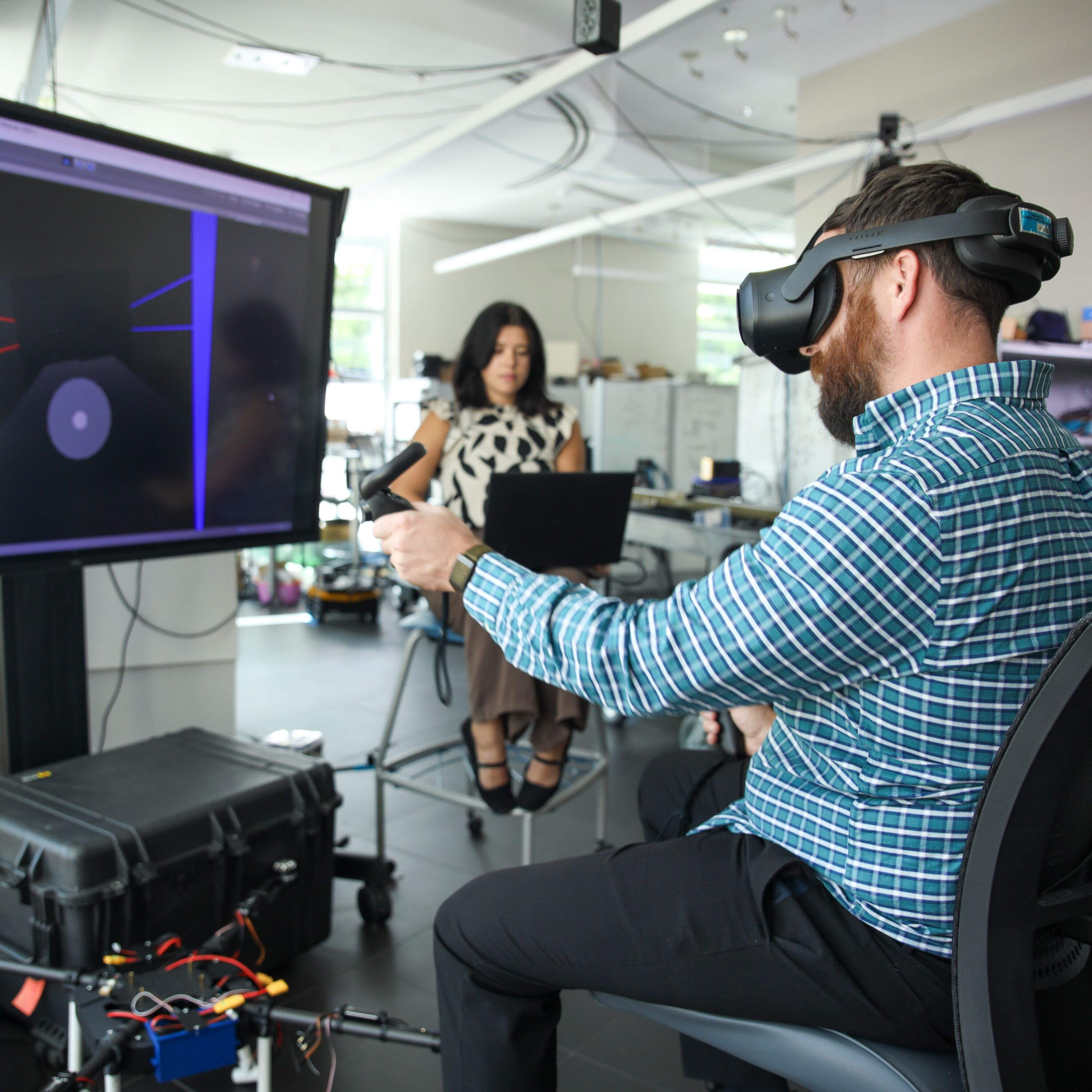
Virtual reality may speed up category learning
What the study tested
Researchers explored whether physical movement in VR can improve how quickly people learn to sort information into categories. Participants wore VR headsets and learned to classify striped objects by their angle and thickness.
Key finding
People using larger, whole-body motions—such as swinging a lightsaber or punching a response box—learned about 4 to 6 times faster than participants who only pressed buttons.
Why it matters
The result suggests VR could be useful for training and education, especially for tasks that involve pattern recognition or rapid decision-making. The hosts note that this is still an early lab finding, but it could eventually inform real-world training in fields like:
- TSA screening
- Medical image analysis
- Other sorting or classification tasks
The amygdala may help control memory formation
What scientists found
A separate study looked at people with epilepsy who already had electrodes implanted in their brains. While they played a memory game, researchers monitored activity in individual neurons in the amygdala.
Main insight
The stronger the amygdala neurons fired when participants viewed an image, the more likely they were to remember it later. This supports the idea that the amygdala is not just involved in emotion and fear, but also plays a direct role in forming visual long-term memories.
Why it matters
Researchers say this is important because it suggests the amygdala may act as a kind of control center for memory formation in humans, not just in animal studies. That could eventually help scientists understand or treat memory-related conditions such as:
- Alzheimer’s disease
- Epilepsy
- Other disorders involving memory loss
Astronomers find unexpected low-energy X-ray sources
What they discovered
Using data from NASA’s Chandra X-ray Observatory, astronomers re-examined a part of the X-ray spectrum that had mostly been ignored and found 84 new low-energy X-ray sources across several nearby galaxies.
What may be causing them
The likely sources are extremely dense systems, such as:
- A black hole pulling material from a companion star
- Two black holes in orbit around each other with surrounding matter shaped into a “zombie disk”
The episode uses playful Halloween imagery—vampires and zombies—to describe these cosmic systems.
Why it matters
These sources may help astronomers better understand:
- Extreme gravity and high-energy astrophysics
- How compact objects interact with stars
- Possible pathways to violent explosions, such as supernovae, that can be used to measure the universe’s expansion
Overall takeaways
- VR may do more than entertain: physical interaction in virtual environments could significantly speed up certain kinds of learning.
- The amygdala has a broader role than expected: it appears to help shape which visual experiences become long-term memories.
- New astronomy data can reveal hidden phenomena: even overlooked portions of the X-ray spectrum can uncover surprising cosmic systems.
Notable scientific publications mentioned
- Science Advances — VR movement and category learning
- Nature Neuroscience — amygdala and memory formation
- Nature Astronomy — newly found low-energy X-ray sources