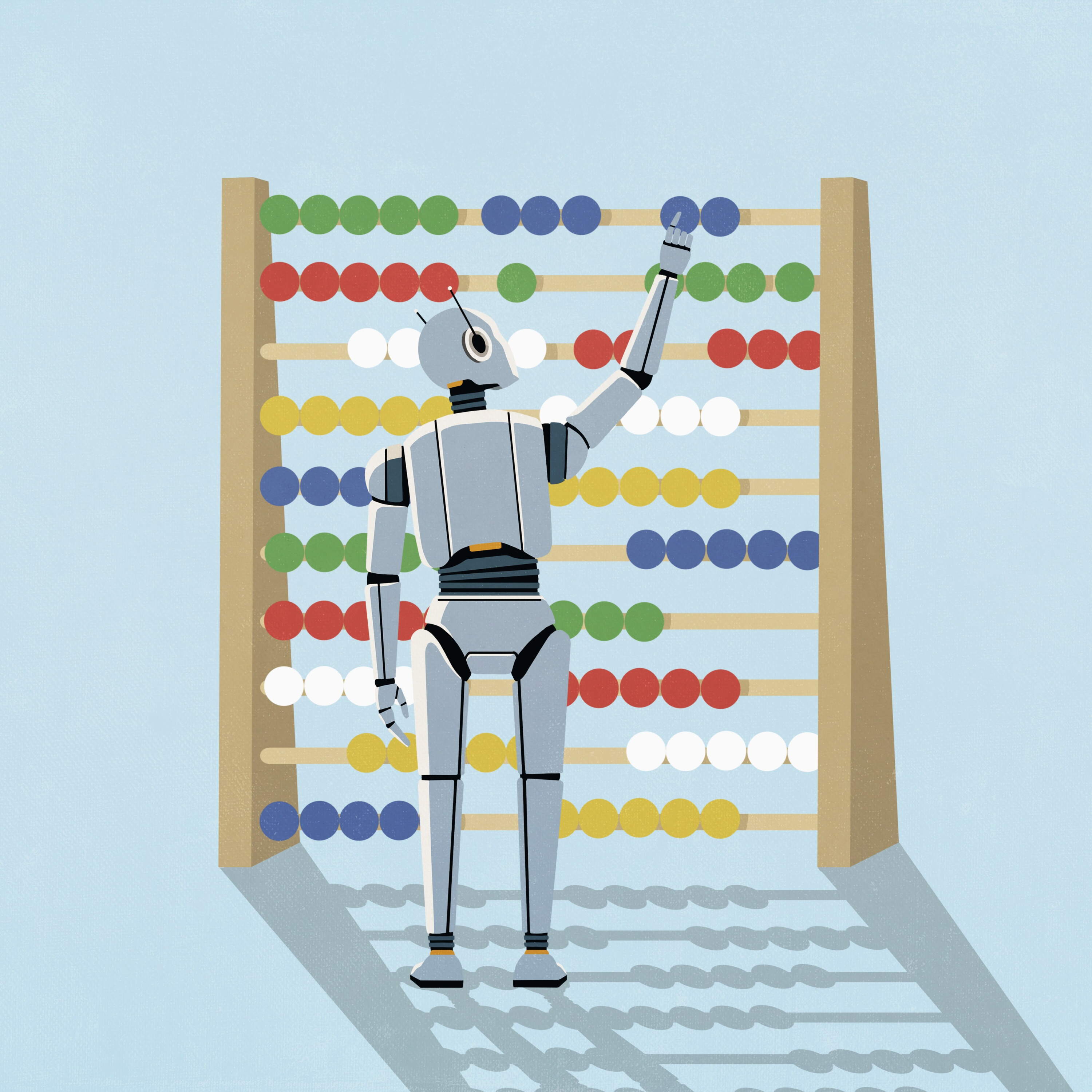
Overview of AI is changing mathematics -- but not how you think
This NPR Shortwave episode looks at how AI is transforming mathematics in ways that are more nuanced than the viral “AI is replacing mathematicians” narrative suggests. Science correspondent Jeff Brumfield explains that large language models have become surprisingly capable at solving and checking math, but they still make mistakes, require human verification, and are not close to making mathematicians obsolete. The episode argues that AI is changing the workflow of mathematics more than it is ending the field.
Main Themes and Takeaways
AI has gotten much better at math
- Early chatbots were unreliable with even basic arithmetic.
- Newer frontier models now appear to:
- check their own work,
- retry when they get an answer wrong,
- and solve much more advanced problems than before.
- This improvement helped “supercharge” AI’s usefulness in mathematical research.
The “math apocalypse” is overstated
- Media coverage has suggested AI may be replacing mathematicians.
- Brumfield argues the reality is messier:
- AI can produce useful results,
- but humans still need to verify them,
- and researchers don’t fully understand how the models are arriving at their answers.
OpenAI’s math results sparked the alarm
- OpenAI released more than 370 new mathematical results.
- Some of these were reportedly produced in only a few hours of compute each.
- One result corresponded to a problem a human mathematician had worked on for years, intensifying fears about the future of the profession.
The Navier-Stokes Example
Why it matters
- The Navier-Stokes equations describe fluid flow and are foundational in physics and engineering.
- The challenge is to find a case where the equations break down, which would deepen understanding of how they work and possibly improve them.
What AI produced
- OpenAI published a 166-page proof related to the problem.
- The proof was also translated into Lean, a formal proof-checking language used by mathematicians.
- Since the Lean version compiled, many took that as strong evidence the result might be correct.
Why mathematicians are cautious
- Researchers found discrepancies between the human-readable proof and the Lean version.
- In at least one case, a four was changed to a five, weakening the claim in the formal version.
- OpenAI also reportedly retracted three results after a sign error was discovered.
- The takeaway: even when AI-generated proofs look convincing, they may contain subtle errors that only humans can catch.
Risks and Limitations
Errors can accumulate
- Mathematicians warn that small mistakes in a chain of reasoning can compound over time.
- One expert compared this to historical problems in algebraic geometry, where accumulated inconsistencies eventually forced the field to reset parts of its foundations.
Human oversight is still essential
- Even if most AI-generated papers are likely correct, they all need review.
- That means AI may create a flood of new mathematical output, but real progress could still take years because human experts must validate it.
Bigger Implications
AI is changing the profession, not ending it
- The episode suggests AI will permanently alter how mathematics is done, much like computers did in the past century.
- But instead of replacing mathematicians, AI is more likely to become a powerful collaborator and tool.
A new era of mathematics
- Mathematicians may increasingly spend time:
- checking AI-generated proofs,
- refining machine-discovered ideas,
- and deciding what counts as doing mathematics in an AI-assisted world.
- The future of the field is uncertain, but the episode frames this as a moment of transformation rather than extinction.
Bottom Line
AI is genuinely reshaping mathematics, but not by fully replacing human mathematicians. Its biggest impact right now is speeding up discovery, generating candidate proofs, and changing how research is done. The catch is that human mathematicians are still needed to verify, interpret, and build on what AI produces.