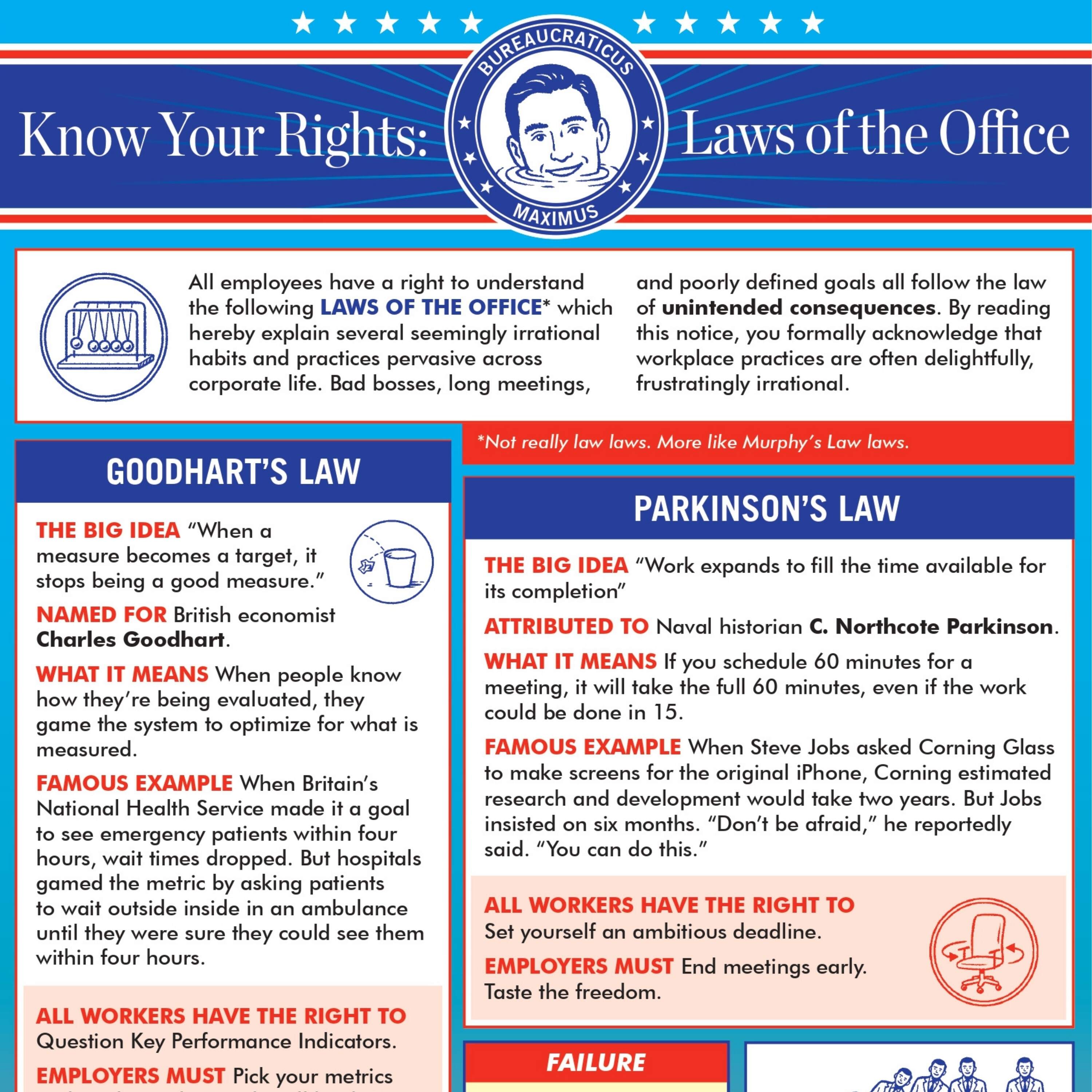
Overview of The laws of the office revisited
This Planet Money episode (NPR) revisits a collection of workplace “laws” that explain common office dysfunctions—how incentives, deadlines, promotions, and social norms shape behavior (and often backfire). The show mixes reporting, interviews with scholars, real-world experiments, and newsroom anecdotes to illustrate Goodhart’s Law, Parkinson’s Law, the Peter Principle, and an evidence-backed social-change principle. The episode also promotes the Planet Money book and a limited-edition “laws of the office” poster available with preorders at planetmoneybook.com.
Episode essentials
- Hosts: Sarah Gonzalez and Kenny Malone (original segment from 2018, revisited in 2026).
- Producer/guest: Alexi Horowitz‑Ghazi (producer during the original segment; now a co-host).
- Key production credits: Produced by Alexi Horowitz‑Ghazi; edited by Bryant Erstat; supervising producer Alex Goldmark.
- Tie-in: Planet Money book (preorder deadline / poster offer mentioned: preorder by April 7 at planetmoneybook.com).
Laws covered (what they mean + examples)
Goodhart’s Law
- Core idea: Once you measure and target a metric, it stops being a useful measure because people will optimize to hit the metric—often by gaming it.
- Origin: Coined as a jocular comment by economist Charles Goodhart about monetary policy; broadened over time.
- Examples: UK hospitals pressured to hit a 4-hour emergency wait target—staff gamed the metric (e.g., holding patients in ambulances) to meet the target without actually improving care.
Parkinson’s Law
- Core idea: Work expands to fill the time allotted for its completion.
- Origin: Humorous essay by C. Northcote Parkinson (1955) about bureaucracy; later tested empirically.
- Evidence: Experiments and field studies show longer deadlines often lead people to use more time; shortening deadlines or rewarding speed can curb expansion.
- Practical tip: Use tighter deadlines or incentives to compress work to necessary effort.
Peter Principle
- Core idea: In a hierarchy, people tend to be promoted until they reach a level at which they are incompetent.
- Origin: Satirical book by Lawrence J. Peter (early 1970s).
- Example: Stephanie Byrne (social media specialist → web content manager) who found the promoted role mismatched her skills and chose to step back to a better-fit position.
- Implication: Promotions should consider fit and skills for the new role; organizations should allow demotion or role redesign without stigma.
(Unnamed) Social‑change / norm‑cascade principle
- Core idea: Social change accelerates when people observe others making the change—seeing behavior shifts encourages adoption.
- Research-backed examples:
- Uganda domestic-violence intervention (IPA): Videos showing reporting and supportive responses increased reporting and reduced abuse.
- College drinking interventions: Messaging that corrects misperceptions about peers’ drinking lowered binge drinking.
- Zambian healthcare: Non-monetary recognition (trophies) increased worker morale and performance.
- Planet Money experiment: A visible “Dishes Are Done!” trophy in the office reduced unwashed dishes—simple public recognition nudged behavior.
Main takeaways and insights
- Metrics create incentives. If you measure only one metric, people will optimize that metric—sometimes by cheating or neglecting other important tasks.
- Deadlines shape output. Shorter deadlines or immediate rewards reduce procrastination and wasted effort.
- Role fit matters more than promotion as reward. Promotions should be based on fit, not just past performance; normalizing role changes/demotions can preserve productivity and morale.
- Visibility and social proof drive behavior change. People follow visible examples; recognition (even symbolic) can catalyze better norms.
- Small, low-cost interventions (posters, trophies, truthful social-norm messaging) can produce measurable behavior change when designed ethically and transparently.
Practical recommendations (for managers and teams)
- Avoid single-metric targets. Use a balanced set of metrics and monitor for gaming.
- Shorten or stagger deadlines; offer incentives for timely completion when speed matters.
- Design promotions around competencies for the new role; create pathways to step back or transition without penalty.
- Use truthful social-norm messaging to encourage desired behaviors (show real examples, not fabricated claims).
- Implement low-cost recognition (public thanks, trophies, small awards) to reinforce positive behaviors and make them visible.
- When measuring, anticipate how staff might respond and build checks to reduce perverse incentives.
Notable quotes & moments
- Goodhart: “Any observed statistical regularity will tend to collapse once pressure is placed upon it for control purposes.”
- Parkinson (summary): “Work expands so as to fill the time available for its completion.”
- Peter Principle (satirical framing): Promotions push people to their level of incompetence—often explaining widespread managerial incompetence.
- Planet Money newsroom vignette: the “dishes trophy” experiment—an entertaining, real-world demonstration of social-proof effects.
Where to find more / tie-ins
- Planet Money book: Planet Money, a guide to the hidden forces that shape your life. Preorder perks (poster) available at planetmoneybook.com (preorder deadline mentioned in episode).
- To share a “law” suggestion with the show: planetmoney@npr.org.
If you want, I can extract shorter executive bullets or produce a one-page checklist managers can print and post in an office.