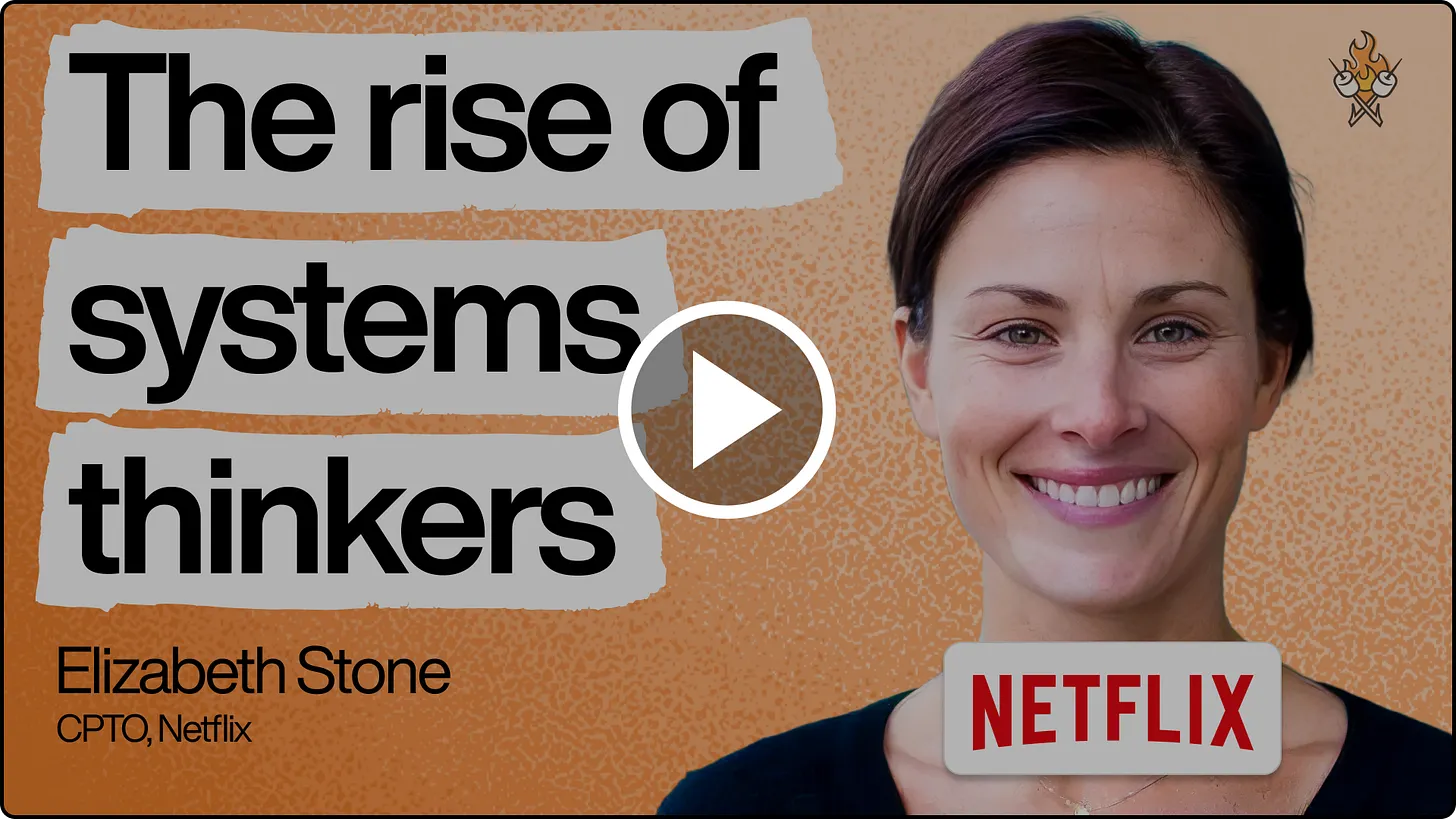
Overview of Why Netflix is betting on systems thinkers—not specialists—in the AI era
In this conversation, Netflix Product & Technology Officer Elizabeth Stone argues that AI is blurring traditional job boundaries, but not making craft or functional expertise obsolete. Instead, it’s shifting value toward people who can think in systems, move fluidly across disciplines, and still maintain high standards for quality, judgment, and accountability. She explains how Netflix is adapting its org design, hiring, and culture to a world where PMs, designers, engineers, and data scientists can all do more earlier in the process—while still needing strong specialists, clear guardrails, and “excellence as an operating system.”
Key takeaways
-
AI is expanding what individuals can do, but not eliminating roles.
- PMs, designers, and data scientists can now prototype, analyze, and shape ideas earlier before engineering gets involved.
- That creates more speed, but also more ambiguity about responsibilities.
-
Netflix sees the future as “systems thinking + craft excellence.”
- The company wants people who can zoom out, understand the broader business/system, and build reusable foundations.
- But deep skill still matters: great engineering, great data science, and great design remain scarce.
-
The company is intentionally building around AI fluency.
- Rather than rewriting every career ladder for AI, Netflix is creating an expectation that everyone should be comfortable using AI thoughtfully.
- AI use is now part of hiring, including coding interviews.
-
Netflix is using AI in more places than people realize.
- Beyond code generation, the biggest wins are in data analysis, distilling company knowledge, personalization, localization, trailers/artwork, and content production workflows.
-
Culture remains a major differentiator.
- High talent density, accountability, autonomy, low process, and willingness to take risks are still central.
- Netflix wants to avoid “fixing” problems with more process when what’s needed is better judgment and stronger talent.
How AI is changing roles at Netflix
More fluidity across functions
Stone says PMs, designers, and data scientists can now move further through the product lifecycle before engineering has to step in. That means:
- Faster prototyping
- Faster hypothesis testing
- More cross-functional experimentation
- Less waiting for a formal handoff
But she’s careful not to overstate the change. AI should help teams move faster, not encourage “everyone does everything” in production without review.
Functional expertise still matters
Even as responsibilities blur, Stone believes core craft still matters:
- PMs remain best at framing the right problem
- Data scientists remain best at interpreting data correctly and responsibly
- Engineers remain best at scalability, quality, and system design
- Designers remain essential for coherence, user experience, and brand integrity
Her view: AI changes the workflow, but not the need for excellence in each discipline.
What Netflix is hiring for now
1. Systems thinkers
Netflix wants people who can:
- Step back from the immediate task
- Identify assumptions
- Understand the broader business context
- Build reusable platforms and components
- Leave systems better for the next set of problems
She notes this is especially important for:
- Infrastructure and engineering, where common paved paths and shared building blocks matter more in an agent-driven world
- Design, where templates, design systems, and consistent experiences help prevent “Frankenstein” product experiences
2. AI fluency
Netflix is not making AI fluency a rigid, role-by-role checklist. Instead, it expects everyone to be:
- Open to experimentation
- Comfortable with changing tools
- Able to judge when AI is useful vs. when human review is needed
3. Less narrow specialization
Stone says the days of very narrow, deep specialization are more limited than before—though not gone entirely. The preference is increasingly for people who can:
- Work across back-end and front-end
- Stretch across disciplines
- Adapt quickly as tooling changes
Where AI is creating real value at Netflix
Internal knowledge and analysis
One of the biggest overlooked use cases is data analysis and knowledge distillation:
- Summarizing prior experiments
- Finding source-of-truth data quickly
- Surfacing insights from years of research and testing
- Turning scattered institutional knowledge into faster action
Content creation and production
Netflix is also applying AI across the entertainment pipeline:
- Promotional asset creation
- Localization, subtitles, and dubbing
- Pre-visualization for creators
- Post-production tools like relighting, reframing, reshoots, and dialogue adjustments
Stone emphasized that creators remain in control—AI is a tool to extend creativity, not replace it.
Personalization and discovery
Netflix’s early ML history, including the famous Netflix Prize, still matters. AI remains central to:
- Personalizing recommendations
- Matching the right title to the right person at the right time
- Helping users discover content in a growing catalog that now includes film, TV, games, live content, podcasts, and mobile experiences
Netflix culture: “excellence as an operating system”
Stone describes Netflix culture as a system designed to produce excellence, not just “freedom” or “low process” for its own sake.
Core ingredients
- High talent density: hire only exceptional people
- Autonomy with accountability: push decisions deep into the org
- Risk tolerance: expect mistakes, recover quickly
- Selflessness: optimize for Netflix members and business outcomes, not personal preference
- Resistance to unnecessary process: don’t reach for bureaucracy when the real issue is judgment or clarity
The Keeper Test
The “keeper test” remains a key management tool:
- If this person came to me today, would I fight to keep them?
- It’s used both to recognize outstanding performers and to address underperformance directly
- Stone says it’s less about being harsh and more about maintaining honest, high-quality feedback loops
How to build systems thinking
Stone’s practical advice is simple:
- For any task, zoom out one click
- Ask:
- What broader problem is this really solving?
- What assumptions am I making?
- Will this scale across use cases?
- How does this help my manager, my team, and the broader organization?
She also suggests asking: “What would make my manager’s job easier?”
That naturally pushes people to think beyond their own lane and operate more like systems builders.
What the future of entertainment looks like
Stone expects entertainment to become:
- More multiformat
- More personalized
- More interactive
- More immersive
- More seamless across devices and contexts
Netflix is already moving beyond traditional film and TV into:
- Live content
- Podcasts
- Mobile-first experiences
- Cloud games
- New vertical-video formats like Clips
Her broader point: entertainment won’t become one thing; it’ll become a set of experiences that vary by moment, device, and audience preference.
Human creativity still sits at the center
Despite all the AI excitement, Stone doesn’t believe entertainment becomes fully AI-generated. Her view is that:
- Humans will remain at the heart of storytelling
- Audiences still connect most deeply to human emotion and human performance
- AI will amplify creation, not replace the human core of narrative
Personal recommendations and quick hits
Books she recommends
- Into Thin Air by Jon Krakauer
- Liar’s Poker by Michael Lewis
Recent movie/TV pick
- Remarkably Bright Creatures — emotional, human-centered storytelling
Favorite product
- 8Sleep
Life mottos
- “Something good happens every day—watch for it.”
- “The last 5% of effort usually makes all the difference.”
Final takeaway
Elizabeth Stone’s core message is that AI is not collapsing the need for specialists—it’s changing where expertise shows up. The winners, especially at Netflix, will be people who can combine:
- Broad systems thinking
- Strong functional craft
- AI fluency
- Comfort with ambiguity
- Accountability for outcomes
In her view, that combination is what will keep Netflix moving fast without losing quality.