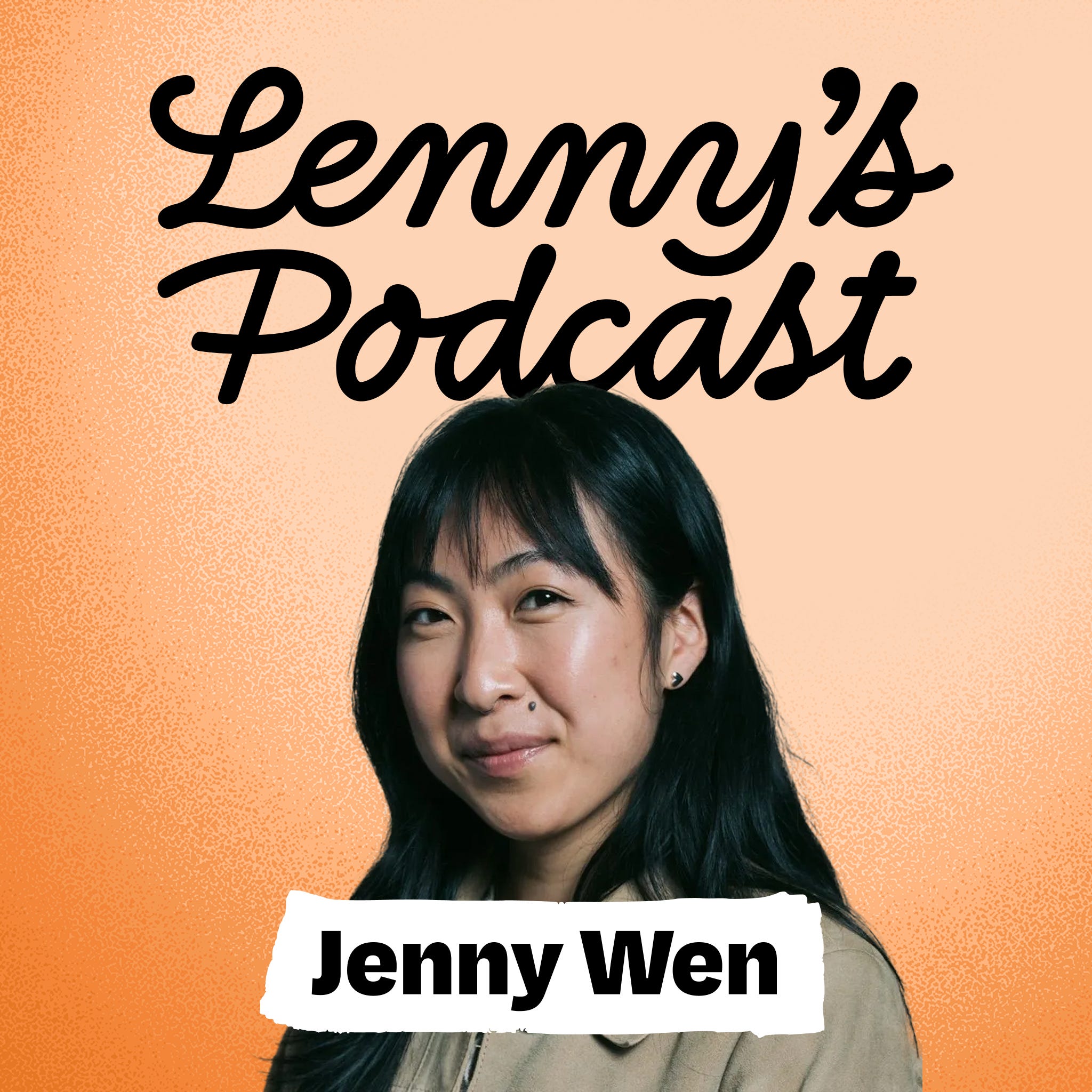
Overview of The design process is dead. Here’s what’s replacing it. (Lenny Rachitsky with Jenny Nguyen)
Jenny Nguyen (lead of design for Claude / Anthropic, formerly Figma, Dropbox, Square, Shopify) joins Lenny to explain how AI-driven engineering workflows are forcing a major shift in how designers work. The old multi-month/quarter design process — heavy on research, high-fidelity mocks and long-term vision decks — is giving way to two fast-moving modes: (1) design that supports rapid execution (pairing with engineers, last-mile polish, in-code prototyping) and (2) short-horizon vision work (3–6 months, prototype-first). Jenny shares concrete changes to daily work, tooling, hiring, leadership practices, and product strategy (illustrated via Anthropic’s Claude and Co-Work launches).
Major shifts in the design process
- The old “trust the process” model (long discovery → diverge/converge → polished mocks) is dying — accelerated by AI that lets engineers prototype and ship faster.
- Work splits into two primary modes:
- Execution-support (consulting, pairing, code polish, quick prototypes).
- Short-horizon directional vision (3–6 months; rapid prototypes rather than long decks).
- Practical change in time allocation (example from Jenny):
- A few years ago: ~60–70% mocking/prototyping, ~20% engineering collaboration.
- Today: ~30–40% mocking/prototyping, ~30–40% jamming/pairing with engineers, plus some implementation.
Two types of design work (how to think about them)
-
Supporting implementation
- Let engineers “cook” and ship quickly; designers unblock rather than gatekeep.
- Provide principles, components, code snippets, and pair on last-mile polish.
- Equip engineers with design-system code examples so future work requires less hand-holding.
-
Direction & vision
- Short, tactical visions and prototypes that point the org toward coherent product decisions.
- Focus on surfacing the right experiments and use cases rather than long-term rigid roadmaps.
Day-to-day at Anthropic (what Jenny actually does)
- Keep up with internal research and prototypes across many teams (big information flow).
- Prototype in code and in Figma; often pairs with engineers on implementation and PR-level polish.
- Reads internal signals to spot illegible but high-potential ideas; extracts UX/formatting patterns.
- Labels many releases as research previews and relies on fast iteration and visible response to feedback to maintain user trust.
Tools / AI stack Jenny uses
- Anthropic/Claude family: Claude chat, Claude Co-Work (for longer-running tasks & multi-step workflows), and a code-assist tool (referred to as Claude Code).
- VS Code (especially when pairing on front-end changes).
- Figma — still important for divergent exploration, multiple directions, and micro visual/interaction decisions.
- Other: Slack integrations, lightweight editors (e.g., iA Writer), and personal apps like Retro for reflection.
Key idea: designers now need a mixed toolkit — canvases for exploration (Figma) plus in-code prototyping and agent-driven tooling.
Product strategy & release philosophy
- Ship early where the value justifies it, mark things as research preview, and iterate visibly.
- Build trust through speed + responsiveness: show users you’re listening and improving quickly.
- Use prototypes with real models (not only mocked states) for AI-driven features — models are non-deterministic and usage reveals real cases.
Hiring: who succeeds in this new era?
Jenny’s three archetypes she’s hiring for now:
- Strong generalists (block-shaped / broad, with multiple 80th-percentile skills) — adaptable across PM/engineering/design tasks.
- Deep specialists (T-shaped with a very deep tip: e.g., visual design, interaction, or technical design) — to differentiate products.
- “Cracked new grad” — early-career people who are unusually curious, resilient, humble, and fast learners (less baggage, rapid adoption of new tools/processes).
Practical advice for candidates:
- Build things — ship projects, use modern tools, show curiosity.
- Show evidence of learning and applied work (not only theory).
Management, leadership & team culture
- Managers should consider rotating into IC roles (or at least do hands-on work) to empathize with changed workflows.
- Low-leverage tasks done by senior leaders can actually be high-leverage:
- Dogfooding, testing, filing bug PRs, and nitty-gritty work create credibility, context, and morale.
- Psychological safety + high standards:
- Encourage candid feedback (Jenny describes playful “roasting” among teammates as a sign of trust).
- Balance warmth and direct challenge (similar to “radical candor”).
- Managers now often need to combine people management with direct craft direction.
Frameworks & mental models
- Legibility framework (Evan Tana): considers whether founders and ideas are legible or illegible. Designers act like internal VCs: spot “illegible” ideas (frontier prototypes with energy but unclear form) and help make them legible via storytelling, UX, and product form factors.
- Use Slack/internal prototype feeds to find emergent concepts worth investing design attention in.
UI / interaction trends
- Chat UIs are not going away — they provide a general-purpose interface that scales with model intelligence and allow rich interaction.
- Expect hybrid surfaces: chat + interactive widgets (clickable components, to-do lists, previews). Jenny expects models to generate/assemble UIs more often.
- Co-Work approach: “Claude with hands” — shows tasks Claude is working on, exposes plans/to-dos, and makes the model’s work tangible and actionable.
Notable quotes (high-signal soundbites)
- “Don’t trust the design process” — the canonical long-process is dying.
- “You as a designer actually do not have the time to make these beautiful mocks anymore.”
- “We’re building trust through speed” — ship early as research preview, iterate visibly.
- “Someone still needs to be accountable for the decision.” — human judgment remains crucial.
Practical takeaways & recommended actions
For designers:
- Get comfortable pairing with engineers, prototyping in code, and doing last-mile polish.
- Maintain Figma for divergent exploration, but learn code-based tools/agents that can ship product-ready experiments.
- Choose one of three career shapes: strong generalist, deep specialist, or “cracked new grad” (learners who ship).
- Build a portfolio of actual shipped projects and experiments (not just static mockups).
For managers:
- Do occasional IC rotations or hands-on work to stay fluent with tools and team realities.
- Do visible, nitty-gritty tasks (dogfooding, bug PRs) to build credibility and culture.
- Cultivate psychological safety while holding high standards — candid culture aids rapid iteration.
For product teams:
- Prefer short horizons and prototype-first visions for AI features; rely on rapid real-user feedback.
- Label early launches as research previews and commit to visible iteration to preserve trust.
Where to follow / hiring note
- Jenny online: X/Twitter — @jenny_wen (she encourages sending product feedback for Claude/Co-Work).
- Anthropic / Claude design team is hiring and actively experimenting — they look for people excited by frontier tools and comfortable with rapid change.
If you want to understand the current and near-future shape of product design in AI-driven organizations, this episode is a concise field guide: expect more in-code prototyping, tighter designer-engineer partnership, shorter product horizons, and a premium on adaptability and judgment.