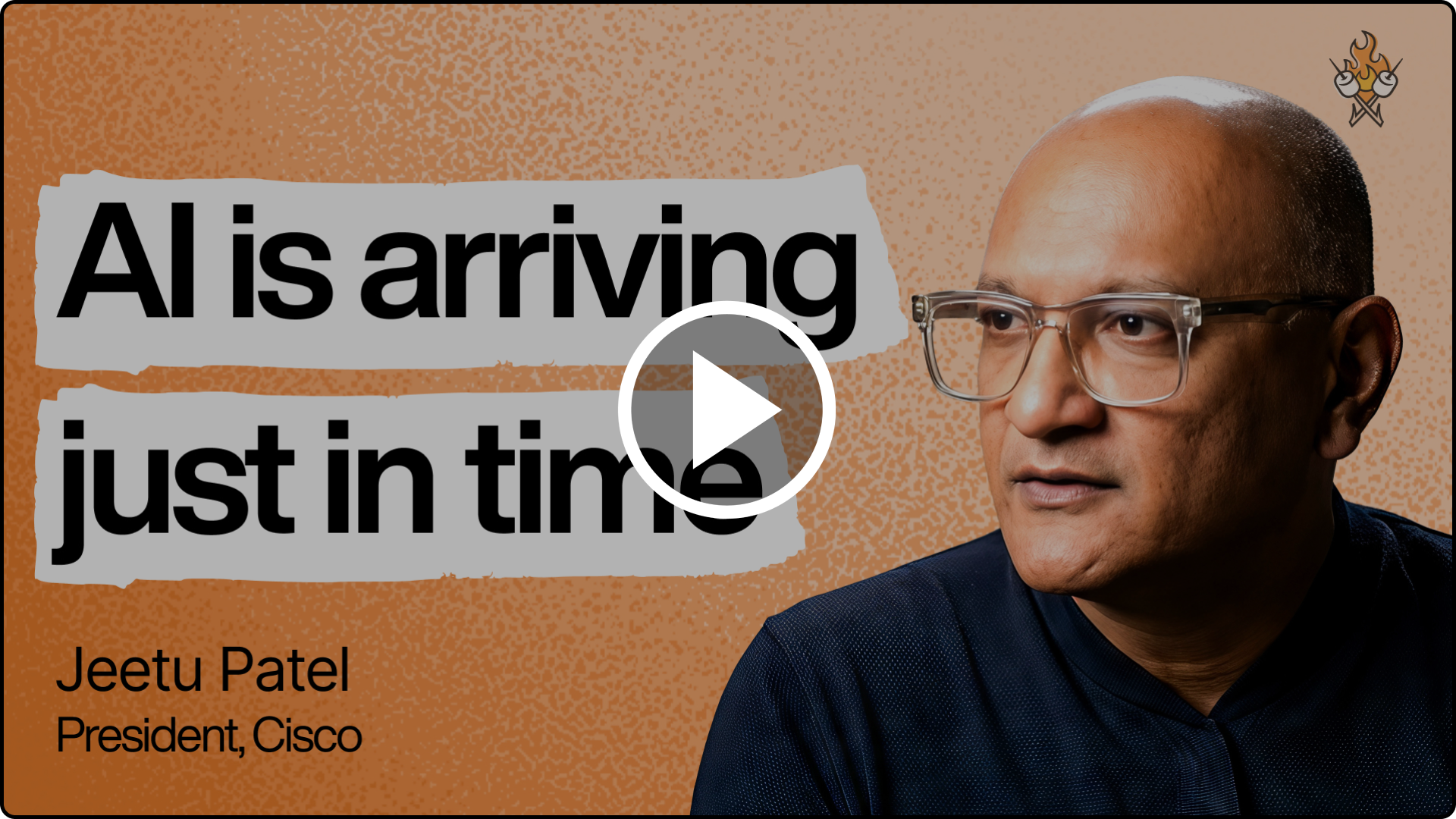
Overview of "AI is critical for humanity’s survival: Cisco president on the AI revolution" (Lenny Rachitsky with Jeetu "G2" Patel)
This episode features Jeetu (often called “G2”) Patel, President and Chief Product Officer at Cisco, in a wide-ranging conversation about AI’s societal impact, how Cisco transformed into an AI-first infrastructure company, leadership lessons at scale, and practical frameworks for product and company strategy. The discussion mixes big-picture predictions (demographics, existential value of AI) with very tactical advice for leaders, builders, and parents navigating rapid AI-driven change.
Key takeaways
- Jeetu argues AI is a megatrend — foundational and unavoidable — and could be essential to addressing demographic shifts (declining birth rates, aging populations). He says, provocatively, “survival of humanity depends on a successful AI.”
- Cisco’s transformation to “AI-first” required clear choices: define non-negotiables, double down on what works, move from silos to a platform mindset, and embrace open ecosystems (partner even with competitors if it helps customers).
- Three constraints that could hold AI back — and where Cisco plays: compute/network infrastructure, trust/safety, and a data gap (need for enterprise & machine-generated data).
- Practical leadership guidance: own the company story, minimize communication “lossiness,” establish trust so critique can happen publicly, be explicit in appreciation, and embrace stamina over intellect.
- A simple, high-priority six-part framework for company success: timing, market, team, product, brand, distribution (in descending order of importance).
Cisco, AI infrastructure, and the industry view
- Cisco’s role: networking/optics, security, observability, and data platforms that enable GPUs and servers to act as coherent, geographically distributed AI clusters.
- Why this matters: modern ML training requires synchronized GPUs across servers, racks, and even data centers — that network fabric and reliability are Cisco strengths.
- Industry constraints Cisco focuses on:
- Infrastructure shortage: compute, power, bandwidth.
- Trust deficit: hallucinations and non-determinism require safety, explainability, and secure systems.
- Data gap: future differentiation will depend on proprietary enterprise, synthetic, and machine-generated data.
- Example: Cisco connected clusters hundreds of kilometers apart so GPUs can train as one coherent system.
Strategy & product principles (practical frameworks)
- “Right to win” / permission to play: enter markets where customers logically expect you to compete and where you have routes to market. Focus resources where your platform or distribution gives an advantaged return.
- Platform vs. silo: move from many disconnected $40M business silos to a loosely-coupled but tightly-integrated platform — consistent customer experience and compounding value when products are combined.
- Open ecosystem: be comfortable partnering with competitors if it helps customer success; ecosystem success feeds back to you.
- Megatrend vs. hype cycle heuristic: if a use case is easy for most people to understand (low friction explanation), it’s more likely a megatrend. If you need a PhD to see it, it may be a niche/hype.
- Operate with future cadence: “Fast forward six months” — plan for rapid change, especially in AI.
The six-part startup/company checklist (stack-ranked)
In descending order of importance — if you don’t have all six you have low odds of winning, but timing is most critical:
- Timing — control the least, but it dominates outcomes.
- Market — big enough and addressable in scalable chunks.
- Team — complementary, well-rounded, and persistent.
- Product — the soul; ethically important to build something great.
- Brand — hard to resurrect once lost.
- Distribution — you must reach customers at scale.
Leadership lessons & ways of working at scale
- Own the narrative: leaders must personally tell the company’s story to avoid “packet loss” (communication loss) through layers of management.
- Public critique, private reassurance: Jeetu rejects “praise in public, criticize in private” as a rule; instead, build trust so critical debate can happen publicly and use private time to reassure and support.
- Stamina trumps intellect: persistence, hunger, and staying power beat raw intellect over the long run.
- Infrastructure mindset: infrastructure teams often get blame, not glory — orient on ecosystem/customer outcomes, not credit.
- Be explicit with praise and appreciation — don’t assume others know how you feel.
Societal & human-centered perspectives
- Demographics: declining birth rates and an aging population create labor shortages for caregiving and other roles; Jeetu contends AI could be necessary to prevent large-scale suffering.
- AI as teammate: shift from tool mentality to teammate framing (AI augments capacity and generates original insights beyond the human corpus).
- Safety & guardrails: while optimistic, Jeetu emphasizes rigorous safety, ethics, and alignment work; AI’s objectives must remain in service of humans.
Personal stories, parenting & values
- Parenting approach: expose kids to technology but prioritize values (kindness, humility, work ethic); he found his daughter emotionally mature and values-driven at 15.
- Don’t insulate children completely from current tech realities; teach values while enabling tech fluency.
- Personal anecdote: working in hospitality (Sizzler) taught communication, eliminated stuttering for him, and provided formative life lessons.
Notable quotes
- “Survival of humanity depends on a successful AI.”
- “Innovation is a choice — every minute of every day you choose to be creative or not.”
- “Stamina trumps intellect.”
- “If you don’t own the story, you can’t expect 20,000 sellers to tell it.”
- “When timing is wrong, it doesn’t mean scrap the idea; sometimes you put it on ice.”
Quick practical recommendations (action items)
For leaders:
- Decide what’s non-negotiable and double down. When an experiment works, go all-in.
- Own and frequently tell the company story yourself; eliminate layers between you and the frontline.
- Shift org incentives toward platform thinking and cross-product integration.
- Invest in trust, guardrails, and explainability for AI products. For product people:
- Ask: Do we have permission to play and a route to market? If not, don’t dilute effort.
- Use the six-part checklist (timing → distribution) when evaluating new ideas.
- Prepare teams for AI’s cadence — think in 3–6 month horizons.
Lightning-round notes (short bullets)
- Books he recommends: The Innovator’s Dilemma + Innovator’s Solution (Clayton Christensen), and The Hard Thing About Hard Things (Ben Horowitz).
- Favorite product impact: large LLM tools (ChatGPT, Gemini, Claude, Grok) — they accelerated his ability to step into the Cisco CPO role.
- Life motto: “Stamina trumps intellect.”
- Where to find him: active on LinkedIn; he uses it to share learnings publicly.
Who should listen and why
- CEOs, VPs of Product/Engineering, and enterprise leaders: for practical guidance on transforming large organizations to be AI-first and platform-oriented.
- Founders and product managers: for the “right to win” framework and the timing/market/team product hierarchy.
- Anyone interested in the intersection of AI, infrastructure, and society: for big-picture thinking about AI’s role in demographics, economy, and human flourishing.
Summary: the episode combines a strong AI optimism grounded in infrastructure reality and safety concerns, with highly actionable leadership and product strategy advice for operating — and winning — at massive scale in the age of AI.