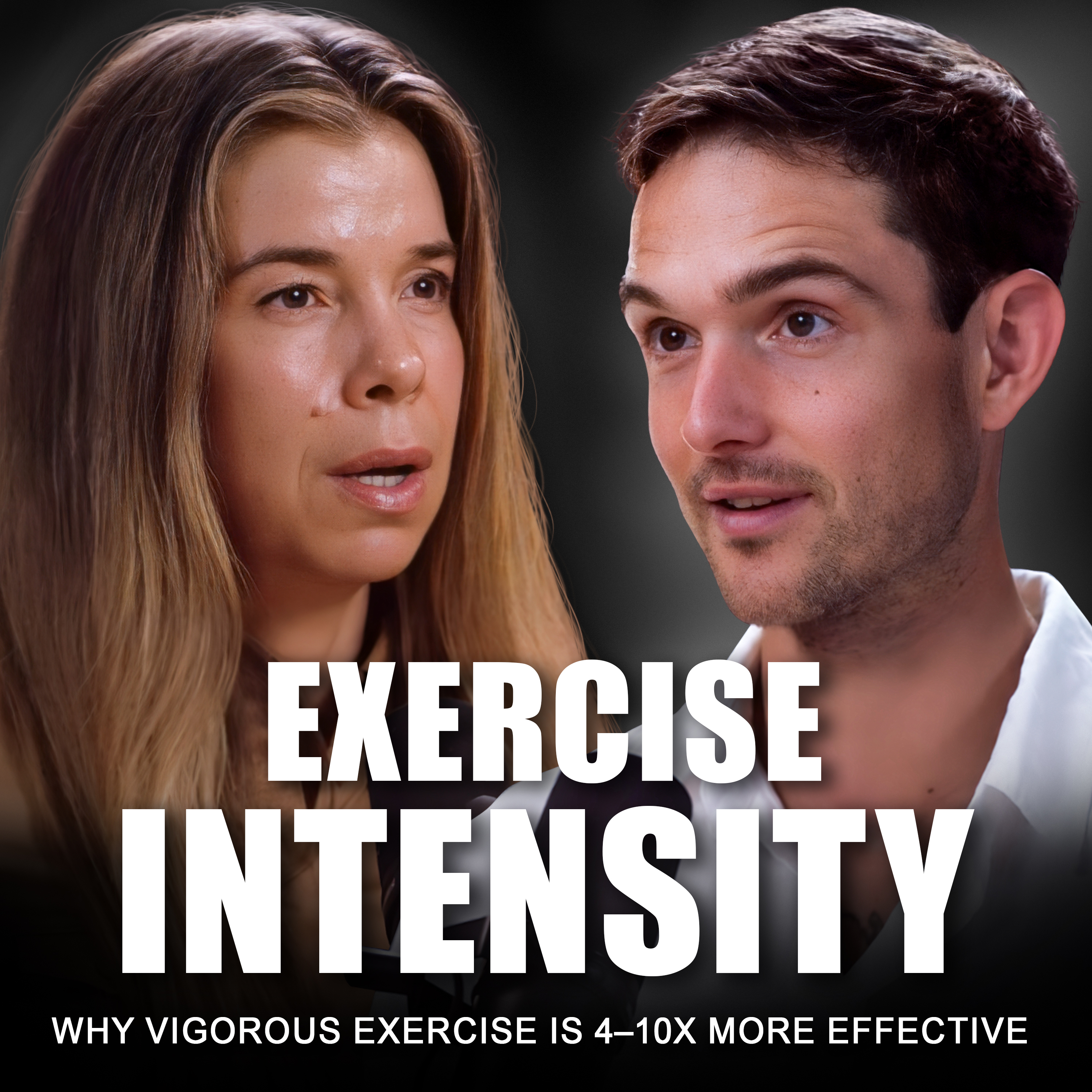
Overview of FoundMyFitness — Episode #108: The Best Type of Exercise for Longevity
Rhonda Patrick, Ph.D., and endurance physiologist Brady Homer review a Nature Communications study that used wrist-worn accelerometer data from the UK Biobank (n ≈ 73,000; ages 40–79; ~8‑year follow up) to re-evaluate the common guideline that 1 minute of vigorous activity = 2 minutes of moderate activity. The paper computed “health equivalence ratios” (minutes of moderate or light activity required to match 1 minute of vigorous activity) for outcomes including all‑cause mortality, cardiovascular events and mortality, type 2 diabetes incidence, and cancer outcomes — and found vigorous activity to be far more potent than previously assumed.
Key findings
- The old 1:2 vigorous:moderate rule (based on METs/calorie burn) does not reflect hard health outcomes.
- Health equivalence ratios (vigorous : moderate) from the paper (approximate):
- All‑cause mortality: 1 min vigorous ≈ 4 min moderate
- Cardiovascular mortality: 1 min vigorous ≈ 7–8 min moderate
- Major cardiovascular events (MACE — heart attack, stroke, cardiovascular death): 1 min vigorous ≈ 5.4 min moderate
- Type 2 diabetes incidence: 1 min vigorous ≈ 9.4 min moderate (~10×)
- Cancer mortality: 1 min vigorous ≈ 3.4–3.5 min moderate
- Vigorous vs light activity (approximate): 1 min vigorous ≈ 53–94 min light for most outcomes; for cancer mortality the paper reported ≈156 min light.
- Short, unstructured bouts of vigorous activity (VILPAs — vigorous intermittent lifestyle physical activity) and planned “exercise snacks” showed large benefits: e.g., ~3–9 min/day of VILPAs associated with 40–50% lower risk for some outcomes in observational analyses (one women’s study reported 3.4 min/day → 45% lower MACE risk, 67% lower heart failure risk).
- Dose–response: benefits increase with more moderate or vigorous activity up to a point; vigorous activity shows a stronger dose response than light activity, which plateaus quickly.
Study design & limitations
- Data source: UK Biobank accelerometer subcohort (~73k adults 40–79), wrist accelerometer worn 1 week at baseline, ~8 years follow‑up.
- Objective measurement: accelerometers logged movement intensity every 10 seconds (movement-based intensity, not heart rate).
- Outcomes: all‑cause mortality, cardiovascular mortality, MACE, type 2 diabetes incidence, cancer incidence and cancer mortality.
- Controls: excluded participants with baseline disease and outcomes occurring in first 12 months to reduce reverse causation/healthy‑user bias.
- Important limitations:
- One‑week accelerometer snapshot may not fully capture long‑term habitual activity (though strong associations imply relevance).
- Accelerometers measure motion, not physiological load (heart rate); some activities (static strength work) may be misclassified but were generally captured as “purposeful movement.”
- Observational — cannot prove causality; residual confounding possible.
- Intensity thresholds used by the device may differ from heart‑rate zones commonly discussed (vigorous here roughly zone‑2+ / above moderate).
Mechanisms that help explain vigorous activity’s outsized benefits
- Vascular/endothelial adaptations: higher intensity → greater shear stress → improved endothelial function, nitric oxide/prostacyclin release, less arterial stiffness, better resistance to atherosclerosis (likely explains strong CV benefits).
- Cardiac and respiratory: higher intensity elevates cardiac output and stroke volume → increases VO2max (cardiorespiratory fitness is a strong longevity predictor).
- Metabolic: vigorous efforts generate lactate and stronger muscle contractions → increased GLUT4 translocation and sustained glucose uptake, improved insulin sensitivity; stimulates PGC‑1α and mitochondrial biogenesis.
- Cancer biology: increased blood flow shear stress can damage/clear circulating tumor cells; exercise also modulates immune surveillance and anti‑cancer signaling.
- Muscle/falls prevention: vigorous activity recruits type II (fast) fibers, which preserve power and reduce fall/fracture risk in older adults — relevant to all‑cause mortality.
- Anti‑inflammatory hormesis: high‑intensity bouts produce transient inflammatory signals that trigger a durable anti‑inflammatory adaptation.
Practical implications — what to do with this info
- Reframe the minute: “a minute is not a minute.” Intensity matters — 1 minute vigorous ≠ 1 minute light.
- Priorities:
- Include some vigorous (purposeful zone‑2+ or above) activity regularly. It doesn’t always mean maximal HIIT; “vigorous” in guidelines includes brisk purposeful movement, running, cycling, playing actively, or high‑effort bodyweight sets.
- Use short bursts across the day (VILPAs) and exercise snacks: 1–3 minute vigorous efforts multiple times daily are powerful and time‑efficient.
- Combine with resistance training to preserve type II fibers and muscle mass/strength.
- Structured HIIT or protocols such as the Norwegian 4×4 once or a few times per week can maximize VO2max and vascular benefits — but program progressively and allow recovery.
- For people with limited time: even a few minutes/day of vigorous movement (or repeated 1–3 min bouts) can produce large health gains.
- Wearables and apps:
- Current trackers often score by steps or calories; algorithms and public health messaging should pivot to emphasize intensity and equivalence ratios rather than just duration or step counts.
- Use devices as tools, but interpret intensity contextually (movement vs heart rate). Encourage devices to credit short vigorous bursts appropriately.
Special populations
- Older adults: can and should incorporate progressive vigorous efforts (even chair squats, stair sprints, short brisk walking intervals). Vigorous activity counteracts cardiac stiffening, preserves power and reduces fall risk.
- Women: can perform vigorous and HIIT workouts safely if energy balance and recovery are managed. Risks (e.g., menstrual disruption) usually arise from chronic under‑fueling/overtraining, not from doing HIIT per se.
- Children: encourage sports and vigorous play. Cardiorespiratory fitness in youth links to cognitive and academic benefits.
- Athletes: training goals differ (performance vs general health). Balance high‑intensity training with recovery; athletes can still benefit from VILPAs/exercise snacks for health but must integrate them into periodized plans.
Actionable recommendations (quick checklist)
- Aim to include at least some vigorous (zone‑2+ or above) activity each week — even short bouts count.
- Add VILPAs/exercise snacks: 1–3 minute vigorous efforts several times daily (e.g., brisk stair climbs, sprint to catch transit, 60–180 sec bodyweight circuits).
- Do resistance training 2+ times/week to protect muscle mass and type II fibers.
- Include 1–3 structured higher‑intensity workouts weekly (HIIT or 4×4 type sessions) depending on fitness and goals.
- Use wearables wisely: track intensity and short bursts, not solely steps or calories.
- Progress gradually, fuel adequately, and consult a clinician if you have significant comorbidities.
Limitations, unanswered questions, and caution
- Observational associations are compelling but not definitive proof of causation.
- One‑week device capture may misrepresent long‑term habits for some individuals.
- Accelerometer thresholds differ from heart‑rate definitions; individual effort perception matters.
- Optimal frequency/intensity mix for specific individuals (and long‑term safety at extreme frequencies) needs further RCT evidence.
- Algorithmic changes to consumer wearables and public health guidelines will take time and careful translation.
Resources mentioned
- How to Train According to the Experts guide — howtotrainguide.com (free; updated content on exercise snacks, VILPAs, creatine, and longevity).
- Brady Homer — book: VO2max Essentials; Substack “Physiologically Speaking”; social handle @b_homer.
- FoundMyFitness premium & topic pages (foundmyfitness.com; premium membership for expanded content).
Summary takeaway: objective accelerometer data suggests vigorous (purposeful) movement is far more time‑efficient for reducing risk of mortality, cardiovascular events, and type 2 diabetes than previously estimated by the simple 1:2 rule. Short bouts (VILPAs/exercise snacks) and modestly increased intensity in daily movement produce large, clinically meaningful benefits — especially for cardiovascular and metabolic outcomes.