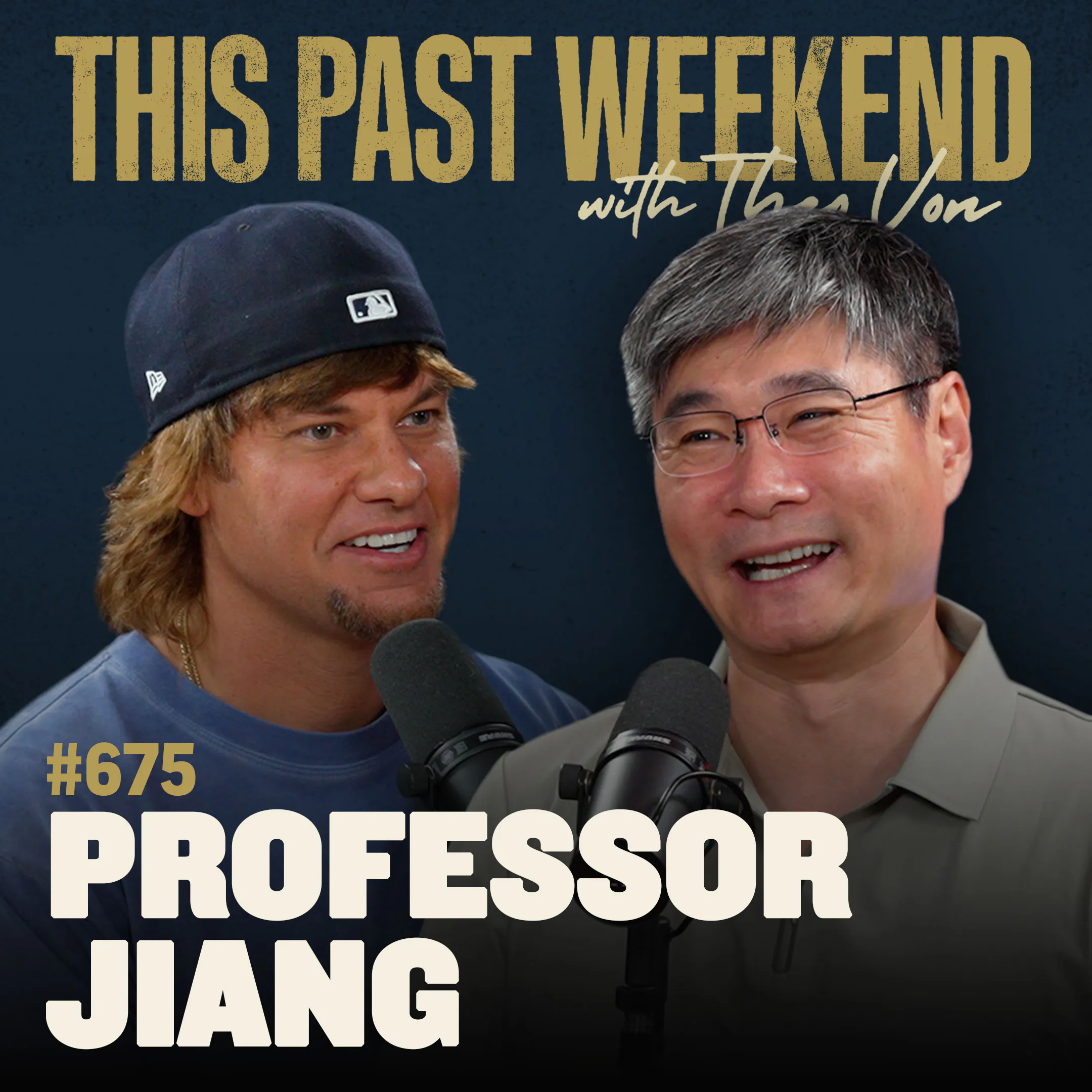
Overview of #675 - Professor Jiang
Theo Von interviews Professor Jiang/Zhang, a Chinese-born high school teacher and YouTuber behind Predictive History, about geopolitics, prediction-making, and the idea that major world events can be understood through game theory. The conversation ranges from the Iran-Israel conflict and the Strait of Hormuz to the U.S., China, Ukraine, secret societies, Zionism, and the possibility of a broader world war. The episode mixes serious geopolitical speculation with Theo’s usual humor and a few personal, reflective moments about family, faith, and staying grounded.
Main Topics Discussed
Geopolitics and War
- The guest argues that the conflict involving Iran, Israel, and the U.S. is part of a much larger escalation that could pull in more countries.
- He emphasizes the strategic importance of choke points like:
- the Strait of Hormuz
- the Bab al-Mandab Strait
- the Suez Canal
- He claims disruptions in these areas could cause:
- oil shortages
- famine
- trade collapse
- refugee waves into Europe
- broader regional instability
Game Theory as an Analysis Tool
- The guest explains his worldview through game theory:
- identify the players
- understand their incentives
- predict the most likely moves
- He says this framework helped him make online predictions, including:
- Trump winning in 2024
- a war involving Iran
- Theo repeatedly challenges and fact-checks parts of the guest’s framing, especially when claims are exaggerated or speculative.
Israel, the “Clean Break” Memo, and the “Greater Israel” Theory
- A major portion of the discussion focuses on the 1996 Clean Break memo, which the guest treats as a roadmap for later Middle East policy.
- He argues that:
- some Israeli and American policymakers pursued a strategy of destabilizing neighboring states
- the Iraq War, Libya, Syria, and pressure on Iran fit that pattern
- He connects this to an extreme vision of a “Greater Israel” project.
- He distinguishes this from Judaism as a whole, but his explanation leans heavily into conspiratorial framing and should be treated as the guest’s interpretation, not established fact.
Secret Societies and Transnational Capital
- The guest claims the world is effectively run by transnational capital and secret networks rather than by nation-states alone.
- He references:
- the Rothschilds
- Freemasons
- Jesuits
- the Jewish diaspora
- the Illuminati
- His argument is that these networks operate through:
- information advantage
- infiltration
- coordination
- Theo pushes back at points, but the guest continues to frame global events as the result of hidden coordination.
China, America, and Global Stability
- The guest says China is primarily interested in:
- trade
- stability
- avoiding major war
- He describes a possible “grand bargain” between the U.S. and China:
- Taiwan accommodation
- reduced U.S. presence in East Asia
- continued economic interdependence
- He argues the U.S. is in imperial decline and could face internal instability or civil conflict.
Notable Personal and Human Moments
Family and Faith
- Theo and the guest repeatedly shift back to themes of:
- love
- marriage
- children
- God
- meaning
- The guest shares a personal story about meeting his wife when he was broke, depressed, and uncertain about his future.
- He says that family and spiritual life are the antidotes to geopolitical doom-scrolling and fear.
Humor and Light Moments
- Theo and the guest riff on:
- Los Angeles street life
- dog mess on the sidewalk
- heaven as a workplace
- “gay” jokes and awkward first-date questions
- The conversation stays playful even while covering dark subject matter.
Biggest Takeaways
- The guest believes the world is entering a dangerous period of escalating conflict and systemic instability.
- He sees global politics as a strategic game driven by incentives, hidden networks, and long-term plans.
- Theo often grounds the discussion with skepticism, humor, and reminders about faith, love, and keeping perspective.
- A recurring message of the episode is that, regardless of geopolitics, people should focus on:
- family
- laughter
- spirituality
- personal responsibility
Context and Caveats
- Several of the guest’s claims are speculative, highly contested, or conspiratorial.
- Theo and the transcript include occasional fact-checking and corrections, especially around historical and geopolitical details.
- The episode works best as a mix of:
- geopolitical commentary
- conspiracy-style analysis
- comedic back-and-forth
- personal reflection