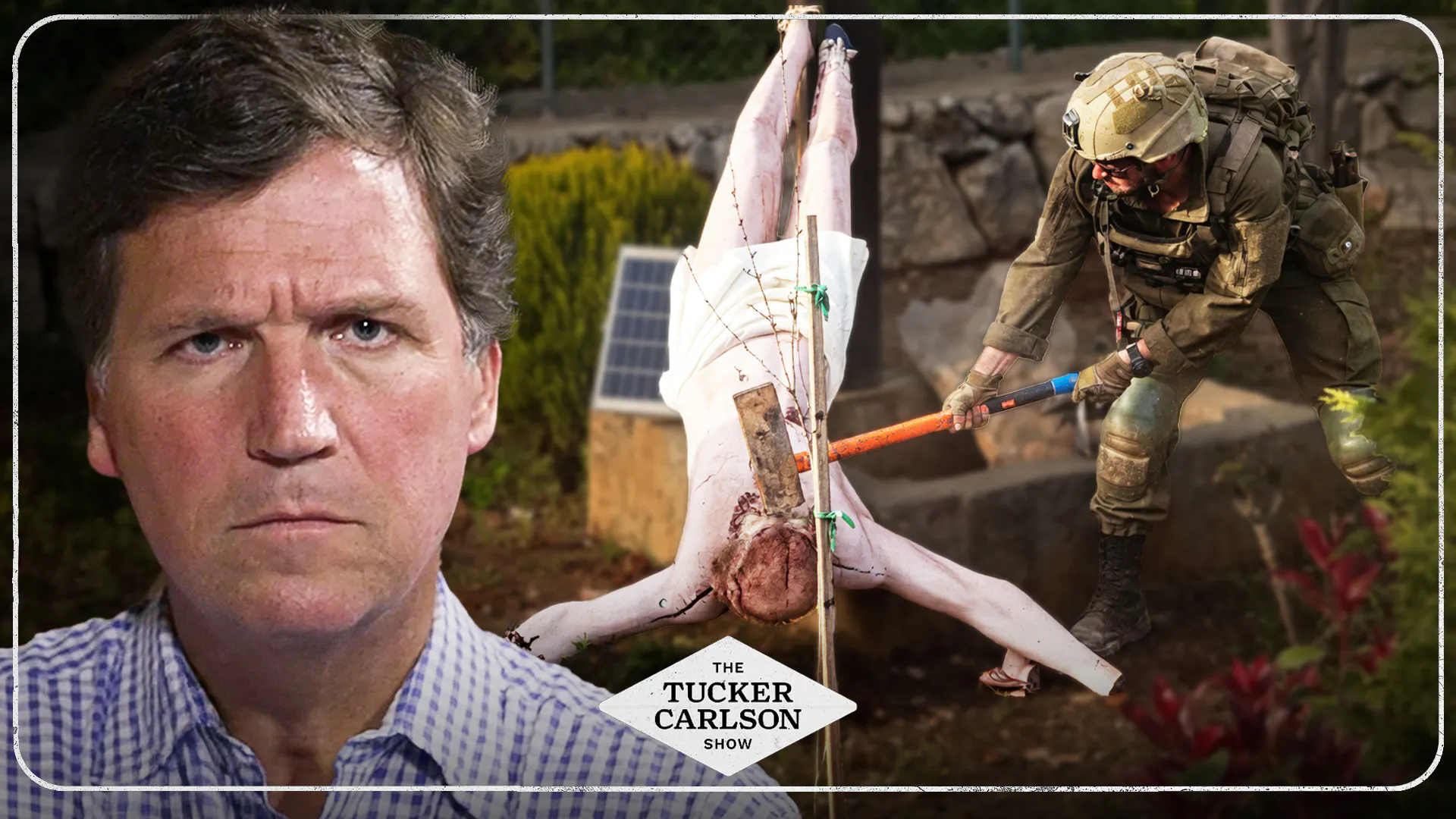
Overview of Tucker Responds to Israel’s Attacks on Jesus Christ & the American Christian Leaders Supporting It
Tucker Carlson (Tucker Carlson Network) responds to viral footage showing an Israeli soldier smashing a statue of Jesus and uses that incident to criticize Israel’s treatment of Christians, the response of Israeli and American media (notably CBN), and the uncritical support U.S. evangelical leaders provide to Israel. The episode includes a long interview with Alice Kasia, an Arab Christian activist from the West Bank (Al-Makhrur/Bethlehem area), who describes repeated settler violence, land confiscation, demolitions, harassment, and what she calls a campaign to push Christians out of the West Bank.
Main takeaways
- The sledgehammer photo of an Israeli soldier destroying a Jesus statue was initially dismissed as fake but later confirmed to be real; Carlson argues the media and Israeli officials focused on optics rather than root causes.
- Carlson claims there is a recurring pattern — and sometimes policy — of Israeli forces or settlers desecrating Christian sites and intimidating Christian communities across Gaza, the West Bank, Lebanon and Jerusalem.
- He criticizes American evangelical leaders and outlets (e.g., CBN) for downplaying these incidents and for providing uncritical political and financial support to Israel.
- Alice Kasia recounts personal experiences: home and business demolitions, shootings/assaults, thefts, court/administrative manipulation, and organized efforts (she attributes to settler groups and the Israeli civil administration) to dispossess Christian Palestinians.
- Carlson urges American Christians to pressure U.S. politicians (e.g., contact members of Congress and Speaker Mike Johnson) to reconsider unconditional aid and support until Israeli abuses against Christians are addressed.
Topics discussed
- The viral image of an IDF soldier smashing a statue of Jesus and the immediate online/official reactions.
- Israeli media framing and the punishment of the soldier and the filmer (focus on damage control).
- CBN’s response urging caution and rejecting broad judgments about Israel from a single image.
- Allegations of repeated Israeli attacks and desecrations against Christian sites: Gaza church bombings, a mother and daughter shot in a churchyard, tank damage to Christian statues in Lebanon, and assaults on Christian clergy in Jerusalem.
- The role of settler organizations, private companies (named Hemanuta in the transcript), and Israeli political figures (named Smotrich and others) in land-taking and settler expansion.
- The relationship between American Christian Zionism and continued U.S. funding for Israel.
- The interview with Alice Kasia: land confiscation, legal forgery claims, demolitions, police behavior, settler violence, forced displacement, and grassroots resistance.
Interview: Alice Kasia (summary)
- Background: Arab Christian born in Jerusalem (claims Israeli citizenship and French citizenship), active in defending family land in Al-Makhrur (near Bethlehem).
- Key claims:
- Settlers repeatedly vandalize Christian symbols (statues, crosses), spit on priests, and physically assault Christian residents.
- Her family’s home and restaurant were demolished multiple times; they rebuilt repeatedly before final demolition.
- She alleges organized land-theft using forged documents and manipulation of archives and legal processes via private companies and the civil administration.
- Settler groups — sometimes recruiting minors or foreigners (she names the U.S., Ukraine, Eastern Europe) — are used to seize lands; police often side with settlers and arrest Palestinians who resist.
- Christian Zionist organizations in the West allegedly offer relocation assistance (jobs, visas) that she characterizes as facilitating ethnic cleansing rather than protecting Christians in situ.
- She reports roughly 200 Christian families left Bethlehem since October 7 (the war surge) due to instability and pressure.
- Activism: She founded a local organization (Seyvil Mahrur) to resist land theft non-violently and provide community development to stop emigration.
Notable quotes (as presented in the episode)
- “The problem with an IDF soldier smashing the face of Jesus is not that he smashed the face of Jesus. The problem is that he got caught on camera.”
- “If an American soldier burned a Torah scroll, that would be the biggest story in the world.” (used to contrast reactions)
- Alice Kasia: “They hate Christians because they know that Christianity is more like… we are very peaceful.”
- Carlson on evangelical leaders: “If they were to speak up… and call their member of Congress and say, I cannot support this, I am not going to stand by… that might actually get us somewhere.”
Evidence and claims presented (what the show asserts)
- The statue-smashing incident (initially labeled fake by some outlets) is presented as real and confirmed.
- Carlson cites multiple alleged incidents:
- Israeli shells/bombing of churches in Gaza and killings of Christian worshippers (including a mother and daughter).
- An Israeli tank destroying a St. George statue in Lebanon (2024).
- A cited study (by a “Jewish Israeli group”) reporting 61 physical assaults against Christians in Jerusalem in “2025” (transcript uses that year — verify independently).
- Claims of administrative/legal manipulation (forgery of land records) and collusion between private companies, settler organizations, and elements of Israeli civil/military administration.
- Allegation that American evangelical support materially underwrites Israeli actions because U.S. funding helps provide the Israeli state with resources.
Recommendations & action items Carlson suggests
- American Christians and church leaders should gather information from Christians who actually live under occupation (East Jerusalem, West Bank, Gaza, Lebanon, Syria) rather than rely on government-organized tours.
- Call elected officials — especially members of Congress and leaders like Speaker Mike Johnson — and demand accountability or condition aid on protection for local Christians.
- Evangelical leaders should reassess unconditional political support for Israel if abuses of Christians are occurring and unaddressed.
Caveats, context & how to verify
- The episode mixes firsthand testimony (Alice Kasia) with reporter commentary and political argumentation. Tucker Carlson is a partisan media figure; his framing is rhetorical and aimed at a particular audience.
- Some factual claims should be independently verified before being treated as established fact (e.g., casualty details, specific legal-forgery evidence, the 61-assaults figure and the year cited).
- To corroborate incidents and legal claims, consult:
- International human-rights NGOs (Human Rights Watch, Amnesty International).
- Local Christian community organizations and clergy in Jerusalem/West Bank/Gaza.
- Independent journalism from multiple outlets (AP, Reuters, BBC, regional reporters).
- Official Israeli Defense Forces and Israeli government statements (for denials/explanations) and court/administrative records where available.
Conclusion
This episode uses a viral image of a soldier smashing a Jesus statue as a springboard to argue that Israeli forces and settlers systematically target Christian symbols and communities, and that American evangelical support for Israel has blinded many U.S. Christians to that reality. The show pairs Tucker Carlson’s critique of media and evangelical leaders with a detailed, personal interview with an Arab Christian activist who alleges persistent settler violence, land theft, and administrative manipulation. Many of the serious claims made here merit independent verification through human-rights reports, local sources, and official records before drawing firm conclusions.