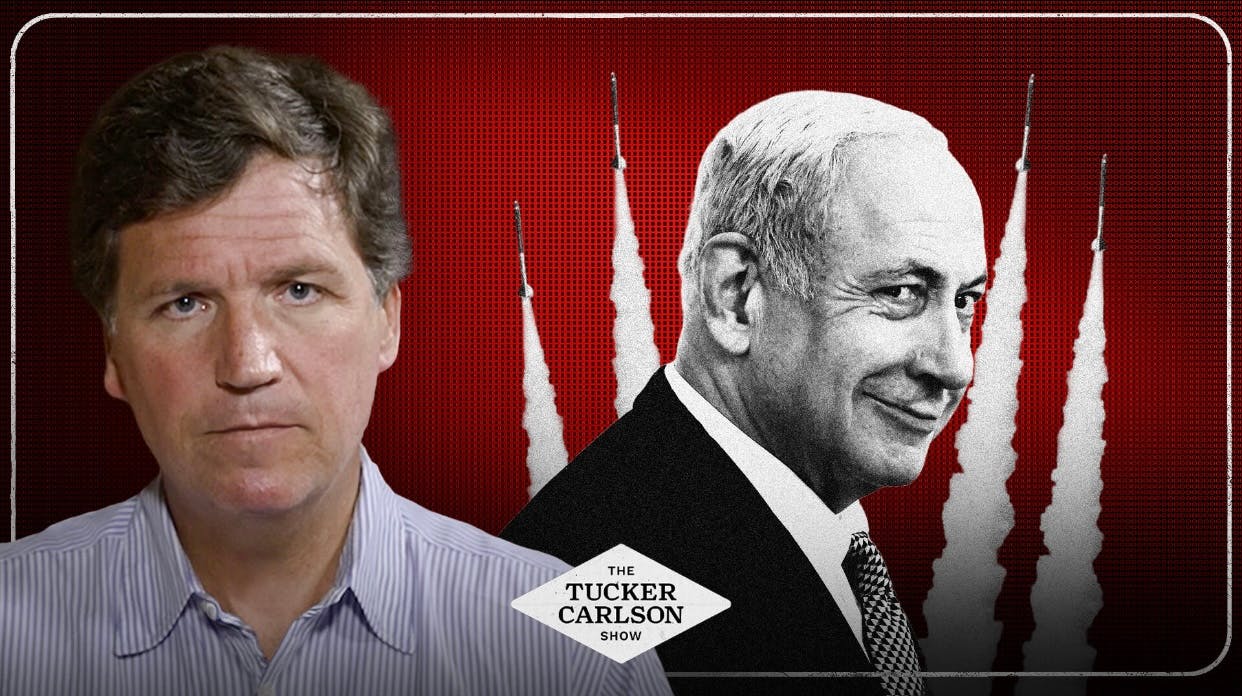
Overview of Newest War Developments: AI Bombings, Advice to Trump, and the Nuclear Agenda to Reset the World
Tucker Carlson (Tucker Carlson Network) interviews Colonel Douglas Macgregor about the unfolding Middle East war that began roughly a week earlier. The conversation covers censorship and information gaps, the complexity of U.S.–Israel–Iran dynamics, risks of escalation (including nuclear proliferation), the possible role of autonomous weapons in civilian casualties, geopolitical and economic fallout (energy and the petrodollar), and what the U.S. should do next.
Main takeaways
- Information is heavily restricted: governments in the region and social media platforms are suppressing footage and casualty reports, making facts difficult to verify.
- The conflict is not simply a conventional war to stop nukes; Macgregor frames it as a civilizational/epochal struggle driven by religious and secular “eschatologies” that aim to reshape the global order.
- Israel is acting as a co-equal partner with U.S. decision influence; that complicates U.S. options and may increase likelihood of prolonged conflict.
- Civilian harm (e.g., a girls’ school bombed twice) raises urgent questions about targeting rules and whether autonomous/AI-directed weapons played a role.
- Prolonged conflict will accelerate nuclear proliferation (states will seek deterrence) and could catalyze de-dollarization pressures (BRICS, gold-backed alternatives).
- Economic shocks are already visible via energy markets; wider economic damage (high oil prices, market crashes) is plausible if the straits and Gulf infrastructure remain contested.
- Ground invasion by the U.S. is unlikely; escalation will most likely be by air and sea, with the danger of open-ended bombing campaigns.
- Macgregor advises urgent diplomacy via neutral intermediaries (he suggests India’s Prime Minister Modi) to create an off-ramp and halt escalation.
Topics discussed
- Censorship and information reliability: social media takedowns, government restrictions, and opaque casualty reporting.
- Nature of the war: theological/secular motivations, long-term aims to “reset” the world order rather than limited objectives like non-proliferation.
- U.S.–Israel relationship: Israel’s influence on U.S. policy and the danger of the U.S. being drawn into projects not aligned with American national interest.
- Civilian casualties and targeting decision-making: questions about human vs. autonomous targeting, “double-tap” strikes, and the moral/strategic necessity of transparent investigations.
- Nuclear proliferation: the war’s incentives for regional states to acquire nukes; Pakistan/Turkey/Saudi dynamics referenced.
- Economic and global order consequences: disruptions to oil flows, damage to ports/refineries, risks to the petrodollar, BRICS and a possible gold-backed currency alternative.
- Military realities: limitations of modern force projection, difficulties of ground intervention, and the erosion of U.S. conventional readiness.
- Domestic political implications: loss of credibility for diplomacy, potential structural strains on U.S. institutions and public trust.
- Practical civilian advice: prayer, personal preparedness (food, water, energy), and skepticism of official narratives.
Notable quotes and arguments
- “Wars like that are fundamentally theological in nature — that's theology whether it's secular or religious.” — framing the war as ideological/eschatological.
- “You can't kill the children of your enemies…if you wake up in mourning and you live in the kind of country that thinks it's okay to kill not simply military officers but their daughters, that country is not worth fighting for.” — on honor, civilian casualties, and legitimacy.
- “If a nuclear weapon is used it will be by Netanyahu and his government, not us.” — Macgregor’s assessment of nuclear risk (he hopes Trump would not follow).
- Concern that autonomous weapons or AI might be making targeting decisions, producing catastrophic mistakes (example: the girls’ school hit twice).
Evidence gaps and uncertainties
- Many claims and impressions are based on partial reporting and are acknowledged as potentially wrong. The pair emphasizes the opacity of on-the-ground data.
- Assertions about who ordered or influenced U.S. decisions (e.g., Israeli pressure on Trump) are interpretations; verification requires transparent investigation.
- The exact role of autonomous systems in any specific strike is unconfirmed; it’s presented as a plausible hypothesis needing examination.
Risks and likely consequences highlighted
- Long-term regional destabilization and increased risk of nuclear proliferation (states seeking deterrence).
- Economic shock via higher oil prices, supply-chain disruption, and financial market turmoil; threat to the role of the dollar/petrodollar system.
- Geopolitical realignment: increased cohesion among BRICS or alternative currency arrangements; deeper Russian/Chinese involvement if the conflict widens.
- Erosion of U.S. diplomatic credibility if negotiations were used as cover for military action.
- Moral and political costs at home if the U.S. is seen to tolerate or hide civilian-targeting errors.
Recommendations and action items (for policymakers and the public)
For policymakers:
- Immediately investigate fatal strikes involving civilians; be transparent about findings and accept responsibility for mistakes.
- Suspend or restrict autonomous lethal targeting until strict human-in-the-loop rules are guaranteed and independently audited.
- Appoint/accept neutral mediators with credibility to both sides (Macgregor suggests India’s PM Modi) to seek an off-ramp.
- Reassess alliance dynamics; ensure U.S. national interests are not subordinated to a partner’s expansionist aims.
- Avoid open-ended bombing campaigns with no clear strategy or achievable end-state.
For the public:
- Demand transparency and independent verification of casualty reports and targeting decisions.
- Press elected officials for a clear national-strategy rationale and for congressional oversight (resupply, authorization, objectives).
- Prepare at household level for supply or energy disruptions (basic emergency preparedness).
- Stay skeptical of social-media narratives but insist on the right to uncensored, verifiable information.
Short summary conclusion
Tucker Carlson and Colonel Douglas Macgregor argue the current war is opaque, potentially driven by ideological projects to reshape global order, and already producing serious strategic, humanitarian, and economic consequences. They call for immediate transparency about civilian strikes (and the role of AI), for a neutral diplomatic off-ramp (Modi suggested), and for public and political scrutiny to prevent open-ended escalation that could trigger nuclear proliferation and broad geopolitical and economic damage.