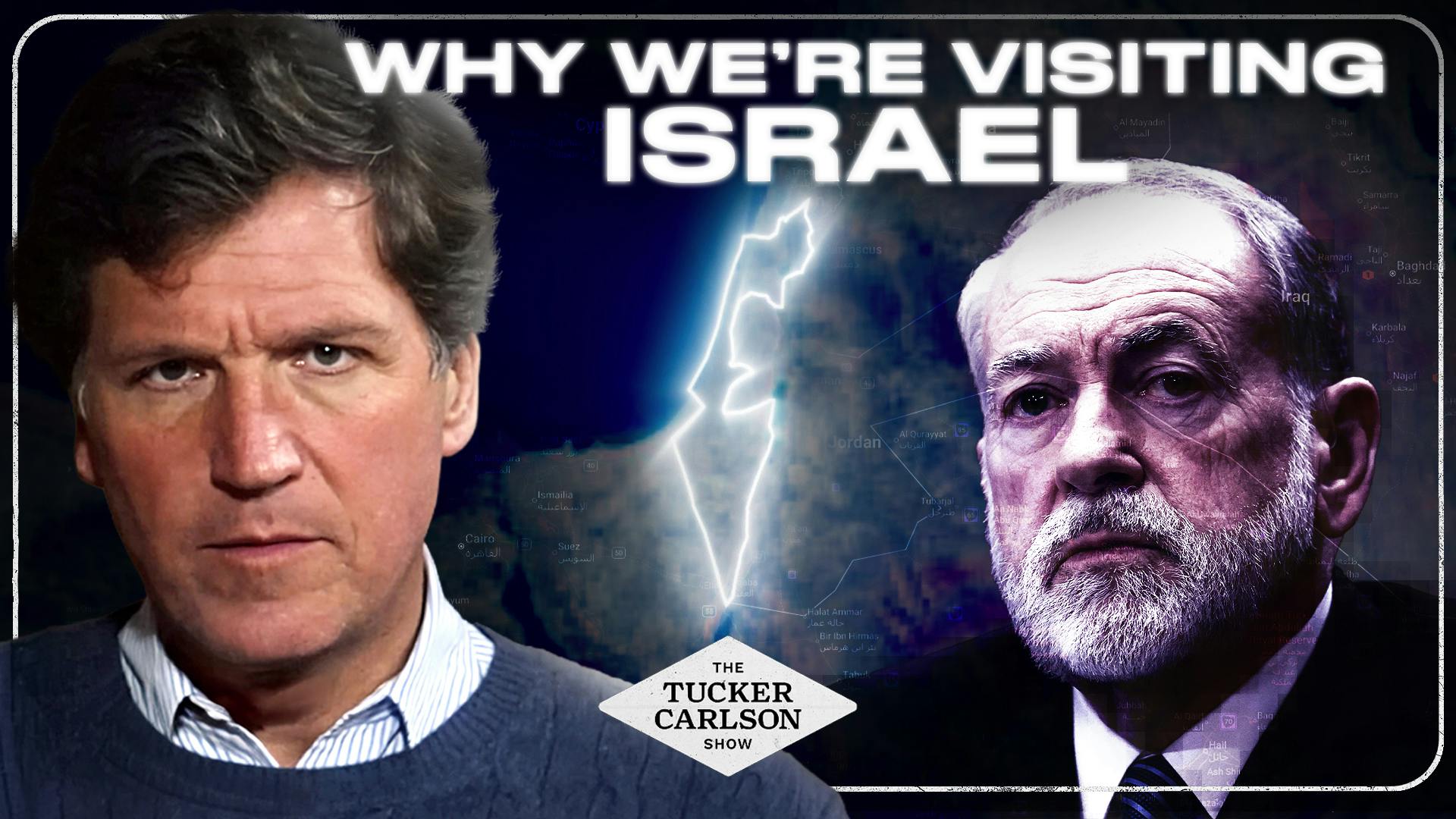
Overview of Israel’s Purging of Christians From the Holy Land and the Plot to Keep Americans From Noticing
This Tucker Carlson Network episode examines how U.S. political and evangelical support for Israel is affecting indigenous Christian communities in the Levant. After framing the wider debate—how questions about U.S.–Israel policy are shut down as “anti‑Semitic”—Carlson travels to speak with Fares (Fares) Abraham, a Palestinian‑American Christian minister from Beit Sahur (a majority‑Christian town outside Bethlehem). Abraham recounts first‑hand experiences of settler violence, military checkpoints, population squeeze‑out, and the broader theological and political dynamics of Christian Zionism. The episode argues that many American evangelicals and political leaders either ignore or enable policies that threaten the 2,000‑year continuous Christian presence in the Holy Land and calls for a different, Jesus‑centered Christian posture: truth‑seeking, justice, and peacemaking.
Key people and context
- Host: Tucker Carlson (Tucker Carlson Network). Framing: free inquiry vs. censorship via accusations of antisemitism.
- Guest: Fares Abraham — Palestinian‑American Christian minister from Beit Sahur; founder/leads Levant Ministries; Liberty University alumnus; identifies as a Christian, U.S. citizen, and Palestinian.
- Background place: Beit Sahur — historic Christian village adjacent to Bethlehem (shepherds’ fields, long continuous Christian presence).
- Broader context: West Bank (also discussed in terms of the terms “West Bank” vs. “Judea and Samaria”), post‑1967 occupation, Israeli settlements, checkpoints and movement restrictions, Gaza conflict and its humanitarian impact.
Main claims and themes
- Middle Eastern Christians are nearly absent from U.S. public discussion about Israel/Palestine, despite being the region’s original Christians and under existential pressure.
- Settlement expansion and associated infrastructure (roads restricted to settlers, checkpoints, water/resource control, walls, motion sensors) are being used to take land and squeeze Palestinian communities — including Christian villages — toward disappearance.
- Settler violence occurs frequently and often with impunity; Israeli authorities rarely hold settlers accountable while Palestinian perpetrators (when accused) are quickly prosecuted and families punished collectively.
- U.S. evangelical funding and political advocacy — including organized pastor delegations and large donations — have materially supported settlements and helped normalize policies that harm Palestinians, including Christians.
- Christian Zionism (as described by Abraham) substitutes the gospel’s centrality in favor of privileging a modern Israeli state or a territorial reading of biblical promises; this theological lens can be used to justify or ignore dispossession.
- Jesus’ teaching, Christian theology, and the New Testament (e.g., fulfillment in Christ, expansion of Abrahamic promises to all nations) argue against privileging land/ethnic entitlement over justice, reconciliation, and protection of the vulnerable.
- Rebuilding a “Third Temple” (at Al‑Aqsa/Temple Mount site) is presented as a dangerous and unnecessary eschatological political goal; Abraham rejects it theologically.
Notable evidence, anecdotes and examples (from the interview)
- Beit Sahur: majority Christian village with continuous Christian presence for centuries; now encircled by settlements that restrict growth and movement.
- Personal trauma: Abraham recounts witnessing an Israeli soldier shoot his mother when he was a child; she survived. He cites other murders and injuries of Christians (e.g., Salam Misleh shot through a window while at dinner).
- Psychological trauma: a child fainting after being forced through an armed checkpoint on the way to school; families waiting weeks for water trucks while nearby settlements have full lawns and swimming pools.
- Gaza: churches and civilians hit in the 2023–24 conflict; Abraham names specific civilian casualties (e.g., an elderly pianist from Gaza Baptist Church, and others) and describes bombings of church buildings.
- Data point cited: an Israeli human‑rights organization documented 111 attacks on Christians in 2024 (guest uses this to illustrate scale).
- Financial claim: Abraham refers to organizations raising and spending roughly $3.5 billion to support settlement expansion (funding from evangelical donors mentioned).
Note: some organization names in the transcript were unclear/mis‑transcribed; the summary avoids inventing specific institutional names beyond widely used descriptions (Israeli human‑rights groups, settlement funding organizations).
Theological and political arguments
- Theology: Abraham argues Jesus fulfills and reinterprets promises to Abraham — the covenant’s scope and meaning become spiritual, universal, and centered on Christ (not a modern ethno‑territorial state). He rejects replacement theology but also rejects a theology that equates biblical promise with unconditional political/land claims that dispossess others.
- Christian Zionism: portrayed as a theopolitical movement that treats the contemporary Israeli state or the land as the primary locus of God’s promises, sometimes overriding concerns for justice, peace, and the living Christian witness in the land.
- Politics: international law and UN resolutions view settlements as built on occupied land; Abraham highlights how U.S. political gestures (e.g., moving embassies, politicians planting trees in settlements) reinforce settlement narratives and obscure Palestinian suffering.
Recommendations and calls to action (from the guest and host’s framing)
- Listen to and include Middle Eastern Christians in U.S. and Western conversations about Israel/Palestine.
- Avoid reducing complex policy debate to accusations that automatically shut down inquiry (e.g., weaponizing “anti‑Semitism” to silence critics).
- Prioritize humanitarian aid, reconciliation, and protecting vulnerable religious minorities (funding peacebuilding, Christian community support rather than settlements).
- Encourage American churches and leaders to apply biblical ethics consistently: condemn violence against innocents, seek justice, and avoid theology that justifies dispossession.
- Hold political leaders and religious influencers accountable when their actions, rhetoric, or funding materially harm local populations.
Memorable quotes / lines
- Host: “There’s something about true things that just sound different... The truth rings differently from lies.”
- Guest (Fares Abraham): “We are empire survivors.”
- Guest: “Justice is not a zero‑sum game.”
- Guest (theological): “Jesus is the locus of the land… We are the temple of God.”
- Guest on Christian responsibility: “Loving Israel does not mean ignoring the suffering of the Palestinians.”
Caveats and context readers should note
- The episode reflects the host’s critical framing of pro‑Israel responses in U.S. politics and media; it advances personal testimony and moral argument rather than an exhaustive legal or historical account.
- Several names and institutional references in the transcript were unclear or possibly mis‑transcribed; where possible the summary uses verified, generic descriptions (e.g., “Israeli human‑rights organization documented…”) rather than uncertain proper nouns.
- Claims such as the dollar amounts raised for settlements or specific casualty stories should be cross‑checked against independent reporting and human‑rights documentation for use in research or policy work.
Bottom line
This episode’s central thrust: indigenous Christian communities in the Holy Land—some of the earliest continuous Christian populations—are under acute demographic, economic, and physical pressure from settlement expansion and associated policies. The show urges American Christians and policymakers to listen to those communities, reexamine theological and political commitments that may be enabling dispossession, and shift toward justice‑focused, reconciliatory policies and practice.