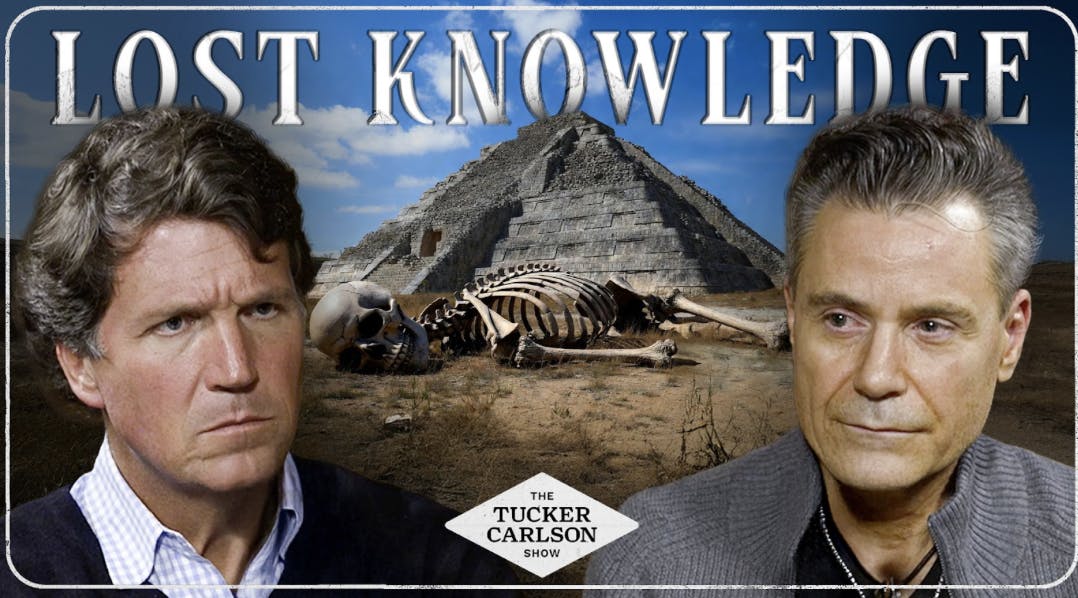
Overview of Giants, Pyramids, the CIA’s Psychic Spies and The Ancient Civilizations More Advanced Than Ours
This episode (Tucker Carlson Network) is a wide‑ranging interview with a guest identified as “AJ.” It challenges mainstream archaeology, physics and history, arguing that there is systematic suppression of evidence for advanced ancient technologies, giant humans, and anomalous phenomena. Topics move from the Great Pyramid and Gobekli Tepe to alleged government secrecy (Tesla files, suppressed inventors), psychic‑spy programs (Project Stargate), and underwater/ancient structures around the world. The conversation mixes cited research, anecdote, and speculative hypothesis while emphasizing the speaker’s conviction that “we don’t know” much about many parts of prehistory.
Key topics covered
- Main thesis: mainstream science and institutions often close off or dismiss uncomfortable questions about the past; curiosity and openness to alternative hypotheses are needed.
- Alternative archaeology and censorship:
- Criticism of the hostile reaction to researchers like Graham Hancock and to alternative interpretations of sites.
- Allegations that officials (e.g., Zahi Hawass) and governments limit access to Egyptian sites and artifacts.
- The pyramids (particularly the Great Pyramid of Giza):
- Claim: no mummies have been found inside the Great Pyramid; “sarcophagus” in king’s chamber not sized for a mummy.
- Questions about dating and construction methods; skepticism that ramps/pulleys fully explain the precision and scale.
- Materials: use of rose granite (piezoelectric properties) and Tura limestone (insulator) — suggested by guest as part of an electrical/sonic functional design rather than a mere tomb.
- Ground‑penetrating radar and satellite scans have revealed anomalies; Italian team’s claimed chamber finds described cautiously as not yet peer‑reviewed.
- Other Egyptian mysteries:
- Hawara “labyrinth” and claims of large underground spaces, a 150‑foot metallic ring, and restricted excavation.
- Stories about Dorothy Eady (Lydia Shapero) and claims of reincarnation knowledge used in Egyptian research.
- Giants, Lovelock Cave and the Smithsonian:
- Repeated claim that historical reports exist of giant human bones and large coffins received by institutions like the Smithsonian and later “lost” or denied.
- Native American oral traditions about giants (e.g., Lovelock Cave red‑haired remains and oversized sandals).
- Global ancient sites and anomalous structures:
- Gobekli Tepe (Turkey) — very early, sophisticated stone work (c. 13,000 years BP) and possible pre‑flood context.
- Yonaguni Monument (Japan), Bimini Road (Bahamas), underwater Cuban structures, and the Rishat (Eye of the Sahara) — presented as sites that are difficult to explain under orthodox timelines.
- Petra, Angkor Wat, Petra cut‑cliff architecture, Andean/Latin megaliths, U.S. earthworks — argued as evidence civilizations were more technically capable than commonly taught.
- Possible ancient technologies and theories:
- Acoustic levitation (legends and limited experiments) as one proposed method to move megaliths.
- Speculation about energy/engineering (piezoelectric use of rose granite, hydrogen generation, resonance/wave‑guides in pyramid passages).
- Links to flood myths and Younger Dryas event: Robert Schoch, Randall Carlson and John Anthony West cited for Sphinx erosion and flood arguments.
- Suppression of energy inventions and advanced tech:
- Recounting multiple inventor anecdotes (Charles Pogue, Tom Ogle, Stanley Meyer, Floyd “Sparky” Sweet) who allegedly developed radically efficient or “free” energy systems and later faced legal pressure, death under suspicious circumstances, or government seizure of assets.
- Reference to the 1951 Invention Secrecy Act as a legal mechanism to classify patents/inventions for national security.
- Tesla: seizure of papers after his death; claim that 20 boxes are missing and John G. Trump (MIT) was involved in analysis.
- Remote viewing and the CIA:
- History of remote‑viewing research at SRI (Russell Targ, Hal Puthoff) and Project Stargate (various program names).
- Key figures mentioned: Ingo Swann, Pat Price, Joe McMoneagle — specific anecdotes of successful remote viewing (Sugar Grove, Soviet facilities, Typhoon submarine) and claims that remote viewing provided actionable intelligence.
- Allegations of obstruction, unacknowledged successes, and mysterious deaths/retirements of participants.
- UFOs, the Moon, and secrecy:
- References to Edgar Cayce (Hall of Records), Edgar Mitchell (U.S. astronaut who spoke publicly about UFOs), and suggestions that something was found on the Moon (and that missing telemetry/footage and evasions cast doubts).
- Statements that modern governments operate opaquely on directed energy, exotic propulsion and classified tech.
Notable quotes and lines
- “There’s a lot of stuff we don’t know and we pretend to know.”
- “We can’t be certain of anything. We can't be certain of when [the pyramids] were built…”
- “No mummies have been found in a pyramid.”
- “What is Atlantis? … Plato stops mid‑sentence in one account.”
- “If it was faked, it’s just one more instance of the U.S. government having to backfill a 57‑year‑old lie.”
- Repeated refrain: curiosity, admit ignorance, and follow the evidence.
Evidence and sources cited by the guest (explicit and implied)
- Advocates and researchers: Graham Hancock, John Anthony West, Robert Schoch, Randall Carlson.
- Sites and archaeology: Great Pyramid, Sphinx, Hawara labyrinth, Gobekli Tepe, Yonaguni, Bimini Road, Lovelock Cave, Petra, Angkor Wat, various megalithic complexes.
- Declassified government programs: Project Stargate (remote viewing), references to CIA involvement and SRI research (Russell Targ, Hal Puthoff).
- Inventor anecdotes and legal framework: Charles Pogue, Tom Ogle, Stanley Meyer, Floyd Sweet, and the Invention Secrecy Act (1951).
- Tesla’s papers and John G. Trump analysis (historical FBI/OAP action after Tesla’s death).
Main takeaways
- The guest argues mainstream archaeology and institutions are too dogmatic and often hostile to alternative hypotheses about ancient civilizations, creating barriers to further investigation.
- Several ancient structures and artifacts are presented as materially anomalous (precision stonework, unknown machining, unusual materials) and inconsistent with the standard “Bronze Age/primitive tool” narratives.
- The guest connects multiple domains — archaeology, fringe physics, suppressed inventions, psychic intelligence programs — into a broad narrative of institutional secrecy.
- The conversation mixes verifiable elements (Gobekli Tepe, Project Stargate’s declassification, Sphinx erosion debates) with anecdotes and speculative claims that lack mainstream consensus and peer‑reviewed corroboration.
Skepticism, caveats and what’s speculative vs. documented
- Documented / declassified items:
- Project Stargate / remote‑viewing research at SRI is real and declassified to an extent. Names like Ingo Swann, Pat Price, Joe McMoneagle and Russell Targ are historically associated with these programs.
- Gobekli Tepe, Sphinx erosion debates (Robert Schoch), and many underwater sites are real archaeological subjects of ongoing study.
- The 1951 Invention Secrecy Act exists and has been used to withhold patent publication for certain national security reasons.
- Speculative or contested claims:
- “No mummies in a pyramid” is a sweeping statement: while some pyramids lack in‑situ mummies, burial practices and depositional histories are varied; mainstream Egyptology offers specific contexts.
- Alleged recoveries and then disappearances of giant human bones at the Smithsonian: historical archive claims exist but are often contested, require primary documentation and careful provenance verification.
- Claims that rose granite was used as a deliberate piezoelectric element powering a hydrogen‑resonance generator in the pyramid are speculative and not accepted as mainstream explanation.
- Inventor suppression narratives and mysterious deaths: individual cases (Stanley Meyer, Floyd Sweet, Tom Ogle) are controversial and often surrounded by disputed evidence, lack of peer‑reviewed replication, and alternative explanations.
- Assertions about Moon coverups, missing telemetry, or a definitive government finding on the Moon are speculative and unresolved.
- Important note: the guest frequently acknowledges uncertainty (“I don’t know”), but the episode blends credible declassified facts, provocative archaeological findings and interpretations, folklore, and conspiratorial readings of events. Distinguish corroborated documentation from anecdote and hypothesis.
Practical next steps / further reading (to evaluate claims)
- Read or research primary and peer‑reviewed sources on:
- Gobekli Tepe archaeological publications (mainstream journals and excavation reports).
- Robert Schoch’s work and peer responses on Sphinx erosion.
- CIA declassification pages and National Archives documents on Project Stargate / “remote viewing.”
- Smithsonian Institution archives and provenance records (for artifact claims).
- Scholarly overviews of pyramid construction methods and materials (Egyptology handbooks, Egyptological journals).
- Investigate counterarguments and mainstream explanations to the same anomalies (to compare evidence and methodology).
- If interested in the fringe/alternative side, consult the named advocates (Graham Hancock, Randall Carlson, John Anthony West) alongside academic critiques to see where claims converge or diverge.
- Check legal texts and historical analysis about the Invention Secrecy Act and documented cases of patent secrecy classification.
Final assessment
This interview is a mix of investigative curiosity, provocative anecdotes and speculative hypothesis advocating for reconsideration of accepted historical narratives. It raises important points about how scientific consensus forms and how institutional incentives can influence inquiry. However, many of the more extraordinary claims (advanced ancient technologies, systematic suppression of incontrovertible physical evidence, spontaneous deaths tied to inventions) are presented with anecdotal support rather than rigorous, peer‑reviewed proof. Listeners should treat the episode as a prompt to ask questions and investigate sources, while applying careful skepticism and distinguishing documented fact from conjecture.