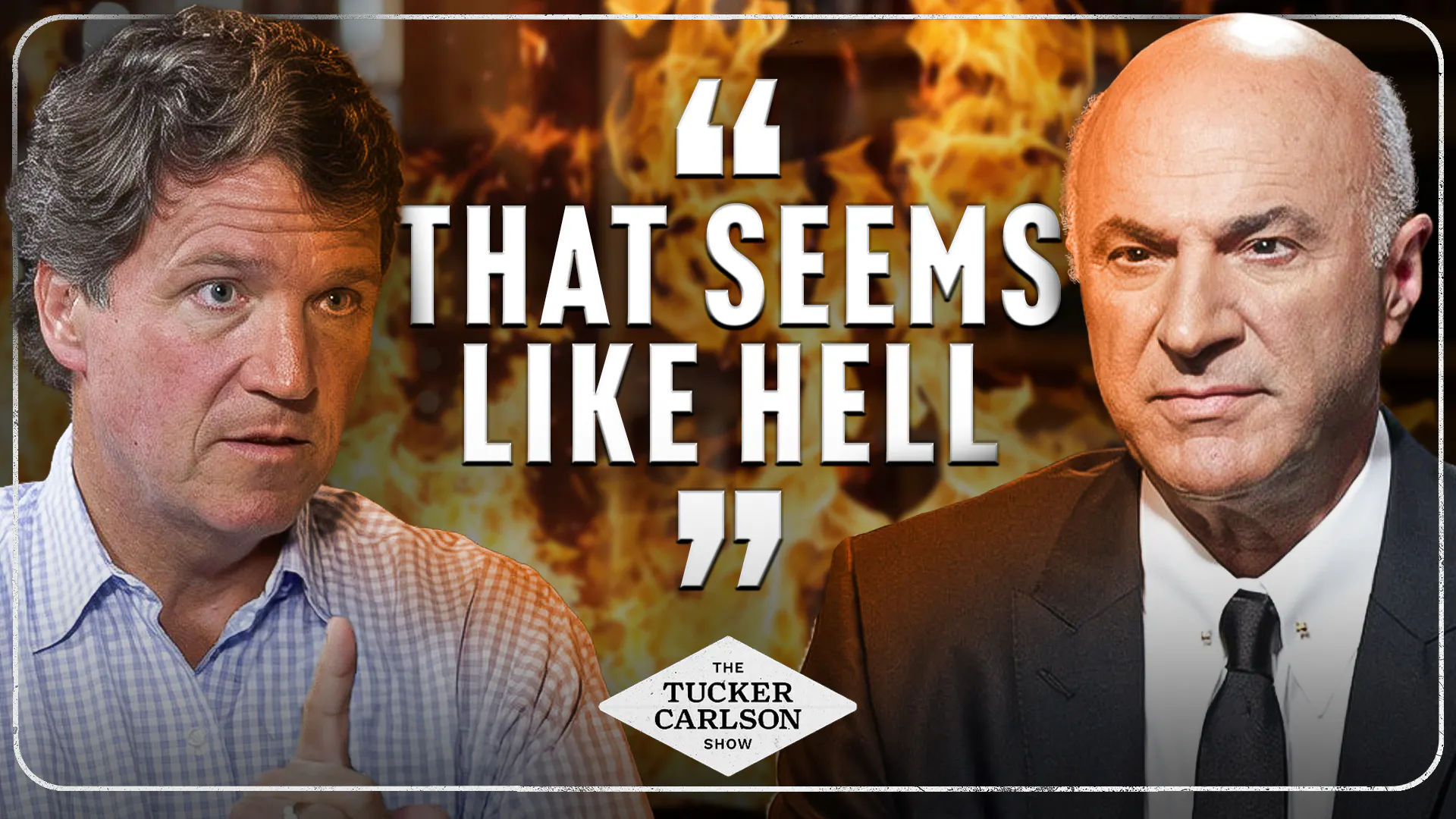
Overview of DEBATE: Tucker vs Kevin O’Leary on the Dystopian AI Future Devouring American Energy and Jobs
This episode centers on a sharp debate over the AI boom, its massive energy demands, and what it means for American jobs, freedom, and national power. Tucker Carlson argues that AI is being sold as “progress” while quietly driving up electricity costs, accelerating surveillance, displacing workers, and expanding a technocratic system that ordinary Americans did not choose. Kevin O’Leary counters that AI compute is now a strategic necessity, that the U.S. must build more data centers and power infrastructure to stay ahead of China, and that the technology will ultimately create new jobs, productivity, and economic growth.
Main Themes
AI as an Energy Crisis
- Tucker frames AI as the latest force driving a global electricity crunch.
- He argues that after the Iran conflict and disruptions to energy supply chains, the world is already facing severe shortages.
- The new demand from huge data centers, he says, is colliding with years of anti-fossil-fuel orthodoxy.
The Central Conflict: National Competition vs. Human Costs
- The debate repeatedly returns to whether the U.S. should prioritize winning the AI race against China.
- Tucker challenges the assumption that “beating China” justifies everything, especially if it means more surveillance and fewer freedoms.
- O’Leary insists that compute capacity is now a form of national power, comparable to military readiness.
Jobs, Purpose, and the Future of Work
- Tucker argues that if AI replaces human labor at scale, it threatens not just wages but meaning and purpose.
- He warns that sending large numbers of people into dependency on government checks could destabilize society.
- O’Leary responds that past technological revolutions also destroyed old jobs but created new industries and opportunities.
Key Discussion Points
The Utah Data Center
- Tucker highlights a proposed massive data center in rural Utah:
- Roughly 40,000 acres
- Planned power demand of about 9 gigawatts
- Presented as larger than any current U.S. manufacturing facility
- He uses it as a symbol of how much land, power, and public support AI infrastructure now requires.
- He argues that local residents were not meaningfully consulted and that the project’s social costs are being minimized.
Power, Water, and Infrastructure
- O’Leary says the data center will not simply pull from the local grid; it will build its own power generation.
- He describes using stranded natural gas and new turbine technology to create electricity on-site.
- He argues that modern data centers can be more efficient than older ones and may even support the grid.
Surveillance and Civil Liberties
- Tucker’s strongest concern is that AI will become a tool of state and corporate surveillance.
- He warns that AI could allow governments to shape public opinion, monitor citizens, and control information at a level that rivals or exceeds China.
- O’Leary dismisses some of these fears as manageable within constitutional limits, but Tucker argues those limits are already being weakened.
China as the Justification
- O’Leary repeatedly returns to China as the main strategic threat:
- China does not want the U.S. to dominate AI compute
- The U.S. must build first to preserve economic and military advantage
- Tucker accepts China as a rival but argues that copying Chinese-style surveillance in response is self-defeating.
Notable Moments and Examples
Jeffrey Hinton on AI Consciousness
- Tucker plays a clip of AI pioneer Geoffrey Hinton warning that machines may become more intelligent than humans and could eventually “take over.”
- Tucker uses this to argue that even AI’s creators are worried about unintended consequences.
The Booing of AI at a Commencement Speech
- A real estate executive promoting AI at a university commencement is booed by graduates.
- Tucker treats this as evidence that young people instinctively sense AI may mean a bleak future of lost purpose and fewer opportunities.
Larry Fink’s Focus on Protecting AI Infrastructure
- Tucker highlights BlackRock’s Larry Fink saying one concern is that people could use cheap drones to attack data centers.
- Tucker sees this as proof that elites know the project is controversial and may provoke backlash.
Lake Tahoe Electricity Warning
- Tucker cites a case where residents were told local electricity may be diverted to a nearby data center, leaving them short.
- He uses this to illustrate how ordinary people may be sacrificed for machine infrastructure.
Tucker’s Core Argument
- AI is being pushed by elites, not demanded by ordinary citizens.
- Its benefits are vague to the public, while its downsides are immediate and visible.
- It may:
- Raise electricity prices
- Accelerate surveillance
- Replace meaningful work
- Concentrate power in the hands of governments and corporations
- His deeper concern is philosophical: a society where machines create and humans merely consume is a dead-end civilization.
Kevin O’Leary’s Core Argument
- AI is inevitable, and the U.S. must not fall behind China.
- Data centers and power generation are the infrastructure of future economic and military strength.
- He argues:
- Data centers can be built responsibly
- They can create jobs and tax revenue
- AI will improve productivity in medicine, imaging, logistics, and other fields
- He presents himself as motivated by legacy, competition, and protecting the American way of life.
Final Takeaway
This debate is less about whether AI exists and more about what kind of civilization will be built around it. Tucker Carlson sees AI as a dangerous power grab that could hollow out jobs, freedom, and human purpose. Kevin O’Leary sees it as a necessary race the U.S. must win, even if it requires huge new energy infrastructure and uncomfortable tradeoffs. The episode leaves viewers with a central unresolved question: is AI a tool for human flourishing, or the beginning of a more controlled, less human future?