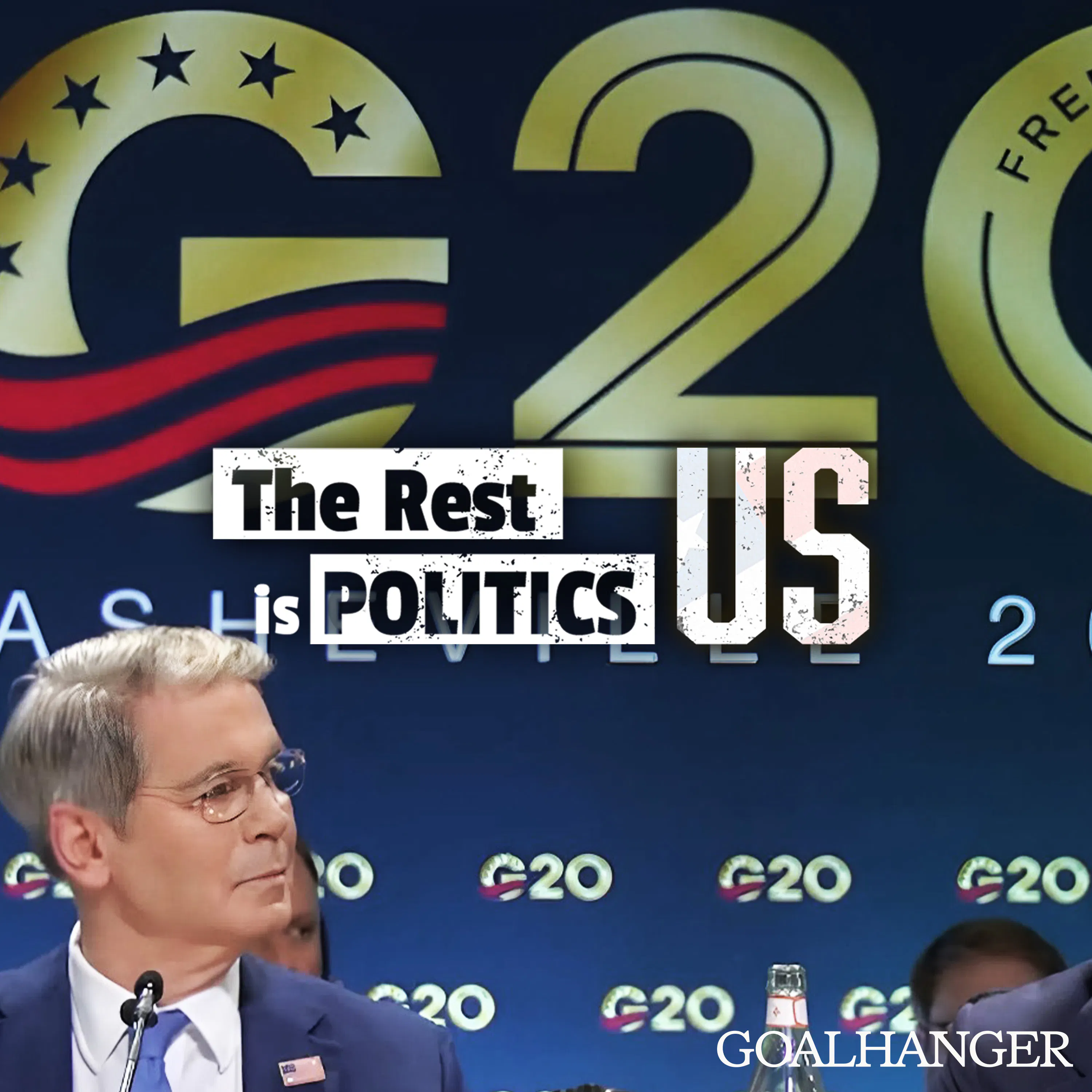
Overview of The Rest Is Politics US — “Trump’s Wars Have Just Broken the Global Economy”
This episode argues that Donald Trump’s trade wars, geopolitical brinkmanship, and fiscal choices are amplifying a already-fragile global economy. Katty Kay and Anthony Scaramucci focus on the bond market sell-off, ballooning U.S. debt, tariff tensions, and the G20’s inability to project unity, while also contrasting America’s instability with China’s increasingly deliberate global messaging. The second half shifts to U.S. politics, especially the Massachusetts primary result and what it suggests about age, incumbency, and progressive appeal heading into the midterms.
Global Economy Under Strain
Bond markets and U.S. debt
- The hosts describe the bond market as the real “warning light” for the U.S. economy.
- U.S. debt has reportedly crossed $40.1 trillion, with concerns that interest rates are being pushed higher because demand for Treasuries is not keeping pace with supply.
- Scaramucci argues that rising rates increase financial pressure everywhere because the dollar remains the world’s reserve currency.
- He frames the debt problem as a structural issue, not a temporary one: debt is growing faster than GDP.
G20 disunity
- The G20 finance ministers’ meeting in Asheville, North Carolina, is portrayed as chaotic and divided.
- The group failed to issue a joint communique, in part because of tensions involving China and Russia.
- The hosts contrast this with China’s more disciplined, controlled economic model and suggest the U.S. is now seen as unreliable by allies.
Trump, Tariffs, and Market Confidence
Tariffs and political risk
- The episode repeatedly returns to Trump’s tariffs and their broader impact on business confidence and global trade.
- Scaramucci argues that Trump’s combative posture is worsening market uncertainty and driving up borrowing costs.
- He emphasizes that markets react to expectations, not just official policy announcements.
Treasury messaging vs. reality
- Treasury Secretary Scott Bessent is criticized for downplaying inflation, bond market stress, and the effects of tariffs.
- The hosts say his public messaging is meant to soothe markets and please Trump, but may instead undermine credibility.
- They note that Bessent’s explanations for oil-price moves and bond performance sound politically useful but not fully convincing.
China’s Messaging and America’s Declining Soft Power
Xi’s diplomatic tour
- The hosts discuss Xi Jinping’s appearances in Kyrgyzstan and Cairo as part of a broader effort to project stability and reliability.
- China is presented as trying to position itself as the steadier alternative to Trump’s America.
Soft power vs. hard loans
- Katty Kay notes that China’s influence in Africa historically came from infrastructure lending, but now it is also projecting political influence.
- She argues that America’s pull has weakened because of Trump-era instability, cuts to USAID, and growing global skepticism.
- Scaramucci pushes back slightly, saying China’s soft power remains limited because many people still prefer the U.S. as a destination, but he agrees America’s image has clearly deteriorated.
China’s internal vulnerability
- The hosts also note that China has major economic problems of its own:
- property bust,
- deflationary pressure,
- youth unemployment,
- a large aging population.
- China’s challenge is how to keep growth going without triggering domestic instability.
Can AI Save the U.S. Economy?
The “grow out of debt” argument
- The episode spends significant time on the idea that AI-driven growth could offset America’s debt burden.
- Bessent and Howard Lutnick are portrayed as arguing that deregulation and AI will power the next economic boom.
Scaramucci’s view
- He says the U.S. absolutely has the innovative capacity to produce another growth wave, but the problem is political leadership and fiscal discipline.
- He points to past examples like:
- post–World War II growth,
- PAYGO budgeting,
- the Clinton-era tax increase and spending discipline.
- His argument: growth can solve the debt problem, but only if spending is restrained.
Main takeaway
- AI may be a powerful growth engine, but the hosts are skeptical that it can by itself paper over runaway deficits.
- Their core warning: the U.S. can grow its way out of debt only if it stops adding debt so quickly.
Youth vs. Experience in Democratic Politics
Ed Markey beats Seth Moulton
- The episode turns to Massachusetts, where 80-year-old Ed Markey defeated 47-year-old Seth Moulton in the Senate primary.
- The hosts discuss whether this reflects an anti-incumbent mood or something more specific.
The real dividing line: age or ideology?
- Katty Kay argues that it’s not just about age.
- Voters, especially younger ones, appear to favor progressive authenticity more than youth alone.
- Markey benefits because he has a long-standing progressive record on climate, housing, and education.
- By contrast, older candidates who seem establishment-oriented are more vulnerable.
Broader lesson
- The conversation suggests that in the Democratic Party:
- youth helps,
- but being visibly progressive helps more.
- In other words, voters want change, but they want ideological clarity too.
Texas, Trump, and Republican Anxiety
Cornyn, Paxton, and a difficult Republican map
- The discussion moves to Texas, where Ken Paxton is challenging John Cornyn.
- Scaramucci argues that Trump’s intervention may be more about self-interest than ideology.
- He says Trump’s biggest concern is money, control, and avoiding embarrassment if Republicans underperform.
Why Texas matters
- Republicans are reportedly worried that:
- Paxton is a weak candidate,
- fundraising is lagging badly,
- Democrats are energized,
- polling is tightening.
- The hosts note that:
- some polls have shifted Texas from “lean Republican” to “toss-up,”
- Trump’s PAC money could be decisive,
- but he may be reluctant to spend it on others.
Midterms as a personal financial issue for Trump
- The hosts argue Trump may not care about the midterms in the abstract, but he does care if Republican losses threaten:
- his legal safety,
- his leverage,
- and his ability to raise or protect money.
- In their view, he may finally step in if it protects his own political and financial interests.
Voting Access and Political Tactics
Election administration concerns
- The episode briefly touches on efforts in some places to reduce polling locations and complicate voting access.
- This is framed as part of a broader Republican strategy to shape turnout.
- The hosts also mention voter-ID and name-change hurdles that can disproportionately affect women.
Key Takeaways
- The bond market is the real alarm bell for the global economy, and U.S. debt is becoming increasingly dangerous.
- Trump’s tariffs and geopolitical choices are deepening uncertainty and weakening America’s credibility with allies.
- China is using the chaos to present itself as stable and reliable, even as it faces its own major economic problems.
- AI may power growth, but it cannot solve debt without fiscal discipline.
- In Democratic primaries, progressive authenticity may matter more than youth alone.
- Trump’s midterm strategy is increasingly about self-protection, not party-building.
Bottom Line
The episode’s central thesis is that Trump-era disruption is no longer just a U.S. political story — it is destabilizing the global economic system. The hosts see rising debt, higher rates, tariff conflict, and weakened alliances as interconnected symptoms of a deeper crisis: America’s leadership is less credible, less disciplined, and less trusted than it used to be.