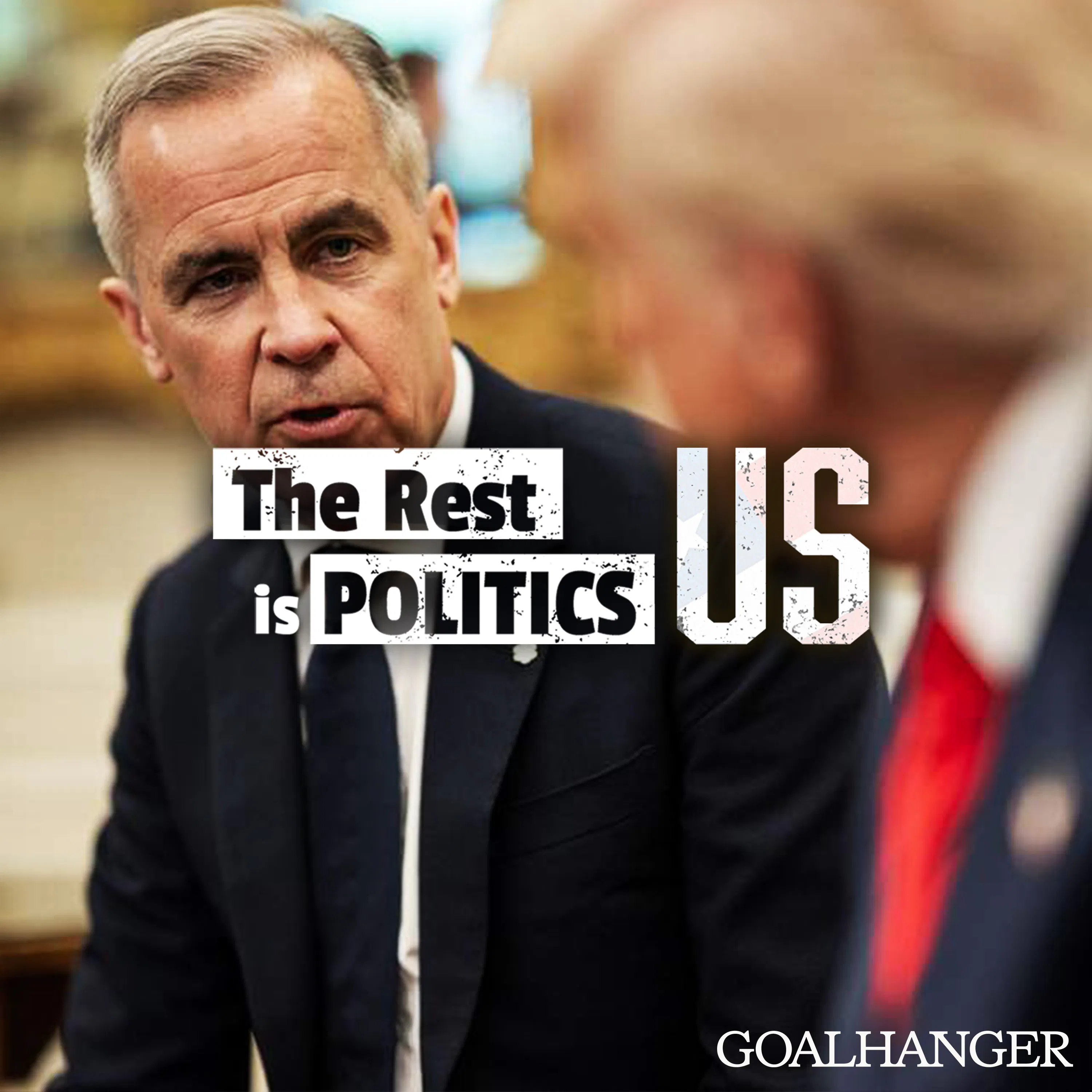
Overview of The Rest is Politics US — “Carney Has Taught the West How To Stand Up To Trump”
This episode centers on Mark Carney’s decision to walk away from a late-stage U.S.-Canada trade deal, with Anthony Scaramucci and Katty Kay arguing that the Canadian prime minister has shown other Western leaders how to confront Donald Trump more effectively: be firm, don’t over-flatter, and be willing to walk away. The conversation then widens into a critique of Trump’s broader approach — trade brinkmanship, the Iran conflict, and attempts to control unfavorable reporting — with the hosts warning that these tactics are creating political and economic blowback.
Mark Carney vs. Trump: The Trade Fight
Why Carney walked away
- Carney reportedly pulled Canada out of negotiations at the last minute rather than accept U.S. demands.
- The hosts say the breaking point was not steel, but a dispute over French-language labeling and other cultural/trade pressure points.
- They frame Carney’s move as a strategic refusal to accept bullying rather than a simple negotiation failure.
Why the hosts think Carney won politically
- The move rallied Canadians across party lines.
- Conservative and opposition figures reportedly backed Carney’s stance.
- Carney is seen as benefiting domestically from looking calm, credible, and unafraid to stand up to Washington.
- His approval rating is cited as unusually strong, around 66%.
Likely outcome
- Despite the public confrontation, the hosts predict a deal will still happen soon — probably within a couple of weeks — because of U.S. political pressure, especially from auto-dependent states and the upcoming midterms.
What This Means for Other U.S. Allies
- Katty Kay suggests Canada may become a model for how allies should respond to Trump: less flattery, more firmness.
- They compare this to the UK’s more conciliatory approach, which may have worked in a limited, uniquely British context but sent the wrong signal globally.
- The episode argues that many allies now assume the White House is unreliable and may keep moving the goalposts.
Trump, Tariffs, and the Limits of the White House Strategy
The legal and economic angle
- The hosts discuss how the administration is trying to justify tariffs through Section 301 of the Trade Act of 1974.
- They note that this legal path is questionable and likely to face challenges.
- Tariffs are described as taxes that ultimately fall on consumers and businesses, whether imposed by the U.S. or retaliated by Canada.
Who is really in control?
- The segment portrays the administration as internally disorganized, with Howard Lutnick and Jamieson Greer described as undermining or mishandling the deal process.
- The White House is depicted as changing terms after announcing progress, which further damages trust with allies.
Iran, the Pentagon, and Military Censorship
The conflict with Iran
- The second half shifts to what the hosts describe as a failing U.S. war with Iran.
- They argue the military situation is not going well and that the administration is trying to mask setbacks with sanctions and economic pressure.
Pentagon media crackdown
- The episode highlights the firing of Stars and Stripes journalists/editors after reporting on military conditions and the USS Abraham Lincoln.
- The hosts frame this as an attempt to suppress bad news rather than address problems on the ground.
- They warn this resembles a more authoritarian approach: if the reality is bad, control the reporting.
Economic fallout
- Gas prices are cited as rising sharply, and the hosts connect that to public dissatisfaction.
- They argue the war and tariff policies are hurting Trump politically, especially in key states.
Immigration, the Military, and the Human Cost
- The episode discusses Joshua Aviles, a service member deployed on the USS Abraham Lincoln, whose father was detained by Border Patrol during a traffic stop.
- The hosts present this as a powerful example of how immigration enforcement and military service are colliding in ways that feel harsh and politically damaging.
- They argue it could hurt military recruiting and fuel public backlash, especially if families of service members feel abandoned.
Key Takeaways
- Carney’s strategy: Calm, firm resistance may be the most effective way to deal with Trump.
- Trump’s weakness: The White House appears disorganized and unreliable, especially on trade.
- Allies are watching: Canada’s stance may influence how Europe and other U.S. partners respond going forward.
- Censorship concerns: Firing military journalists looks like an attempt to hide bad news, not solve problems.
- Political risk for Trump: Trade disruptions, war costs, and immigration hardball are all adding up to voter dissatisfaction.
Notable Lines and Ideas
- Carney is framed as the leader who “taught the West how to stand up to Trump.”
- The hosts repeatedly emphasize that “you don’t fight with people that live in cold weather” as a joking but pointed metaphor for Canadian resolve.
- They argue that the White House is trying to create a reality where bad outcomes disappear simply by suppressing reporting — but the public can still feel the effects in prices, casualties, and instability.