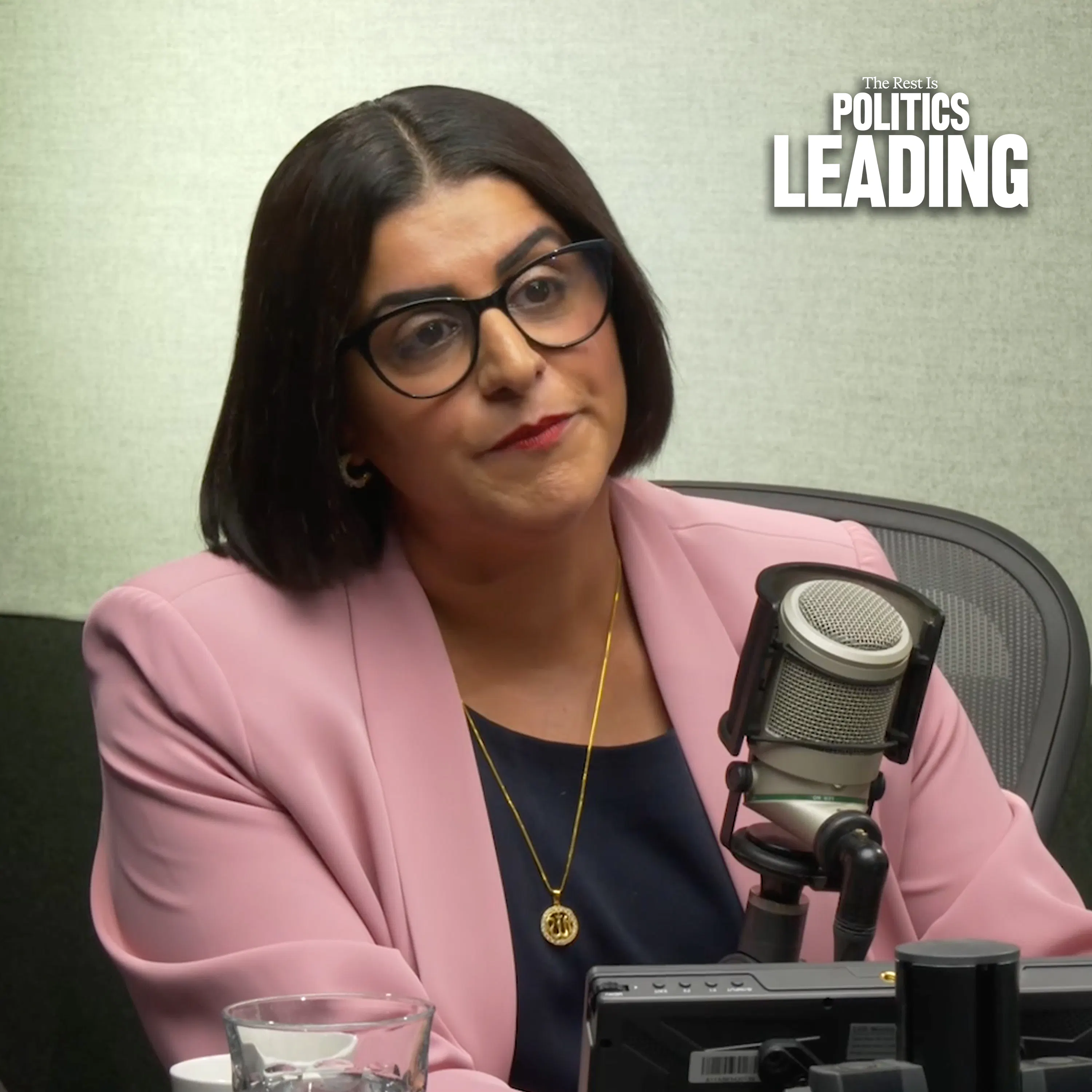
Overview of The Rest Is Politics — Shabana Mahmood
In this episode, Rory Stewart and Alastair Campbell interview Home Secretary Shabana Mahmood about the issues defining her political life and job: faith, race, Palestine, immigration, policing, Labour politics, and what she told Keir Starmer during Labour’s internal crisis. Mahmood comes across as unusually direct and self-possessed, making a strong case that her Muslim faith, working-class Birmingham upbringing, and immigrant family background are central to how she thinks about public service, fairness, and power.
Faith, identity, and upbringing
Mahmood speaks openly and at length about her Muslim faith, saying it is the most important thing in her life.
Key points
- Raised in a deeply religious Pakistani-Kashmiri household in Birmingham.
- Spent part of her childhood in Saudi Arabia, with early memories of Hajj, Mecca, and Medina.
- Says her belief in God has never wavered, though her practice has varied over time.
- Describes faith as shaping:
- accountability,
- honesty,
- humility,
- and the idea that life is both a test and a gift.
She also argues that politics often treats faith as an identity marker rather than a living belief system, which she finds limiting.
Racism, Islamophobia, and solidarity across minorities
A major part of the conversation is her experience of racism and the growing hostility toward Muslims in Britain.
Key points
- Recalls being called “Paki” at school and learning early what racism meant.
- Says Islamophobia has become worse than she expected, especially in the post-9/11 era.
- Warns against the rise of:
- far-right Christian nationalism,
- “Judeo-Christian civilization” rhetoric,
- and the use of religion as a cover for supremacist politics.
- Argues that minority communities need solidarity, including Muslims, Jews, Sikhs, Christians, and others.
- Says extremists on all sides tend to project their own fundamentalism onto others.
Palestine Action, Gaza, and protest
The interview spends significant time on Palestine Action, Gaza, and Mahmood’s stance on protest and proscription.
Key points
- She says she remains strongly pro-Palestinian and supports:
- Palestinian self-determination,
- statehood,
- safety and freedom for Palestinians.
- Defends the decision to proscribe Palestine Action, saying:
- it was taken before she became Home Secretary,
- it met the legal test,
- and she will apply the law consistently.
- Rejects the idea that support for Palestine must include support for a proscribed organisation.
- Draws a parallel with policing the far right: if the law applies to one group, it must apply to all.
- Says the war in Gaza has badly damaged interfaith relations in the UK and made solidarity harder.
She also reveals that during the election period she felt the government’s response to Gaza was not strong enough, and she privately pushed Keir Starmer to correct his handling of a key interview.
Immigration and asylum: control, fairness, and safe routes
Mahmood’s immigration position is firm but more nuanced than simple restrictionism.
Key points
- Says the public wants a system that is:
- controlled,
- fair,
- and perceived as legitimate.
- Supports efforts to reduce small boats, including:
- the UK-France “one in, one out” arrangement,
- safe third-country return hubs,
- and broader international cooperation.
- Acknowledges that such deals depend on political will in other countries, especially France.
- Believes the UK should also expand safe and legal routes for refugees.
- Wants refugee policy to be more proactive:
- community sponsorship,
- university sponsorship,
- company sponsorship,
- targeted routes for vulnerable groups like women, minorities, and LGBT people.
Her broader view
- The UK should still need migrant workers in some sectors.
- But she argues government and employers often use immigration as an easy fix instead of:
- training domestic workers,
- improving pay and conditions,
- and planning properly for workforce needs.
- Criticises the habit of asking for visas whenever a department has a short-term gap.
Policing, Home Office power, and the state
As Home Secretary, she discusses how she sees her role in relation to large institutions.
Key points
- Says ministers must understand:
- what they can control,
- and what they cannot.
- Describes the Home Office as a vast machine covering:
- policing,
- border security,
- intelligence,
- and national security.
- Believes the Home Secretary should have more direct oversight of policing, including some powers removed under the Conservatives.
- Argues for stronger accountability at the top, while respecting operational independence.
- Says most police officers are trying to do a good job, but the system and leadership need improvement.
Labour politics, class, and where she fits
Mahmood resists being neatly labelled, including as “blue Labour.”
Key points
- Says she is shaped by being:
- a Muslim,
- an immigrant-family Brummie,
- and working class.
- Emphasises aspiration, education, and family sacrifice.
- Describes Labour as the party that made her family feel they could be full citizens in Britain.
- Rejects simplistic class politics, but acknowledges the importance of her background.
- Sees herself as someone who can connect tradition, faith, work, and public service.
What she told Starmer, and her view of Labour’s crisis
One of the most revealing parts of the interview is her account of Labour’s internal troubles before the change of leadership.
Key points
- Says Keir Starmer had lost authority and could no longer command a majority in the Commons.
- Believes the government was operating day by day, without stability.
- Says the country needed a leader who could govern for a full term.
- Views the new leadership as a chance for Labour to make a “second first impression” with the public.
- Describes Starmer as someone who can now present a more coherent and functional government.
Personal pressure, abuse, and resilience
Mahmood speaks candidly about the personal costs of politics.
Key points
- Says the hardest parts of political life are not Parliament itself, which she loves, but:
- social-media abuse,
- threats,
- and intimidation in real life.
- Describes harassment during election campaigns, including abuse aimed at her father and brothers.
- Says some of the abuse came from people in her own broader community over her stance on Gaza.
- Nonetheless, she insists on:
- collective responsibility,
- staying inside the system to shape policy,
- and not walking away from difficult government decisions.
- Concludes that even if others do not see it, God does.
Notable takeaways
- Faith is central, not ornamental, in Mahmood’s politics.
- She combines hardline legalism with a strong argument for solidarity and fairness.
- On immigration, she wants control first, but not at the expense of humanitarian obligations.
- She sees institutional reform—especially in policing and asylum—as essential to Labour’s future.
- Her style is unusually plainspoken, disciplined, and self-aware for a senior minister.
Final note
The episode paints Mahmood as a high-pressure operator: deeply religious, politically tough, and highly conscious of the tensions between principle, law, and public emotion. The hosts clearly come away impressed by her candour and her command of the arguments, even where they disagree.