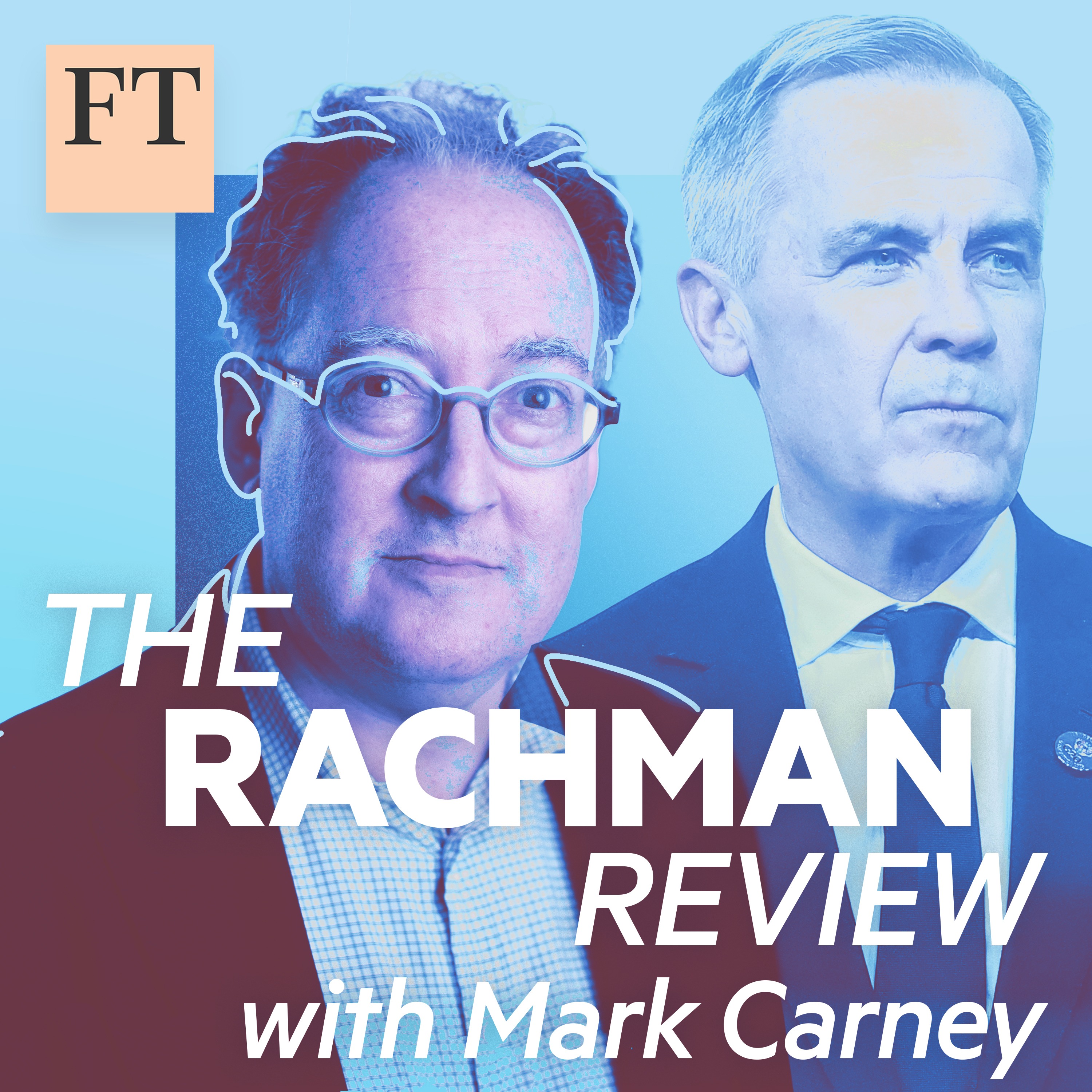
Overview of the Rachman Review — Mark Carney on a world in rupture — and what comes next
This episode of the Financial Times Rachman Review (host Gideon Rachman) covers Mark Carney’s high-profile Davos speech and the follow-up interview. Carney argues that the post‑WWII “rules‑based order” is undergoing a rupture — not a temporary transition — because economic integration is increasingly being used as leverage and coercion. His prescription for middle powers (Canada as an example) is to build strategic autonomy at home, calibrate relationships abroad, and form practical partnerships with like‑minded countries rather than pretending the old order will simply return.
Key takeaways
- The international order is rupturing, driven by crises (finance, health, energy, geopolitics) and by great powers weaponizing economic integration (tariffs, financial infrastructure, supply chains).
- Middle powers should pursue strategic autonomy in essentials: energy, food, critical minerals, finance, and supply chains — because dependence can become subordination.
- Canada’s response: strengthen domestic resilience, diversify and deepen partnerships (trade and security), and act with like‑minded countries to build an “imperfect” new system of cooperation.
- Engagement with China is framed as strategic and bounded by clear “guardrails”: it’s not decoupling but calibrated integration across mutually beneficial areas (energy, agriculture, autos, finance).
- NATO is “under test,” particularly over Arctic security. Canada plans to ramp up defense presence (submarines, fighters, radar, 365‑day presence) and expects NATO reinforcement.
- Carney supports participation in President Trump’s proposed “Board of Peace” (initially focused on Gaza), conditional on effective governance and immediate humanitarian access.
- “Globalism” will likely be replaced by powerful networks of like‑minded partners rather than a single, universal global order.
Notable quotes and lines
- “We are in the midst of a rupture, not a transition.”
- “You cannot live within the lie of mutual benefit through integration when integration becomes the source of your subordination.”
- “We can give ourselves far more than any foreign country can take away.”
- “The NATO sign stays in the window, but we've got to meet the moment.”
Topics discussed (episode structure)
Carney’s Davos speech (highlights)
- Critique of the old rules‑based bargain and American hegemony’s protective role.
- Examples of integration being weaponized (tariffs, financial coercion, supply‑chain leverage).
- Call for strategic autonomy and calibrated partnerships for middle powers.
Interview with Gideon Rachman
- Canada’s resilience to US tariffs (jobs created; second‑fastest G7 growth).
- Trade strategy: leveraging trade agreements covering roughly 1.4 billion people and bridging networks (e.g., CPTPP, EU).
- NATO and Arctic security: need for a robust, collective response to threats (notably from Russia).
- Engagement with China: “offense” not defense — pursue mutually beneficial ties within guardrails.
- Greenland/Arctic geopolitics: security + prosperity for local populations; avoid escalation.
- Board of Peace for Gaza: Canada invited, will participate but wants strong governance and humanitarian access.
- Reframing “globalism”: valued connections remain, but the future will be partnership‑based, not universal.
Policy implications & recommendations
-
For middle powers:
- Invest in domestic resilience (energy, food, critical minerals, finance, supply chains).
- Diversify trade and diplomatic networks; build bridges among willing partners (e.g., Canada + Nordics + EU + India).
- Cooperate on defense where geography and shared values demand it (Arctic security).
-
For NATO/defense planners:
- Prioritize Arctic capabilities: persistent air/sea/land presence, submarines, air defenses, over‑the‑horizon radar.
- Translate pledges into concrete capability and interoperability investments.
-
For trade/security policy toward China:
- Pursue calibrated engagement with clear legal and security guardrails rather than full decoupling.
- Strengthen ties with a broad web of partners to reduce single‑point dependencies.
-
For humanitarian/conflict responses:
- Ensure new governance vehicles (e.g., Board of Peace) are paired with immediate, unimpeded humanitarian aid and robust accountability for outcomes.
Quick facts & stats mentioned
- Canada’s economy: second‑fastest growth rate in the G7 at the time of the interview.
- Jobs: Carney claimed Canada created more jobs in absolute numbers since U.S. tariffs were imposed.
- Trade networks: existing agreements cover ~1.4 billion people.
- Nordics + Canada ≈ 20% of global GDP (used to argue the potential power of like‑minded coalitions).
Conclusion
Carney’s message is a practical recalibration: accept that the old rules‑based world will not fully return, stop “putting the sign in the window,” and instead build domestic strength and strategic, value‑aligned partnerships. The emphasis is not isolationism but resilient, calibrated engagement — a middle‑power strategy of autonomy plus alliances tailored to the new geopolitical reality.