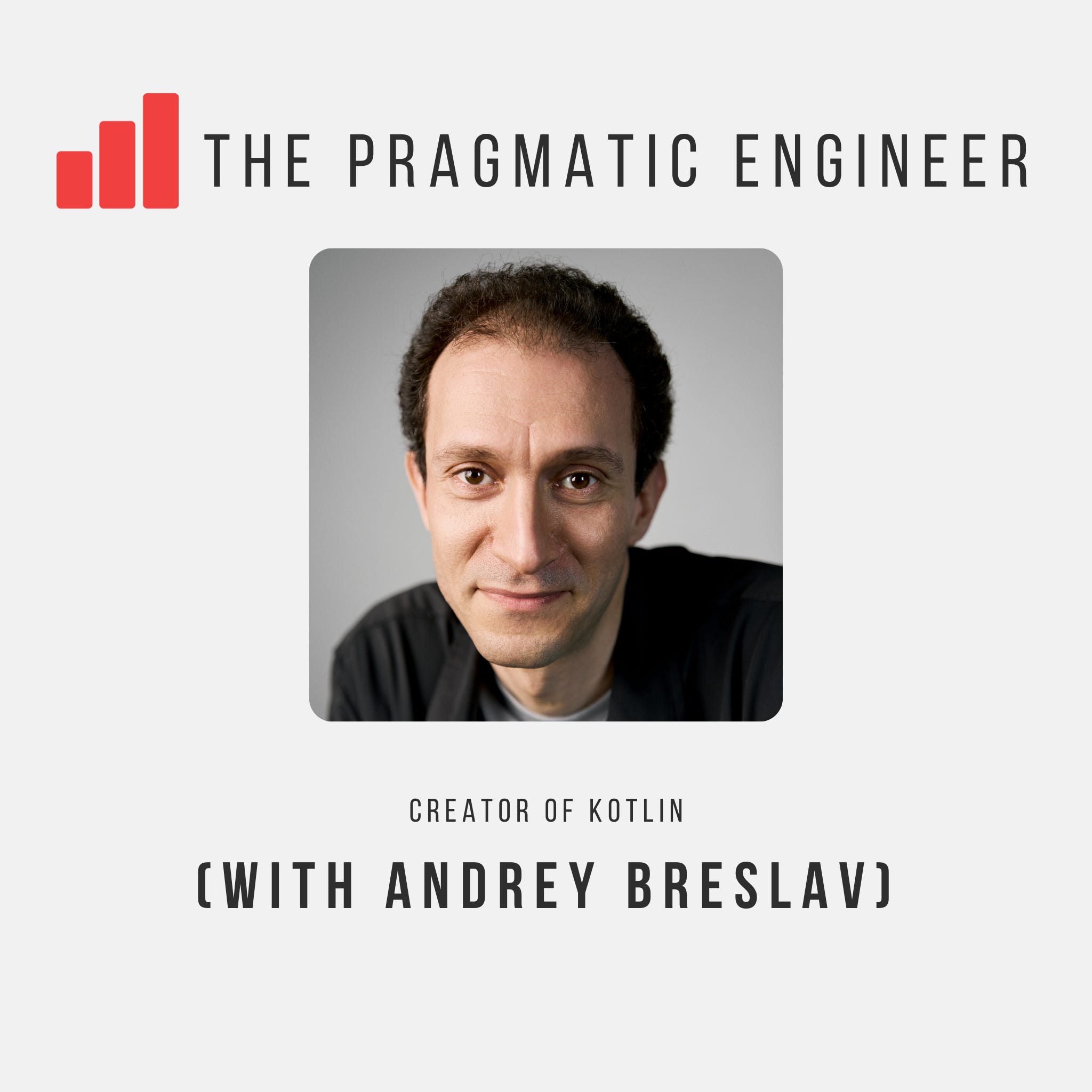
Overview of The programming language after Kotlin – with the creator of Kotlin
Host Gergely Orosz interviews Andrei (Andrey) Breslav, the creator of Kotlin. The conversation covers Kotlin’s origin story, design trade-offs and influences (Scala, C#, Groovy, Gosu), the enormous engineering work to interoperate with Java, how Android adoption exploded after Google’s endorsement, and Andrei’s current work on Codespeak — a new English-based programming language idea built around LLMs and preserving developer intent in a world of AI-assisted coding.
Key topics covered
- Why JetBrains created a new JVM language in 2010 and the goals behind Kotlin
- Concrete design decisions, inspirations and regret (no ternary operator, multiple inheritance discarded)
- How Kotlin achieved deep Java interoperability and the engineering challenges involved
- The adoption curve and the role Google/Android played in Kotlin’s growth
- Development process, release cadence, compatibility strategy and tooling-first approach
- Andrei’s post-Kotlin work: Codespeak — programming with English + LLMs
- Practical impacts of AI on software engineering and advice for developers
Background & origin story
- JetBrains wanted a pragmatic, statically-typed language to modernize Java for large projects (2010).
- Andrei joined after academic work on DSLs; early design was whiteboard-heavy and extremely pragmatic.
- Initial approach: IDE-first (IntelliJ plugin) to rapidly prototype syntax and tooling; later a full compiler and multiple backends (JVM, JS, Native, Wasm).
- Early internal name: “Jet”; final name “Kotlin” came from a local island — chosen partly for being Googleable and unclaimed.
Kotlin design choices and influences
- Slogan: “A pragmatic language for industry” — favor familiarity and proven ideas over academic novelty.
- Major language goals:
- Reduce boilerplate (type inference, properties, less ceremony).
- Improve readability (reading code prioritized over writing it).
- Static typing for large-scale codebases.
- Key features and influences:
- Null-safety (one of the most important differentiators).
- Extension functions (inspired by C#).
- Typed builders / dangling lambdas inspired by Groovy.
- SmartCasts (inspired by Gosu) — infers safe casts after checks.
- Many ideas borrowed and adapted from Scala (constructors, vals/vars, generics) and C# (generic syntax handling).
- Things intentionally left out or postponed:
- Full pattern matching (deferred because it’s large; when combined with smartcasts/destructuring it already covers many cases).
- Multiple inheritance (abandoned due to complexity).
- Ternary operator: omitted because Kotlin made if an expression; Andrei admits this omission is now a regret — it would have been pragmatic to include it.
Java interoperability — the engineering headache and solutions
- Interop was a top priority: Kotlin must call Java libraries and Java must call Kotlin code in mixed projects.
- Practical strategy:
- Compile Kotlin first into JVM bytecode so Java compilers see binaries they can consume.
- Kotlin includes a Java front-end to resolve Java sources during Kotlin compilation.
- Hard problems and tricks:
- Nullable types: Java has no compile-time nullability. Treating all Java types as nullable initially proved unusable. Kotlin devised a hybrid solution (annotations, conservative/widening heuristics, and a special type calculus) to make Java types usable without exploding null-check verbosity.
- Collections: Java collections are mutable and invariant. Kotlin exposes read-only views and uses compiler/hacking-layer tricks to present nicer types to Kotlin while remaining compatible with Java.
- Incremental compilation across two languages, binary compatibility, and special “message from the future” bytes to let older compilers understand newer binaries.
- Result: seamless developer experience but required massive engineering, migration tooling, compatibility management and careful deprecation cycles.
Tooling, process and release history
- IDE-first development (IntelliJ) allowed rapid syntax iteration and good initial tooling.
- Timeline:
- Started autumn 2010; initial prototype and months of whiteboard design.
- Public 1.0 release: February 2016 (≈5 years of work).
- Team growth: a few part-timers → ~25 by 1.0 → ~100 by 2020 (≈70 engineers).
- Practices and lessons:
- Early and public issue tracker; migration tools for breaking changes; experimental features behind explicit flags.
- Bootstrapping complexities (compilers written in their own language) required hacks to move the language forward.
- Compatibility was a major focus—Kotlin delayed 1.0 to reduce breaking changes and provide migration utilities.
Kotlin adoption and Android’s role
- Initial target audience: server-side Java developers (Spring etc.) and desktop Java users.
- Android adoption was not the original plan but became pivotal:
- Android’s fragmented (often old) Java ecosystem created demand for a nicer language that didn’t rely on platform Java upgrades.
- Kotlin’s IntelliJ-based tooling fit well with Android Studio (since Android moved from Eclipse to IntelliJ).
- Google announced official Kotlin support at Google I/O 2017 — a surprise to JetBrains but a watershed moment that sharply increased adoption (from tens of thousands to millions).
- Legal/organizational notes:
- Google temporarily held the Kotlin trademark during foundation setup.
- Kotlin Foundation later established to manage governance.
Codespeak — the next language idea (Andrei’s current project)
- Motivation: With LLMs, many implementation details can be inferred by models from high-level intent. This enables the next jump in abstraction: languages that let you communicate intent in English (or near-English) and have LLMs generate working code.
- What Codespeak aims to be:
- A programming language based on English (informal + formal parts), built to work with LLMs as a primary “library” or resource.
- A language designed to reduce noise/boilerplate and preserve human intent as a first-class artifact (so conversations with agents aren’t lost).
- Emphasis on making test generation and verification integral (tests that prove intent).
- Design challenges:
- LLMs perform best on well-represented languages; a brand new formal language lacks training data.
- Extracting compact, stable English specifications that map to implementation and that evolve nicely with commits.
- Balancing informality (natural language queries) with safety, verifiability, and reproducibility.
- Philosophical stance: Codespeak is for humans-in-charge, not for replacing human decision-making (Andrei rejects the notion of a singularity where models make all decisions).
How AI/LLMs are changing software engineering (Andrei’s view)
- Immediate changes:
- Coding agents and autocompletions drastically increase productivity; tools (Cursor, GitHub Copilot, IDE integrations) are improving fast.
- The conversation with agents (human intent) often disappears once code is committed — creating a missing intent layer between author and collaborators.
- Tests and verification are growing in importance; teams will rely more on automated verification than manual code review in some contexts.
- Near-term tooling needs:
- Integrating agents with code-aware tools (language servers, indexers) rather than raw token-based cloud prompts.
- Development environments built around agents (better UX than simple terminals).
- Improved review tools geared for AI-generated code and tests that better express intent.
- Advice to engineers:
- Learn to use AI tools skillfully — there’s real skill in prompting and verification.
- Invest in testing and verification workflows; tests become central when code is AI-generated.
- Either master depth (low-level systems expertise) or learn to be extremely productive with higher-level tooling; both paths remain valuable.
Actionable takeaways for listeners
- If you’re a developer:
- Start experimenting with AI coding tools and integrate them into your workflow (but keep rigorous tests and verification).
- Learn Kotlin basics (null-safety, extension functions, smartcasts) if you work on JVM/Android — its ergonomics are widely valued.
- Focus either on deep systems understanding (rare expertise) or on becoming highly effective with new agent-driven tooling.
- If you manage teams:
- Invest in tests, automated verification, and developer tools that expose intent and make agent outputs auditable.
- Don’t assume agents remove the need for juniors or teams — they change the nature of work and create new tooling/verification needs.
Notable quotes & short insights
- “The whole art of making a good language was to restrict the user in a good way.” — On balancing power and simplicity.
- “If someone offers you a job to create a system that interoperates transparently with another huge system you don't control, ask for a lot of money.” — On the difficulty of Java interop.
- “You communicate with the machine in human language, but with your teammates in code — that conversation disappears. We’re missing an intent layer.” — The core motivation behind Codespeak.
Quick personal notes from Andrei (fun/rapid items)
- Favorite small tools: AirPods and earmuffs.
- Book recommendation: Zen and the Art of Motorcycle Maintenance — for its blend of technology, philosophy and narrative.
Final summary
- Kotlin succeeded because it was pragmatic: it borrowed proven ideas, prioritized tooling and interop, and solved everyday pain points (nulls, boilerplate, ergonomics) for large teams.
- Creating a language is an engineering and social project: IDEs, compilers, migration tooling, compatibility rules, and platform partnerships are as important as syntax.
- The AI era opens a new frontier: languages and tooling that treat human intent as first-class, leveraging LLMs while preserving verifiability and team collaboration. Codespeak is Andrei’s attempt at that next layer.
- Practical next steps for engineers: adopt AI tools thoughtfully, double down on tests/verification, and keep learning (either depth or productive higher-level practices).
If you want concise cheat-sheet points (e.g., Kotlin features to learn first or practical prompts for AI-assisted coding), say which one and I’ll give a focused list.