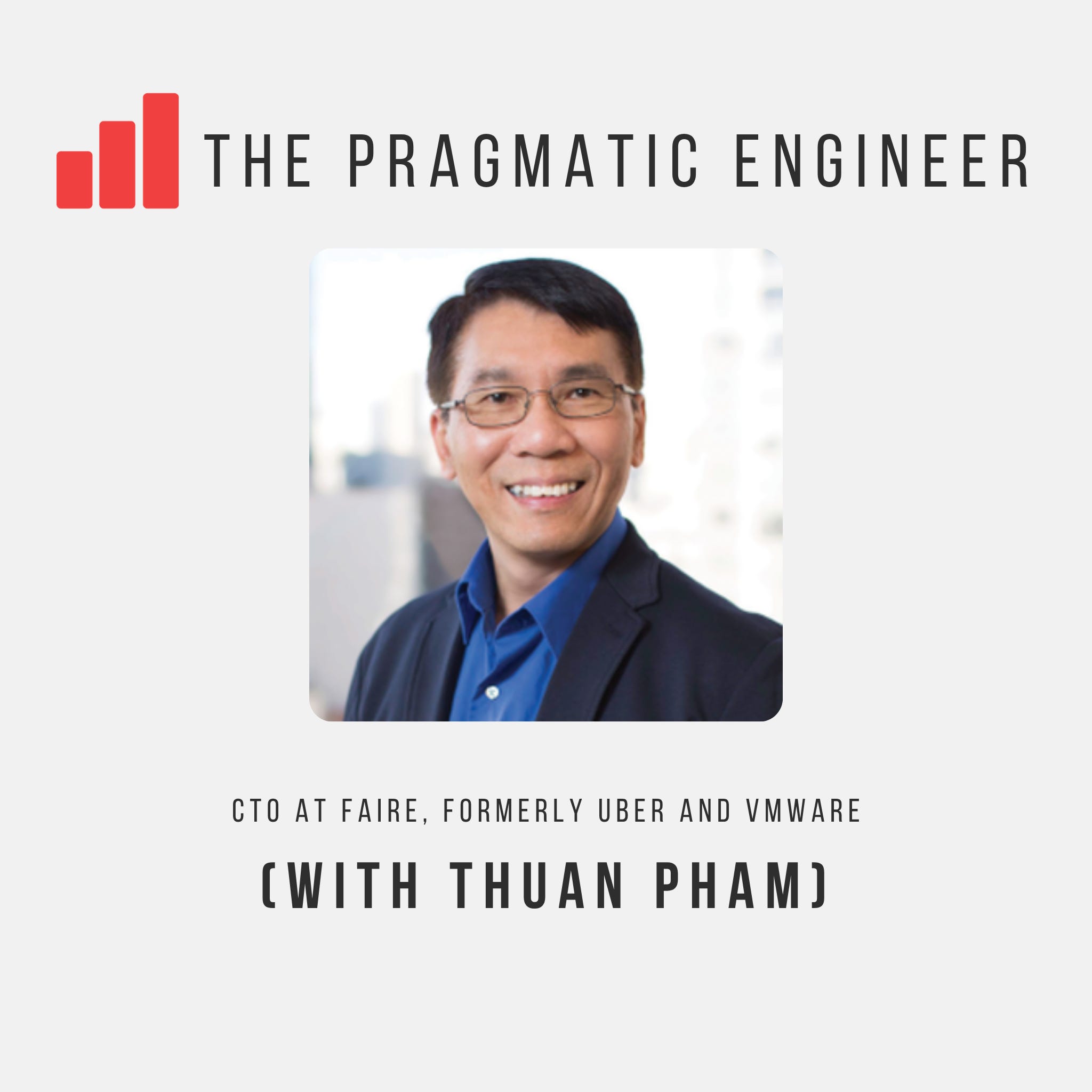
Overview of Scaling Uber with Thuan Pham (podcast: Pragmatic Engineering, host Gergely Orosz)
This episode is a wide-ranging interview with Thuan (Tuan) Pham — Uber’s first CTO — covering his personal path from refugee to senior tech leader, his technical and organizational decisions at Uber (2013–2020), and lessons for engineers and engineering leaders. Topics include the dispatch rewrites that saved the company, the five-month China launch, the full app rewrite (Project Helix), why Uber ended up with thousands of microservices and many internal tools, hiring and org design, and how AI is shaping engineering today.
Key points and main takeaways
- State when Thuan joined Uber: ~40 engineers, ~30k rides/day. The system crashed multiple times per week and had a limited runway before a dispatch brick wall.
- Focus on the choke points: Thuan prioritized dispatch first (matching riders/drivers) and set two simple scaling constraints: a city must be served by multiple boxes; a box must serve multiple cities — enabling horizontal scale and buying runway.
- Rewrites are sometimes necessary and repeated: Uber performed multiple rewrites (dispatch, APIs, data pipelines, Helix mobile rewrite) because the business grew faster than decomposition work could keep up.
- Org design: program (product) vs platform split, and cross-functional (product–design–mobile–backend) teams were introduced early to avoid functional bottlenecks.
- Microservices explosion was emergent, not planned: new features kept getting added to the monolith while teams decomposed it, so decomposition lagged growth — resulting in thousands of services. Later cleanup (domain interfaces, Arc) reduced complexity.
- Internal infra & open source: many internal tools were built out of necessity because open-source components (e.g., Postgres at extreme scale) hit limits and lacked vendor-style support. Uber both built internal tools and open-sourced several (Jaeger, M3, etc.).
- Leadership & talent: Thuan’s career shows the long-term compound value of doing high-quality work and building relationships. He repeatedly brought trusted engineers with him (e.g., from VMware) to solve core infra problems.
- People-first policies: introduced easier internal transfers, level structure changes (L5A/L5B) to create visible growth, and naming/standards to improve onboarding and maintainability.
- AI: Early adoption of AI tooling (including agent “swarm” coding and orchestration) can double productivity for top engineers; the most valuable traits (curiosity, fearlessness) remain unchanged.
Notable stories and episodes (concrete examples)
Dispatch rewrite (first priority)
- Problem: single-threaded Node.js dispatch could not scale with rising city volumes.
- Approach: set minimal, clear constraints that force horizontal scaling (N cities × M boxes); rewrite rapidly to buy ~12 months of runway.
- Outcome: deployed before the brick wall; enabled continued growth.
China launch (apparently impossible)
- Requirement: run services on China soil; maintain partitioned data and separate operations.
- Timeline: executive demand for “two months”; team scoped to ~6 months; agreed to incremental launch starting with the hardest city (Chengdu) — launched in ~5 months across phases.
- Lesson: do the hardest thing first; incremental rollout to the big risk reduces risk overall and builds team confidence.
Project Helix (full app rewrite)
- Why: UX and architecture were limiting future product extensions; designers (Travis & lead designer Yuki) pushed for a future-proof UX and flow (from polling to push, etc.).
- Scale & timeline: ~600–700 engineers involved, ~7–8 months to deliver a new Uber app architecture still used today.
- Outcome: major investment but delivered durable, scalable UX and backend changes.
Technical and organizational lessons
On prioritization and buying runway
- Identify the single systems without which the business cannot operate (dispatch, core APIs, billing pipelines).
- Choose the simplest constraints that guarantee scalability and can be implemented fast to buy time for longer-term solutions.
On org structure
- Functional teams (mobile-only, backend-only, infra-only) create coordination bottlenecks as product complexity grows.
- Move to cross-functional program teams aligned to business domains (programs) and separate platform teams that build shared infrastructure.
- Make teams responsible for owning problems end-to-end.
On microservices vs monoliths
- Microservices at Uber were a pragmatic response: mandate new features be built as services and run a decomposition program (Darwin).
- Decomposition competes with feature delivery; if growth outpaces decomposition, the monolith will bulge and decomposition takes longer.
- After scale stabilizes, clean-up projects (Arc, domain interfaces) are needed.
On infrastructure and building vs buying
- At extreme scale, open-source components may break in ways you cannot get timely help for (lack of vendor support).
- Build internal tooling where necessary (observability, tracing, data pipelines), and open-source what’s broadly useful to the ecosystem.
Leadership, culture, and people practices
- Reputation compounds: Thuan’s career progressed via relationships built by doing high-quality work; recruitment relied on trust and past relationships.
- Talent density matters: build and maintain a high-performance team; great teams attract more great people.
- Internal mobility: make transfers easy — internal movement should be simpler than interviewing outside.
- Career ladder design: split levels to create visible promotion steps (e.g., senior split into L5A/L5B) so people see progress before reaching staff/principal.
- Standards & naming: consistent naming, documentation, and conventions matter for onboarding and scaling (avoid “Mickey Mouse” naming).
- Three “tours of duty” (Pham’s framing):
- Fix and stabilize (reliability)
- Scale globally (capacity & architecture)
- Guide through turbulence (governance, culture, resilience)
AI and the future of engineering (what Thuan sees)
- AI amplifies productivity quickly (code generation, refactoring, search/recommendation).
- Early adopters can see dramatic output gains (Thuan reports examples where top engineers doubled output).
- New workflows: “swarm” of agents + orchestrator patterns; engineering becomes more multi-threaded cognitively (prompting, validating, integrating).
- The human differentiators remain: curiosity, willingness to experiment, fearlessness, and the ability to learn fast. Great engineers will use AI to push new boundaries; average engineers will use it to be more productive in the same patterns.
- Challenge ahead: get AI to help produce new features safely and reliably in large, legacy codebases (not just greenfield generation).
Actionable recommendations (for engineering leaders and teams)
- Identify your top-1 critical path systems (the “dispatch” of your product). Protect and scale those first.
- When growth threatens to exceed capacity, prefer simple, fast changes that buy runway over perfect-but-slow redesigns.
- Favor cross-functional product teams for faster end-to-end delivery; reserve platform teams for shared services and tooling.
- Create easy internal mobility to retain talent and increase opportunity; publish internal job boards.
- Track talent density and be willing to reassign or remove underperformers — it preserves velocity.
- If OSS components fail at scale and vendor support is unavailable, plan to either: (a) invest in specialist hires/consultants, or (b) build targeted in-house alternatives.
- For major launches in risky environments, plan incremental rollouts but prioritize the hardest case first.
- Start pragmatic AI pilot projects: measure productivity, train teams on new workflows, and build tooling that orchestrates agent-based flows safely.
Advice for individual engineers (career and skill recommendations)
- Early career (first 5–10 years): choose roles that maximize learning and stretch you technically.
- Mid-career: seek roles where you can make outsized impact (smaller companies or high-leverage positions).
- Senior phase: focus more on coaching, mentoring, and scaling other people.
- Continuously invest: learn new paradigms (AI-enabled workflows, system design, observability); complacency is a fast route to obsolescence.
- Maintain curiosity and fearlessness — these traits remain the strongest predictors of long-term success.
Notable quotes and pithy lines
- “See around the corner.” (Thuan’s fractal view of a CTO’s job)
- “This is not a Mickey Mouse shop.” (on naming and standards)
- “It’s not a jail — people have free will.” (on internal transfers)
- “Complacency is death.” (on continuous learning)
- Referenced wisdom: “Skate to where the puck will be.” (Gretzky — about foresight)
Quick reference facts & metrics from the episode
- When Thuan joined (2013): ~40 engineers, ~30,000 rides/day, 20–30 cities.
- Dispatch rewrite: first prioritized system; rewrite deployed months ahead of a predicted brick wall.
- China launch: scoped to 4–6 months, delivered in ~5 months via incremental, hardest-first rollout.
- Project Helix (app rewrite): ~600–700 engineers, ~7–8 months.
- Microservices: thousands were created during rapid growth; later cleanup reduced the count (Uber reported fewer services in 2026 than 2016).
- Post-Uber: Thuan served on boards/advisory roles (Coupang, Nubank) and later became CTO at Fair.
If you want to skim the episode quickly: focus on the dispatch rewrite (early in the conversation), China launch (mid), Project Helix (mobile rewrite), microservices & internal infra discussion, and the AI/future engineering section near the end — each segment is rich with tactical guidance for leaders and engineers.