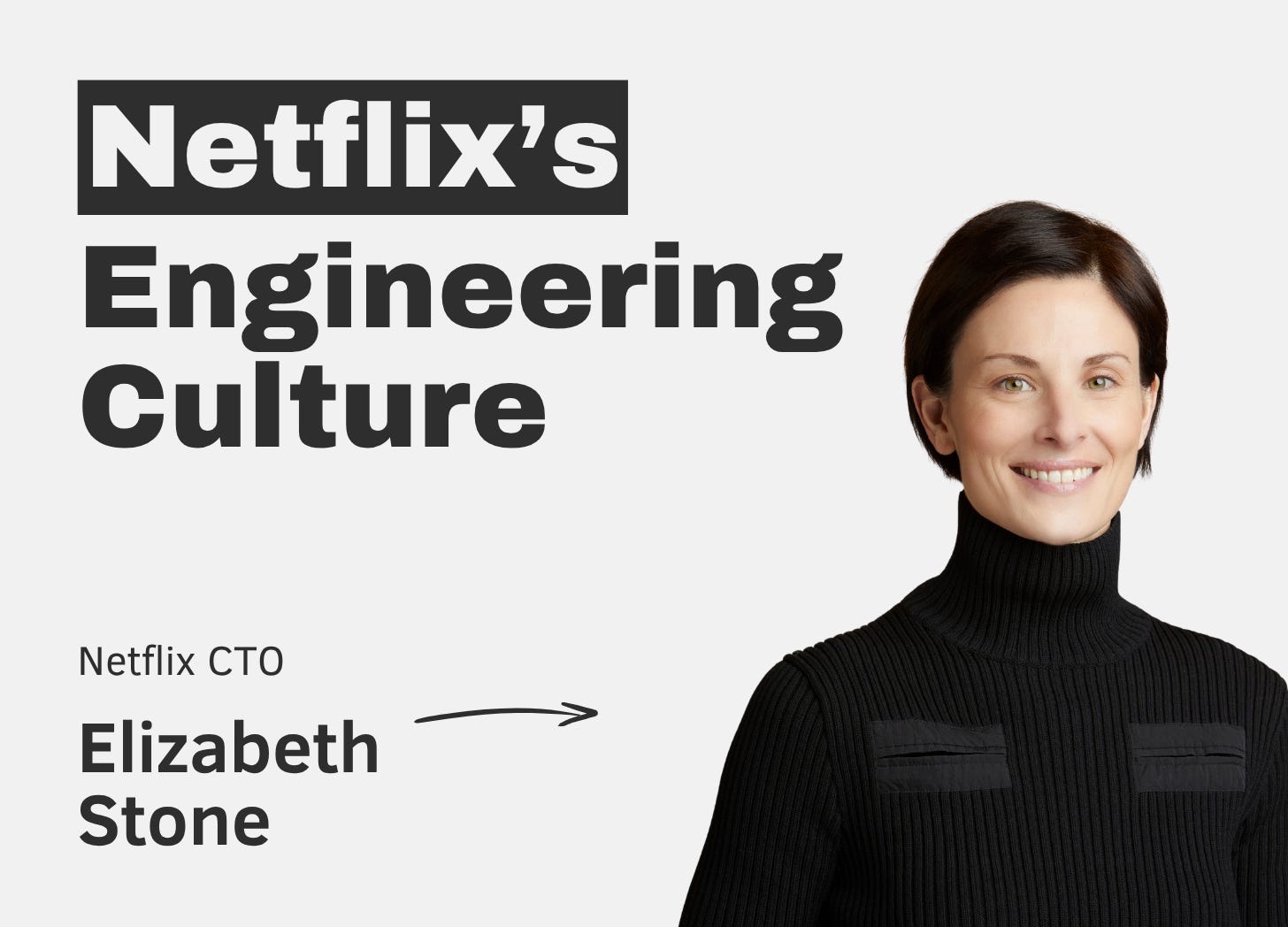
Overview of Netflix’s Engineering Culture
This episode of The Pragmatic Engineer (host Gergely Orosz) is a wide-ranging interview with Netflix CTO Elizabeth Stone about what it’s like to build software at Netflix. It covers Netflix’s scale, unique engineering problems (studio tooling, encoding, Open Connect, live streaming and games), the company’s culture (high talent density, autonomy, “Keeper Test”), performance management (no formal perf cycles), pragmatic use of AI, open source contributions, and a detailed case study of launching Netflix Live (from the first live special to a 65M-concurrent-stream event).
Key takeaways
- Netflix is massive in telemetry and media scale: more than a trillion events per day and custom engineering for content life cycle from “pitch to play.”
- Engineers have high autonomy and responsibility; innovation is team-driven rather than top-down.
- Live streaming forced Netflix to add guardrails (tiering, quiet periods, testing thresholds) while trying to preserve speed and autonomy.
- Netflix avoids formal, cadence-heavy performance reviews; it emphasizes continuous, candid feedback plus annual 360s, compensation reviews, and promotion cycles guided by the “Keeper Test.”
- Netflix is pragmatic about AI: experimenting with coding assistants and GenAI where they increase quality or impact (prototyping, documentation, migrations, anomaly detection).
- Netflix contributes heavily to open source (notably encoding technology), benefiting the industry and members.
Topics discussed
- Scale & systems: telemetry, media files, CDN (Open Connect)
- Unique Netflix engineering: studio production tools, media production suite, VFX (Scanline, Eyeline)
- End-to-end pipeline: “pitch to play” lifecycle from greenlight → production → encoding → delivery
- Live streaming launch case study: Chris Rock (first live), Jake Paul vs. Mike Tyson fight (largest), NFL events, WWE
- Engineering culture: autonomy, talent density, engineering principles (e.g., “Yearn to Learn”)
- Performance management: continuous feedback, Keeper Test, compensation/promotion process
- AI usage: coding assistants, prototyping, automation, detection/response
- Open source: encoding innovations, industry collaboration (Open Media Alliance)
Notable stats & facts
-
1 trillion events captured per day (consumer interactions + supporting signals)
- Open Connect CDN: ~6,000 edge locations, serving >175 countries
- Live timeline: first live (Chris Rock) March 2023 → largest live event (Jake Paul vs. Mike Tyson, Nov 2024) with ~65M concurrent streams
- Time from first live to the biggest event: ~18 months
- Netflix’s encoding work reduced required bandwidth by ~60% for equivalent quality (per CTO’s claim)
- Netflix has earned multiple technical Emmys for encoding work (CTO cited nine)
Live launch case study — how Netflix shipped Live at scale
- First live: March 2023 (Chris Rock special). By Nov 2024 they streamed a record-breaking boxing match (~65M concurrent).
- Team organization: self-organizing, cross-functional teams (Open Connect, encoding, production, discovery, data science).
- Timeline & approach: urgency + scrappiness + engineer-driven roadmaps; learned fast and iterated across subsequent events (NFL, WWE).
- Control room/launch ops:
- ~100 people on site; 30–40 engineers/data scientists in the launch room
- Custom dashboards built for the event (time-to-render, app start, rebuffer rates)
- Hardlined internet, VPN backups, launch commander, makeshift triage rooms
- 40–50 page launch plan with if/then playbooks
- Post-event learning: blameless, team-led retros; rapid memos with prioritized fixes; engineering ownership of resilience improvements
- Outcome: NFL launches later that year were “flawless” after iterating from observations.
Engineering culture & processes
- Autonomy and local judgment: teams own design, testing, and resilience decisions.
- Talent density: Netflix historically hired senior engineers (one level) but has added levels and now hires earlier career talent while still aiming for high bar.
- Guardrails introduced when needed: live required structured tiering (tier-zero/one services), quiet periods for high-risk windows, and testing thresholds for critical systems.
- Preference: minimize persistent process friction; use guidelines and guardrails for high-risk scenarios and leave judgment to teams.
- Cultural mottos: “Yearn to Learn,” “Think globally, act locally,” “Build for the future,” and “unusually responsible.”
Performance management & the Keeper Test
- No traditional, formal performance review cadence. Emphasis is on:
- Continuous, timely, candid feedback (manager and peer-driven).
- Annual 360 feedback for themes and improvement conversations.
- Compensation reviews once a year (reflecting market/top-of-market philosophy).
- Promotion cycles evaluated a couple times per year with collected feedback.
- Keeper Test: managers and teams ask whether they’d want to keep someone on the team (and vice versa). The culture is self-managing with checks and balances: managers are supported and reviewed by leadership when making compensation/promotion decisions.
AI adoption: how Netflix approaches tooling
- Pragmatic, experimental approach: provide teams options, create space/time to experiment, and collect feedback (GenAI champions help coordinate).
- Useful areas so far:
- Rapid prototyping (bootstrap ideas & cross-functional demos)
- Documentation and knowledge access (speed up getting system context)
- Large migrations (automation for repetitive tasks)
- Anomaly detection and incident response (triage & deep-dive assistance)
- Not seen as a silver bullet; Netflix evaluates where AI increases quality/impact rather than just cost reductions.
Hiring & talent strategy
- Historical model: very senior-heavy (single “senior” level early on) to achieve talent density and autonomy.
- Current model: broader distribution — still high bar but adding early-career engineers, interns, and investing in senior/principal/distinguished roles.
- Rationale: early-career hires bring new perspectives (esp. on AI), energy, and a path to build talent internally.
Open source & engineering contributions
- Netflix invests heavily in open source (approx. 1 in 5 engineers work on OSS per one cited report).
- Encoding & media tech are major contributions: improvements in encoding reduced bandwidth needs and increased catalog size/quality.
- Industry collaboration: founding member of industry efforts like the Open Media Alliance to push open encoding standards.
- Open source serves both altruistic and strategic purposes—raising the industry bar benefits Netflix’s members and operations.
Actionable advice Elizabeth Stone gives to new engineers
- Be curious: ask questions, challenge problem definitions, and experiment.
- Take smart risks: prototype and iterate; don’t be paralyzed by fear of failure.
- Lean on the community: seek mentors and learn from other engineers—ideas and improvements can come from anywhere in the org.
- Embrace ownership: high autonomy at Netflix comes with high accountability.
Short list of notable quotes / insights
- “We have more than a trillion events that we’re capturing every day.”
- “Pitch to play” — engineering underpins the full content lifecycle from greenlight to delivery.
- “I feel like I lost 10 years of my life in that one night” — describing stress and intensity of the Paul/Tyson (boxing) launch.
- “No formal performance reviews … we focus on continuous, timely, candid feedback.”
- Favorite engineering principle: “Yearn to learn.”
Who should listen / value
- Engineers and managers curious about operating at extreme media scale, building end-to-end content pipelines, or running live streaming at massive concurrency.
- Leaders designing culture/process trade-offs: autonomy vs. guardrails, hiring distributions, and continuous feedback models.
- Practitioners interested in pragmatic AI adoption and open-source impacts in production media systems.
If you want a quick takeaway: Netflix combines exceptional engineering scale and unique media problems with a culture that prioritizes autonomy, accountability, talent density, and pragmatic tooling—adding targeted guardrails only where business-critical risks demand them.