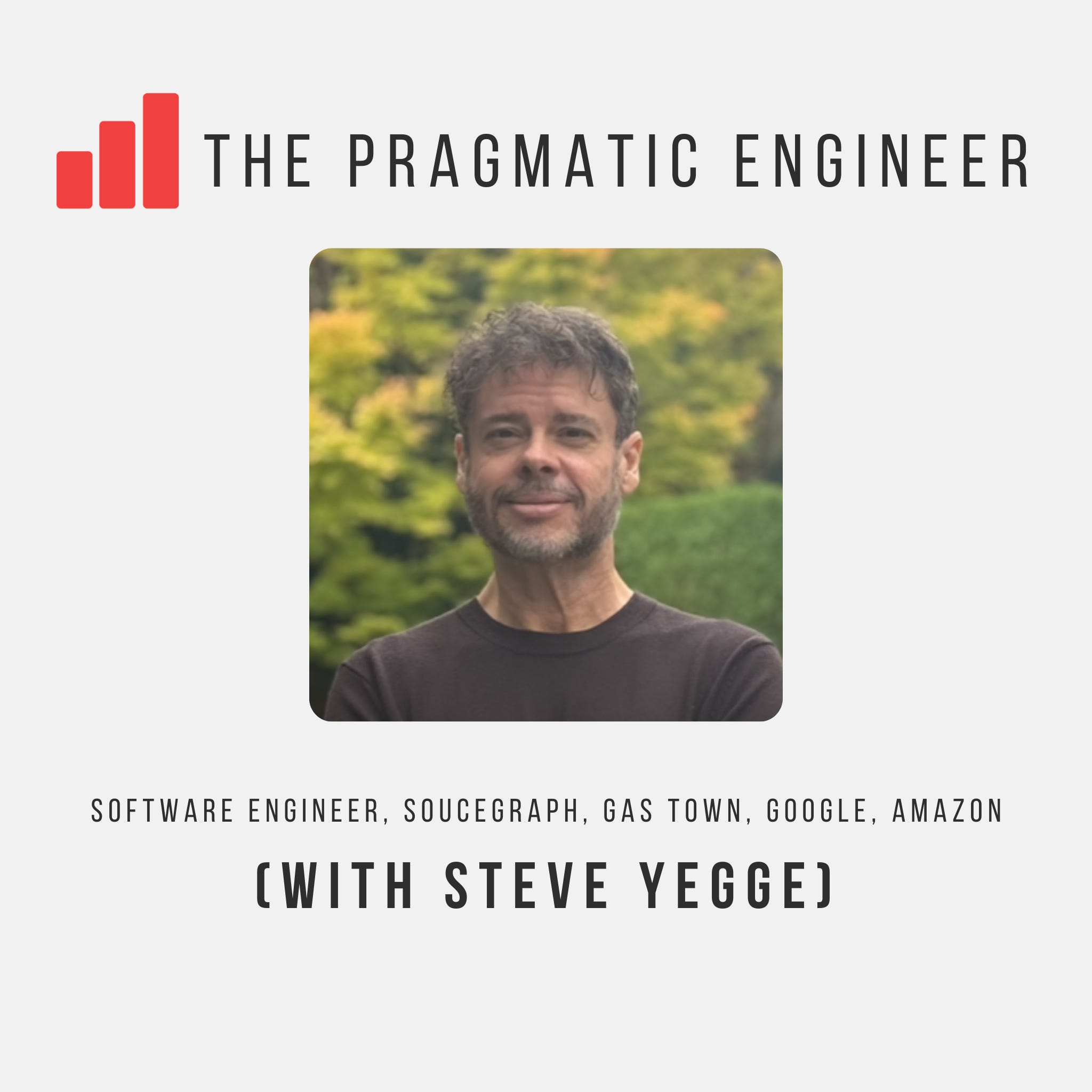
Overview of From IDEs to AI Agents with Steve Yegge
This episode (hosted by Gergely Orosz) is a wide-ranging conversation with Steve Yegge about how AI—especially agent orchestration—will change software engineering. Steve covers his eight-level spectrum of AI adoption, the design and lessons from his open-source orchestrator Gastown, the productivity/psychological trade-offs of "vibe coding", why big tech may struggle while small teams gain power, and practical guidance for engineers and companies that want to avoid being left behind.
Main topics discussed
- Steve’s background, earlier essays and how his views evolved from compilers/debuggers to AI agents
- The eight levels of AI adoption for engineers
- Gastown: what an orchestrator looks like in practice (architecture, roles, workflows)
- The two fundamental agent workflows: maximize-context vs minimize-context
- Productivity curves, model improvement cadence (Anthropic / Opus), and the “bitter lesson”
- Industry consequences: layoffs, redistribution of work, small-team advantage
- Human effects: “vampiric” burnout, value capture, token burn
- Risks: non-determinism, agent “heresies”, monoliths, safety/verification
- Practical actions engineers and organizations can take now
Key takeaways
- AI adoption is a multi-stage journey: most engineers are still on the low end. Those who don’t move up risk being left behind.
- Agents + orchestration is the next big shift after completions and chat: running agents that spawn and coordinate other agents transforms how code gets produced.
- The productivity boost from agents is real and large (Steve uses orders-of-magnitude language), but it creates distribution questions: who captures the value and how to avoid burnout.
- Big companies face structural bottlenecks (monoliths, politics, inability to absorb rapid output); nimble small teams can outcompete them if they adopt agents.
- Practical experimentation (high token burn) is the organizational signal of learning and progress—companies should measure and encourage it.
- Many current orchestrator/UIs are still immature; visibility and UI matter because most people struggle with long-form reading/prompts.
Steve’s eight levels of AI adoption (summary)
- No AI at all.
- Basic IDE help: yes/no completions inside your editor.
- Low-trust usage: you “YOLO” small tasks and frequently check results.
- Higher trust: agent generates large chunks; you review diffs less and focus more on conversational steering.
- Agent-driven workflows: you let the agent produce code and only inspect in the IDE later.
- Multiplexing: your main agent is busy so you spin up additional agents and bounce between them.
- Chaos/mess: multiple agents conflict, create uncoordinated changes—now you need orchestration.
- Orchestrated parallel agents: coordinated agent teams with governance, inboxes, identities, monitoring.
(The spectrum shows increasing trust, decreasing per-line human ownership, and rising need for orchestration and coordination tooling.)
Gastown — what it is, how it works, and lessons learned
- What it is: an open-source orchestrator Steve built for running agents that spawn and coordinate other agents (agents running agents).
- Architecture metaphors: “the mayor” (talk to it), “crew” (max-context workers for complex design), and “polecats” (min-context workers for narrow tasks). Workers have identities/inboxes; you can inspect and poke them.
- Two complementary workflows:
- Maximize-context (crew): load lots of docs, hold conversations, tackle design problems.
- Minimize-context (polecats): short explicit tasks, efficient and self-contained.
- Practical status: intentionally experimental and sometimes brittle—many workarounds for current model limitations; migrating Gastown storage to Dolt (Git-like DB).
- Design lessons:
- Visibility matters: treat orchestrators like factories you can peek into (UIs help).
- Document common failure modes (“heresies”) and embedding guardrails in prompts/tooling is essential.
- Expect rapid tool churn—current designs may be short-lived as models improve.
Major industry and social implications
- Model improvements are continuing fast (shortening cycles): Steve expects rapid, continuing leaps (Opus 4.5 → more).
- Layoffs & company trade-offs: some employers may reduce headcount to pay token/inference costs while keeping output—this creates redistribution of jobs and suffering for many displaced engineers.
- Small teams advantage: 2–20 person teams that adopt agents can rival big-company output; we may see many new startups and building-block providers.
- Democratization: non-developers can ship software more easily; personal/bespoke software will increase dramatically.
- Politics and organizational friction: companies with more people than meaningful work risk land grabs and stagnation; engineering org design must change.
- “Vampiric” burnout: working with agents is cognitively intense—people can be far more productive but only sustain a few high-quality hours per day.
- Value capture problem: if one engineer becomes 100× productive, how is that extra value shared? New compensation models (equity, post-employment payouts) may be needed.
Risks and technical challenges
- Non-determinism and risk-aversion: businesses often can’t accept probabilistic outputs in critical systems; adoption will be cautious.
- Monoliths: large monoliths won’t fit in context windows; breaking systems apart is a precondition for agentic benefits.
- Heresies: recurring incorrect patterns can take hold across agent-generated code—these are hard to detect and need tooling and documentation.
- Debugging and verification: models currently rely on primitive debugging patterns (prints); specialized debugging and verification tooling will be required.
- Training/visibility gaps: many people struggle with long-form reading and prompt-based workflows—good UIs and summarization layers are necessary.
Practical advice & action items (for engineers and teams)
- Start experimenting now. Token burn (actively trying tools) is the best proxy for learning and organizational momentum.
- Try multiple interfaces: CLI, conversational UIs like Claude Co-work, or visual agent UIs—pick what helps you iterate.
- Break up monoliths or plan to rewrite components into units agents can operate on.
- Build transparency: make work visible and push prototypes publicly early to find partners, bugs, and product-fit faster.
- Instrument and measure token burn, experiments, and outcomes—encourage safe experimentation.
- Guard against burnout: plan for fewer deep-focus hours; negotiate captured value (equity, comp, time) so productivity gains are not purely captured by employers.
- Defend against "heresis": document known failure modes in prompts and build checks that prevent agents from repeatedly adopting the same wrong architecture.
- If you’re an engineering leader: expect politics and new resource allocation problems—decide how you’ll share gains and how you’ll retrain staff.
Notable quotes and short insights
- “If you’re anti-AI at this point, it’s like being anti-the sun.”
- “The single most important proxy metric … is token burn.”
- “There’s a vampiric effect happening with AI where it gets you excited and drains your energy.”
- “Don’t try to be smarter than the AI. The bitter lesson: bigger is smarter.”
Predictions Steve makes (short list)
- By the end of the (current) year, most people will program by talking to a “face” (a conversational front-end) rather than typing in an IDE.
- Small teams (2–20 people) that adopt agent workflows will rival big-company output.
- Many big companies are structurally ill-suited to this rapid agent-driven world and may quietly lose dominance.
- Personal/bespoke software will become common and democratized; agents will be central to discovering and assembling that ecosystem.
- Short-term: orchestrators and agent tooling will iterate quickly—current projects will be replaced or reshaped fast.
Quick summary — what to do this week
- Pick one agent UI (Claude Co-work, a visual agent tool, or an orchestrator prototype) and spend 30 minutes/day experimenting.
- Measure token burn for your team and allow a small budget for exploratory experiments.
- Identify a small, well-scoped service or module in your codebase that could be rewritten as an agent-friendly microservice; prototype it.
- Document at least two “hereses” (common ways agents might get it wrong) and add checks or prompts to prevent them.
This episode is a pragmatic call to action: the agent era is already here for those who try; the biggest gaps are organizational (readiness, tooling, compensation, and culture), not merely technical. If you want to stay relevant, experiment fast, push for visibility, and think about how to share the value you create.