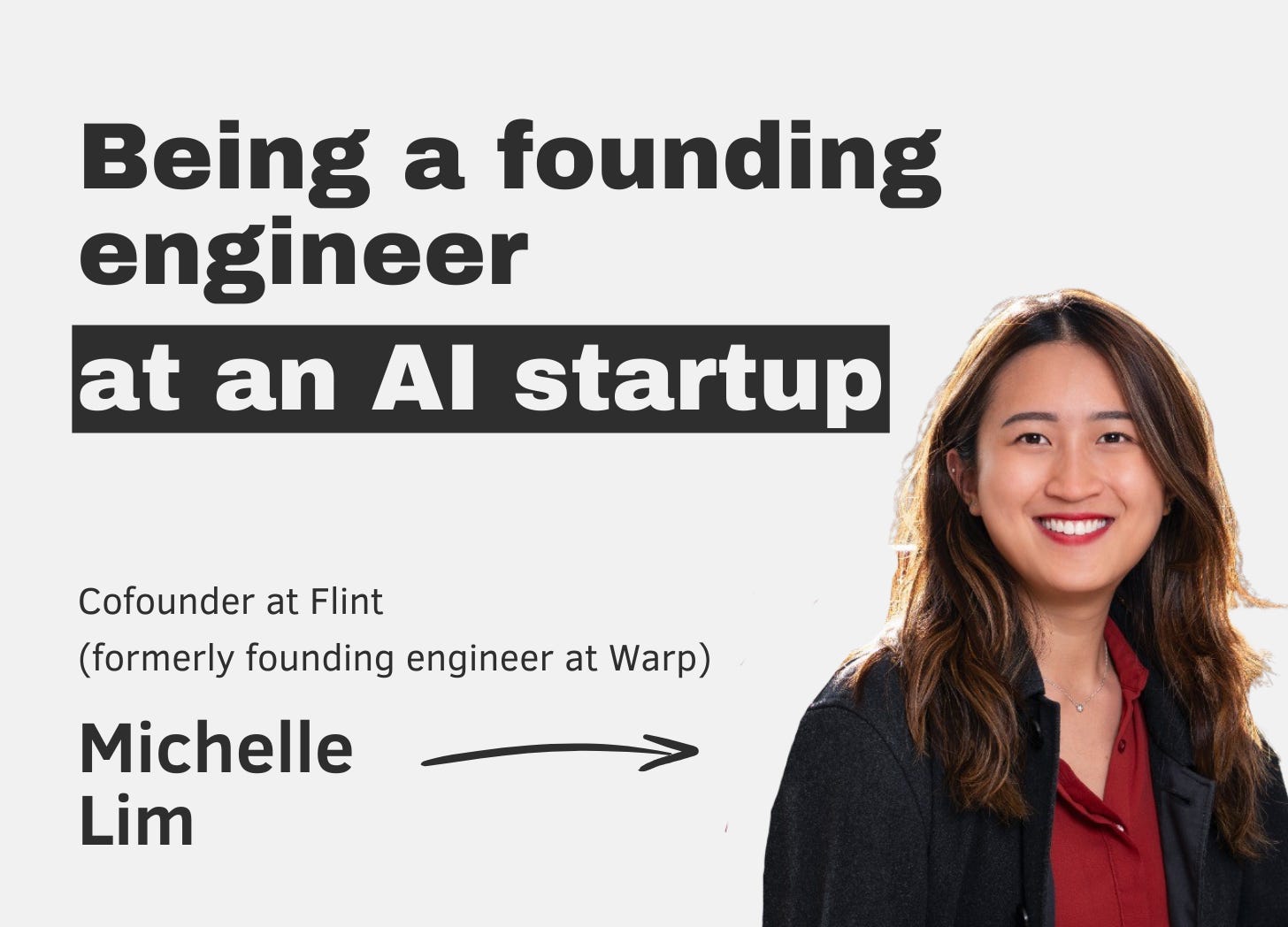
Overview of Being a founding engineer at an AI startup (podcast with Gergely Orosz & Michelle Lim)
This episode follows Michelle Lim’s journey from a late CS major to internships at Facebook/Slack/Robinhood, to being the founding software engineer at Warp, and now a founder at Flint (an AI startup building “autonomous” websites). The conversation covers why she chose an early-stage startup over safer options, what being a founding engineer actually looks like day-to-day, technical and product trade-offs (TypeScript → Rust at Warp), how to evaluate and negotiate early-stage offers, and pragmatic advice for engineers who want to join or start AI startups.
Key takeaways
- Ownership increases substantially as team size shrinks. Michelle’s internships (12k → 1,200 → 300 people) led her to seek the highest possible ownership: being the first engineer at Warp.
- Founding engineer = early joiner + wide remit. Expect to be full-stack and to do non-engineering tasks the company needs (growth, docs, Hacker News, sales enablement).
- Product-first vs code-first engineers: product engineers prioritize user impact and can work across the stack; code-first engineers often gravitate to infrastructure and low-level elegance.
- Tech tradeoffs matter for adoption and performance. Warp started in TypeScript then rewrote in Rust for performance, development speed under load, and community/marketing signal.
- Negotiation and compensation: equity is negotiable and important for early hires; Michelle traded salary for equity and used a spreadsheet with multiple options and dilution/tax scenarios.
- Vet the founder/manager as carefully as the company: ask for references of people the founder managed (especially junior hires), and consider asking how the founder intends to treat employees in raises, secondaries, or exits.
- AI tooling is now pervasive: pair-programming with AI is common, and teams use tools like Cursor / Cloud Code in the IDE. Building small AI products as side projects is a strong signal for joining AI startups.
- Flint’s vision: agentic/autonomous websites that perceive market signals, make decisions, and control content—closing the loop so sites self-optimize and personalize in real time.
Topics discussed
Michelle’s background and internships
- Started CS in college motivated by entrepreneurship.
- Internships: Facebook University (Android apps, Git, big codebases), Slack (Kleiner Perkins fellowship, strong product ownership, CEO accessibility), Robinhood (news feed — data pipelines, tagging, ranking; product+tech).
- Smaller companies gave clearer line of sight to user impact.
Joining Warp (founding engineer story)
- Warp (initially “Denver”) was just an idea + mocks when she joined as first engineer.
- Core product concepts: block-based terminal UI, collaboration, environment-sharing.
- Decision to join: passion for product, potential business impact (terminals matter for ops/enterprise), mentorship from a seasoned founder/engineer, and opportunity to learn quickly.
Tech stack choices and practices
- Initial frontend in TypeScript, then full rewrite in Rust for:
- Rendering performance (many rectangles/logs, smooth scrolling).
- Fewer runtime stress-testing cycles.
- Community/marketing signal (Rust-built terminals are perceived as higher-performance).
- Pair programming with experienced engineers (e.g., Nathan Sobo) accelerated learning Rust and idioms.
Product engineer vs infrastructure/code-first
- Product engineers: focused on user problems, full-stack, prioritize visible user milestones.
- Code-first/infrastructure engineers: care about low-level performance, libraries, elegance.
- Hiring processes should include product rounds to identify product thinkers (user focus, milestone decomposition).
Compensation, negotiation, and references
- Michelle negotiated aggressively for equity (accepted lower cash).
- Used a spreadsheet with multiple salary/equity options, including dilution and tax modeling (a tool she still uses).
- Recommended: ask for references for the founder/manager (especially about how they treat junior hires); a “hell yes” endorsement from references is a strong hiring signal.
- Also ask about founder behavior in exits/secondaries (not binding but informative).
Non-engineering work & career growth as a founding engineer
- Founding engineers often take on "unsexy" but high-value tasks: community management, blog posts, Hacker News, Twitter, Discord, marketing, responding to security questionnaires, building compliance materials.
- Doing these well can lead to rapid career growth and unexpected responsibilities (e.g., being asked to lead growth or enterprise sales).
AI, tools, and Flint (Michelle’s current startup)
- AI is integral for productivity: everyone pairs with AI assistants; Cloud Code and IDE-integrated AI are common.
- Flint’s product: autonomous websites that sense market changes, generate/optimize pages (comparison pages, product demos), dynamically personalize per visitor or agent, and expose agent-to-agent protocols for a more “agentic web.”
- Challenges: maintaining on-brand, pixel-perfect pages for enterprise customers; building perception → decision → control loops; agent interoperability.
Notable quotes / useful lines
- “Every time I went down [in company size] I felt way more ownership.”
- “Product-first people see technology as a means to an end of user impact.”
- “Founding engineer counts if you are in the first five or so that joins within the first few months.”
- “Volunteer to do the things that no one wants to do, but are the most important for the business.”
Actionable advice / checklist
For engineers evaluating early-stage AI startup offers
- Do manager/founder reference checks—ask specifically about how the founder treats junior hires and whether they would rehire the candidate with a “hell yes.”
- Ask about how the company plans to treat early employees in potential secondaries or acquisitions; listen to whether the founder has thought it through.
- Negotiate equity intentionally; consider trading cash for more upside when you believe in the product and team.
- Check the tech choice realism: will the stack support the user performance needs? (Michelle’s Rust decision is a concrete example.)
To thrive as a founding (or early) engineer
- Be full-stack and product-minded: focus on user-visible milestones and iterate end-to-end.
- Volunteer for “hot potatoes” (community, growth, compliance)—doing them well accelerates career exposure.
- Build small AI/product projects on the side to demonstrate applied LLM or model experience.
- Use modern AI coding tools (Cursor, Cloud Code) to accelerate productivity—pair with them like a teammate.
- Ensure core engineering responsibilities remain solid—only take extra roles after your technical work is on track.
For founders hiring founding engineers
- Show genuine care for people, outline promotion paths, and be explicit about how early employees will be treated in raises/secondaries/exits.
- Hire for product-first instincts when you need full-stack, user-focused problem solvers; include product rounds in interviews.
- Offer clear equity explanations (dilution, tax, outcome scenarios) to help candidates evaluate offers.
Technical notes & tools mentioned
- Warp: TypeScript → full rewrite in Rust (performance and perception).
- Pair programming accelerated Rust adoption and idiomatic coding.
- AI dev tools: Cursor, Cloud Code integrated into IDEs (even Vim).
- Flint: TypeScript backend/front-end stack (Michelle notes Rust may appear later), building agentic websites, agent-to-agent protocols.
Sponsors mentioned (brief)
- Statsig: feature flags + experimentation platform for safe AI-accelerated shipping (experiment at small %, detect harm early).
- Linear: product management tool that helps teams coordinate during hyper-growth.
Who should listen / read this summary
- Engineers considering joining early-stage or AI startups who want a realistic picture of responsibilities and trade-offs.
- Founders hiring early engineers who want signals to assess product-minded candidates and how to structure offers.
- Engineers deciding between product-first vs infrastructure roles and wanting tactical advice for standing out.
If you want to act on anything from this episode: start a small AI side project (even a weekend prototype), build a short equity/dilution spreadsheet to understand offers, and practice asking for manager references during interviews.