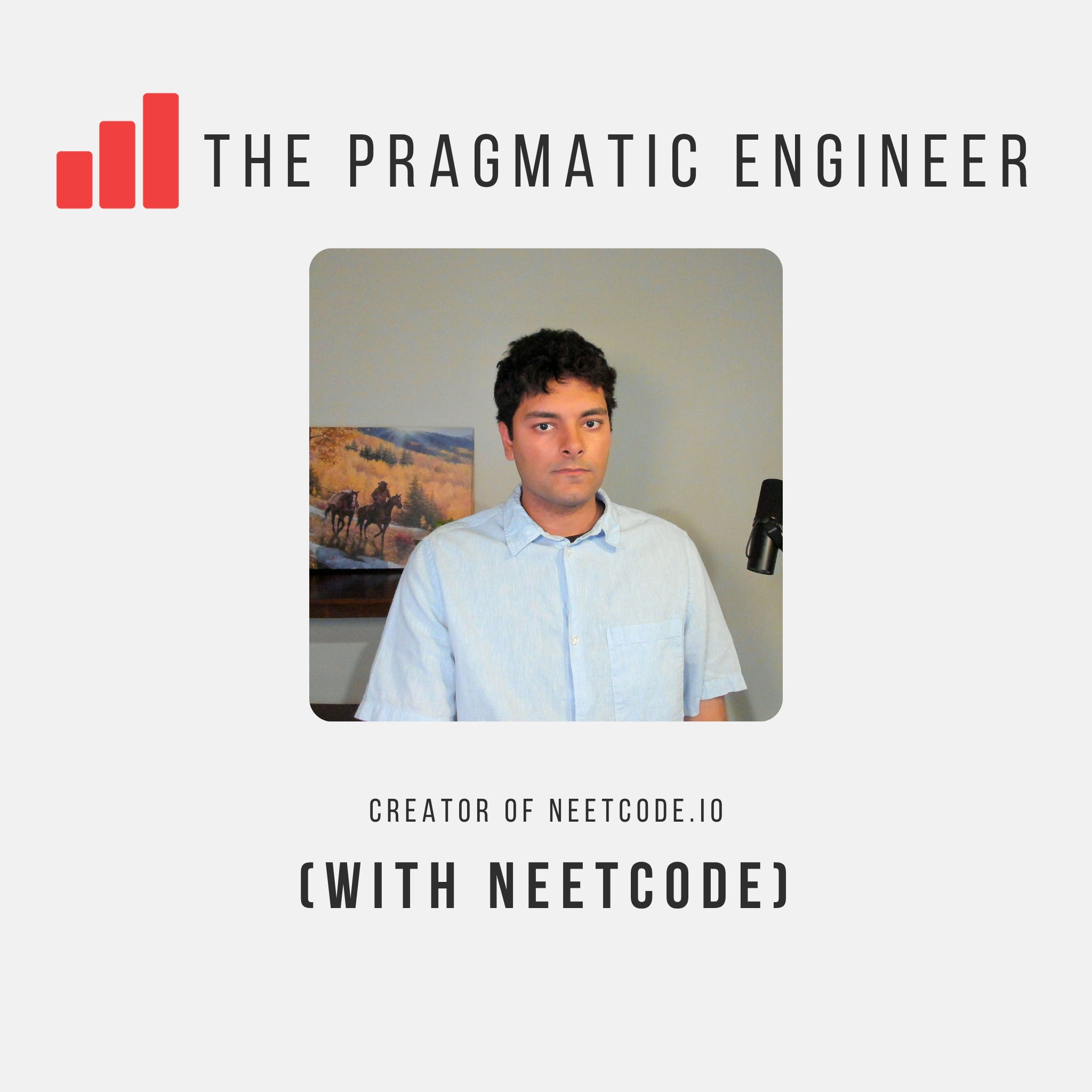
Overview of Tech Interviews with NeetCode
In this episode, Gergely Orosz talks with Navdeep Singh (“Neet”), the creator of NeetCode, about what coding interviews really measure, how AI is changing software engineering, and which skills still matter most over a long career. The conversation ranges from Neet’s unusual path from electrical engineering to Amazon, Google, and then full-time content/business building, to his broader views on hiring, productivity, and why effort, communication, and agency may matter more than memorized algorithms.
Neet’s Path Into Tech
From electrical engineering to programming
- Neet originally studied electrical engineering because he liked math and physics.
- He struggled at first with programming basics in C, but eventually “clicked” into it once concepts like variables, loops, functions, and conditionals came together.
- What hooked him was the infinite complexity that can be built from simple primitives.
Amazon was a rough start
- He joined Amazon after college, but left after about two months.
- He described the environment as highly stressful and misaligned with how he worked best.
- The experience left a strong impression on him about how much company culture shapes a new engineer’s early career.
Google was the opposite experience
- At Google, he found the environment much more supportive and less chaotic.
- He worked independently, built confidence, and was promoted relatively quickly.
- That period helped him realize he could succeed in a better-fitting environment, even if he still preferred going deep on technical details.
Why Coding Interviews Still Haven’t Changed
DSA interviews remain “sticky”
Neet argues that data structures and algorithms interviews have survived AI disruption because:
- Companies still don’t know how to reliably predict job performance.
- Interviews are less about exact job simulation and more about assessing whether a candidate can think.
- Changing interview systems is costly, bureaucratic, and risky, especially at large companies.
The format is imperfect, but hard to replace
- He acknowledges that LeetCode-style interviews don’t perfectly correlate with job performance.
- But the biggest problem is not that they are ideal; it’s that no scalable alternative has proven clearly better.
- AI-assisted interviewing may appear, but adoption will likely be slow and uneven.
What NeetCode Actually Teaches Beyond Algorithms
The hidden value of interview prep
Neet believes prep for DSA interviews builds more than just algorithm knowledge:
- Deep problem-solving habits
- Communication under pressure
- Ability to explain tradeoffs clearly
- Structured thinking and planning
- Discipline to work through hard things without immediate help
The real skill: thinking, not memorizing
- He argues that the useful part of interview prep is learning how to reason through problems.
- In real engineering work, that translates into:
- breaking down ambiguous tasks,
- explaining your approach to teammates,
- and making decisions under constraints.
NeetCode as a Business
Started as a side project
- Neet began making tutorial videos after leaving Amazon, mainly for fun and to help others.
- He initially felt the audience was small, but the channel grew dramatically after he got into Google and could point to the results.
The website and the business grew
- He built a free website to organize the content.
- Over time, it became a larger business, and he eventually went full-time.
A recurring theme: tradeoffs
Neet repeatedly emphasized that:
- Good product decisions are about what matters to users, not what looks impressive technically.
- He deliberately took shortcuts on low-value things when it helped him move faster.
- AI later helped him clean up technical debt and migrate faster than would have been possible before.
Neet’s Views on AI and Software Engineering
AI makes building easier, but value harder
One of Neet’s strongest themes was:
- It’s easier than ever to build software.
- It is much harder to build something people actually value.
Why
- AI can generate features quickly, but speed alone can create clutter, regressions, and low-quality product decisions.
- The bottleneck is no longer just implementation; it’s judgment, prioritization, and understanding users.
He sees AI as eroding some skills
- Students and engineers may become overly dependent on AI tools.
- That can weaken their ability to think independently or code without assistance.
- He expects more in-person or AI-resistant interview formats as a response.
Hiring Philosophy: Agency, Communication, and Effort
What he looks for in candidates
Neet said he increasingly values:
- Agency: people who get things done without needing hand-holding
- Communication: people who can explain why they made a decision
- Motivation: people who genuinely care
- Adaptability: people who can learn a new domain quickly
Why this matters more than raw coding skill
- AI can supply answers and code snippets.
- What AI cannot supply is judgment, ownership, and the ability to defend tradeoffs.
- He gave examples of candidates who had weaker formal resumes but were far more effective because they were proactive and fast learners.
His view on hiring processes
- For smaller companies, trial periods, paid test projects, or direct work samples may be better than long interview loops.
- For big companies, that model is harder to scale, which is why traditional interviews persist.
His Hot Takes on Tech Careers
“Some people should give up on tech careers”
This was one of the most controversial parts of the conversation.
What he meant:
- Not that people should literally quit tech.
- But that if someone is unwilling to put in effort, learn deeply, and work through hard problems, tech may not be a good fit.
- He feels many people enter the field expecting shortcuts, especially with AI, and underestimate the work required.
Effort is becoming the differentiator
Neet’s core argument is that:
- When AI makes mediocre output cheap, effort becomes more visible.
- Being able to explain your choices, care about quality, and think through problems matters more than ever.
Broader Reflections on Engineering
Systems thinking still matters
Neet and Gergely discussed whether “systems thinking” is really just domain expertise in disguise. Their conclusion:
- It’s both.
- Deep domain understanding and the ability to think in systems reinforce each other.
- Engineers who transfer well across domains often combine both.
Engineering is about tradeoffs, not perfect answers
- Neet repeatedly contrasted engineering with math: engineering rarely has a single correct answer.
- The best answer depends on the business problem, constraints, and long-term maintainability.
- This is true whether you’re building software, managing a team, or shipping AI-assisted code.
Key Takeaways
- Coding interviews survive because no scalable replacement has won yet.
- DSA prep teaches thinking, communication, and tradeoff analysis—not just algorithms.
- AI lowers the cost of implementation, but increases the importance of judgment and effort.
- Agency and communication are becoming more valuable than rote coding ability.
- Public work, authenticity, and clear explanation can matter a lot in hiring and audience-building.
- If you want to stand out, learn to think deeply, explain your reasoning, and adapt quickly.
Practical Advice for Engineers
If you’re job hunting
- Don’t just memorize solutions; practice explaining your thinking.
- Learn to articulate tradeoffs and assumptions.
- Be ready to show initiative and ownership.
If you’re already working
- Ask for feedback early and often.
- Know what your team values and align with it.
- Build the habit of making your reasoning visible to others.
If you’re using AI tools
- Use them to move faster, but don’t let them replace your own judgment.
- Be careful not to lose foundational skills.
- Keep practicing independent thinking and code comprehension.
Notable Insight
“What you cannot prompt is caring.”
That idea captures the episode’s central message: in a world where code and design can be generated quickly, the real differentiator is still the human one—effort, taste, judgment, and the ability to explain why something should exist at all.