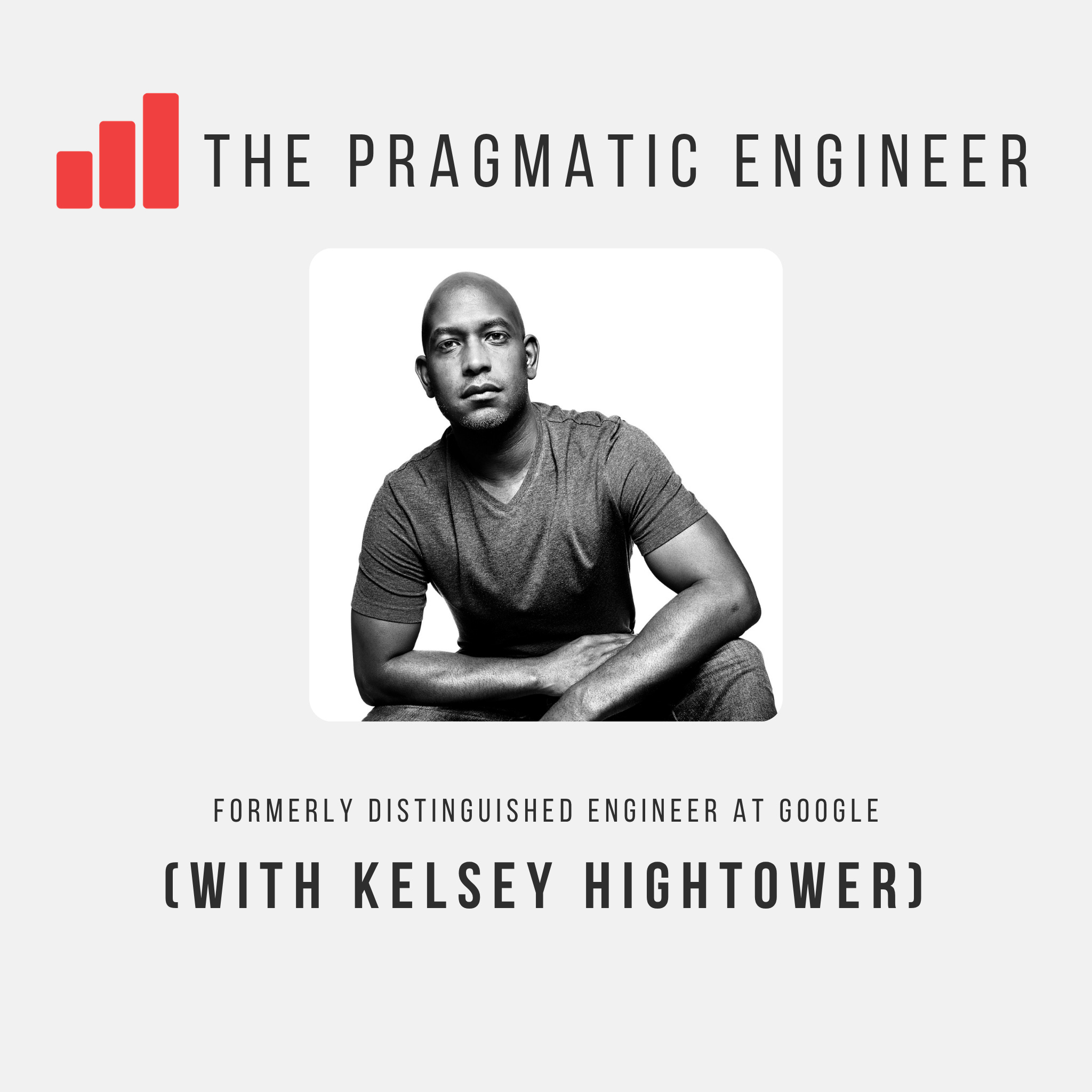
Overview of Kubernetes and retiring at the top with Kelsey Hightower
This episode traces Kelsey Hightower’s unlikely rise from teen McDonald’s worker and DSL installer to one of the most influential figures in cloud infrastructure, and then to an early retirement at the top of the industry. Host Gergely Orosz and Kelsey cover his hands-on career path through data centers, web hosting, Puppet, CoreOS, Docker, and Kubernetes, plus the career moves, mindset shifts, and practical advice that shaped his trajectory. The conversation also goes deep on how Kubernetes won, how to think about promotions and negotiation, and why Kelsey sees AI as a tool that should enhance — not replace — human decision-making.
Kelsey Hightower’s Unconventional Path Into Tech
Kelsey’s story is defined by fast learning, practical skills, and constant reinvention:
- First jobs: He started at McDonald’s, quickly learning responsibility and operations.
- Early programming exposure: In high school he got into AutoCAD and then basic programming through a TI-86 calculator.
- College didn’t stick: He briefly attended college but left because it felt too slow and disconnected from the real job market.
- The real entry point into tech: He earned A+ certification, which led to contractor work installing DSL and networking equipment at BellSouth.
A recurring theme is that Kelsey didn’t wait for permission. He learned what the market needed, got certified, and built a business around it.
From Contractor to Entrepreneur to Google
Before Google, Kelsey:
- Installed and troubleshot home and business internet setups.
- Opened a small computer store near Atlanta.
- Built custom PCs and supported local clients.
- Expanded into music studio tech work as studios moved toward digital tools like Pro Tools.
- Even managed a comedian on the side, showing his knack for logistics and business.
His move to Google came from wanting stability, scale, and the chance to keep learning. He joined as a data center technician, where he learned how Google operated at massive scale and became obsessed with improving his performance and speed.
What He Learned at Google Data Centers and Web Hosting
At Google, Kelsey saw a different world:
- Highly standardized data centers.
- Large-scale machine repair and hardware diagnosis.
- Metrics-driven work with feedback loops that helped him optimize his approach.
He then moved to web hosting, where he learned the power of automation:
- Provisioning servers from forms and scripts.
- Automating installs, networking, and configuration.
- Seeing how much could be done end-to-end if systems were designed right.
One of the biggest lessons from this era: impact matters more than activity. It wasn’t about being busy on calls; it was about reducing the ticket queue and improving the outcome for the whole team.
Puppet, DevOps, and the Shift From Manual Work to Automation
Kelsey describes Puppet as a major inflection point:
- He used it to hide complexity behind Jira workflows.
- He contributed to open source at nights and weekends.
- He helped move operations away from one-off manual tasks toward repeatable automation.
- This was before “DevOps” was even a mainstream term.
He also highlights a key cultural change:
- Many people stay in the same operational loop for decades.
- Real career growth comes from moving from manual execution to system design.
How Kubernetes Won: Docker, CoreOS, and the Right Abstractions
Kelsey explains the container era as a series of competing visions:
- Docker made containers mainstream.
- Terraform shifted the cloud mindset toward APIs and infrastructure as code.
- CoreOS pushed a future where the OS and distributed systems were built around containers.
- Kubernetes succeeded because it had the right abstractions and timing.
Why Kubernetes broke through
According to Kelsey, Kubernetes succeeded because it:
- Built on Docker, rather than fighting the existing ecosystem.
- Used etcd and a clear control-plane model.
- Introduced infrastructure as data, not just code.
- Made the system extensible through custom resources and a strong API model.
- Gave users a better, safer way to describe desired state.
He emphasizes that Kubernetes brought types to infrastructure, reducing ambiguity and making automation safer.
The “Every Job Is an Interview” Lesson
One of the strongest themes in the episode is that every job is an interview:
- When Kelsey demoed Kubernetes from a slide deck at GopherCon, the CoreOS team was in the audience.
- His open-source contributions to Puppet were noticed when James Turnbull visited his office.
- Showing your work publicly creates opportunities, even if you don’t see them immediately.
This is one of Kelsey’s practical career lessons: keep doing strong work in public, because your next opportunity may already be watching.
Promotions, Impact, and the Microsoft Negotiation Story
Kelsey’s promotion path at Google was driven by impact, not just output:
- He moved from L5 to Distinguished Engineer over about seven years.
- He created programs like empathetic engineering to help product teams understand what users actually needed.
- He learned to write promotion packets that felt authentic and direct, rather than corporate and sterile.
Microsoft offer and counteroffer
A notable story in the episode:
- Microsoft made him a very large offer, which nearly doubled his comp.
- He did not use it as a blunt ultimatum.
- He told Google the truth, and they matched and surpassed the offer.
- He later had a direct conversation with Satya Nadella, which reinforced that he was respected across the industry.
His takeaway: negotiation should be honest, not adversarial, especially when trust already exists.
Why He Retired Early
Kelsey retired because he had already achieved what he wanted:
- Financially, he had enough.
- Professionally, he had reached the top.
- Personally, he wanted more time and control over his life.
He treats money as “freedom tokens”:
- He kept his lifestyle modest.
- He avoided lifestyle inflation.
- He planned for retirement early instead of assuming he’d work forever.
He also became more intentional about life outside work:
- Spending time with family.
- Slowing down.
- Being present.
- Prioritizing relationships and experiences over constant productivity.
Kelsey’s Practical View of AI
Kelsey is neither naïve nor anti-AI. His view is grounded and pragmatic:
What AI is good for
- Speeding up repetitive work.
- Helping with documentation and examples.
- Acting as a new interface for existing systems.
- Reducing friction where APIs are poorly designed.
What AI should not do
- Replace human judgment.
- Turn software engineering into a pure code-generation exercise.
- Encourage people to skip fundamentals.
His biggest point: software engineering is about solving human problems, not just typing code.
Advice for engineers worried about commoditization
Kelsey argues that engineers should:
- Reflect on how software has already automated other industries.
- Recognize that coding is only one part of the job.
- Learn deeper fundamentals: architecture, systems, security, hardware, and product thinking.
- Use AI as a tool, not a substitute for understanding.
Key Takeaways
- Kelsey’s career was built on initiative, public work, and continuous learning.
- The biggest leaps came from impact and systems thinking, not just raw technical skill.
- Kubernetes won because it aligned with the existing Docker ecosystem and offered better abstractions.
- Retirement became possible because he combined high earnings with low spending.
- AI is useful, but it doesn’t change the core purpose of engineering: helping humans solve real problems.
Notable Insight
“Every job is an interview.”
That idea runs through the whole episode and captures Kelsey’s approach to work, reputation, and opportunity.