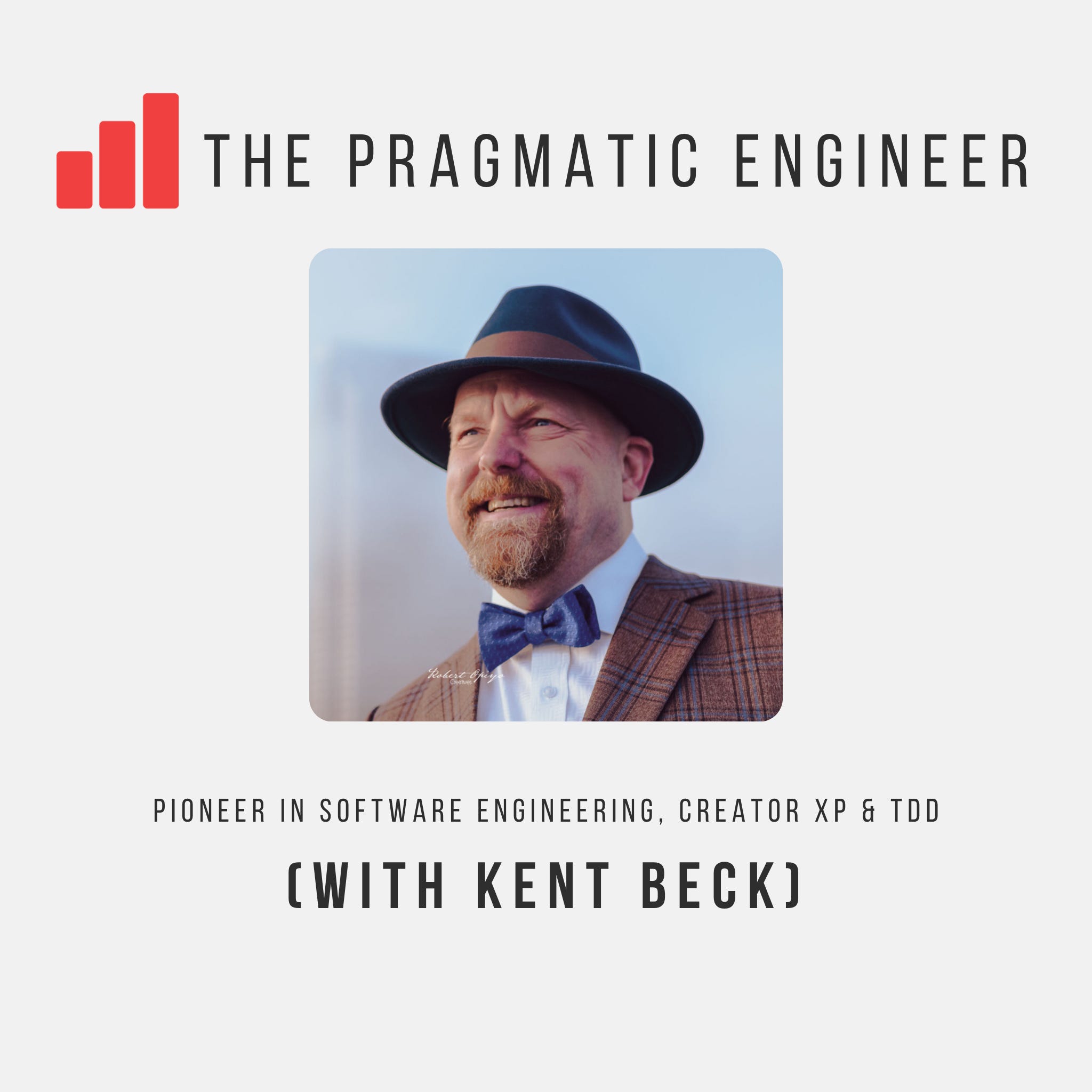
Overview of How Kent Beck shapes the software engineering industry
This episode is a wide-ranging oral history of Kent Beck’s career and influence on software engineering, from his early fascination with computers in the 1970s to his current thinking on AI-assisted development. Gergely Orosz and Beck trace the origins of major ideas like Smalltalk, design patterns, CRC cards, SUnit/JUnit, Test-Driven Development (TDD), Extreme Programming (XP), and the Agile Manifesto—while also exploring less-known chapters like his time at Apple, his burnout after the dot-com crash, and his coaching work at Facebook. A central theme throughout is that software engineering is as much about human trust, communication, and learning as it is about code.
Kent Beck’s early years and first contact with computing
Beck grew up around engineering and electronics:
- His father was an electrical engineer and Navy radio operator.
- Beck’s first memorable computing experience came from a programmable calculator and later early microcomputers.
- He was captivated by the idea that a machine could turn imagination into something real.
Key early influences included:
- Nixie tube displays and early calculator programming
- Reading machine manuals obsessively, even when he barely understood them
- Early exposure to assembly language, BASIC, and stack-based systems
He describes this period as the moment he realized that understanding machines could unlock creativity.
College, music, and the “wrong year” theme
Beck attended the University of Oregon, where his path was anything but linear:
- He started in computer science
- Switched to music
- Then switched back to programming
- Eventually completed a master’s degree after a long detour
He jokes that he “ended on the wrong year,” but the larger point is that he was always moving between domains based on curiosity and obsession. Music sharpened his sense of pattern, practice, and iteration—traits that later carried into software.
Smalltalk, Ward Cunningham, and the birth of new ideas
At Tektronix, Beck encountered Smalltalk, which became foundational to his thinking. He describes Smalltalk as radical because it treated programming as:
- A language of expression
- A language of interaction
- A system where nearly everything was an object
He highlights how Smalltalk’s simplicity and flexibility encouraged experimentation, tool-building, and learning.
Working with Ward Cunningham
His collaboration with Ward Cunningham was especially formative:
- They worked side by side on Smalltalk projects
- Their style involved intense back-and-forth collaboration, keyboard sharing, and rapid iteration
- They used tools like HotDraw to build graphical interfaces and explore new UI concepts
This period seeded several enduring ideas:
- Design patterns
- CRC cards (Class, Responsibility, Collaborator)
- A more collaborative, user-centered approach to software design
Beck emphasizes that good software design depends on moving computation closer to data, reducing coupling, and making systems easier to evolve.
SUnit, JUnit, and the rise of test-driven thinking
Beck’s work on testing began as a practical attempt to reduce anxiety and improve confidence in software:
- He wanted a way to automatically test programs
- He synthesized SUnit in Smalltalk, building the core ideas of:
- Test case
- Test suite
- Test result
This later became the basis for JUnit, which he developed with Erich Gamma.
Why it stuck
The testing ideas spread because they solved a real problem:
- Programmers could test in the same language they used to write code
- Tests became a natural part of development, not a separate QA ritual
- The framework made it easy to write isolated, repeatable tests
Beck also explains how TDD emerged from this work:
- Start with a test
- Watch it fail
- Write the code to make it pass
- Repeat
For him, TDD’s value is not dogma—it’s the rapid alternation between doing and learning.
Extreme Programming and the Agile Manifesto
Beck’s time on the Chrysler project became the crucible for Extreme Programming (XP).
Why XP emerged
The team needed a better way to build software than the heavyweight, document-heavy methods of the time. XP emphasized:
- Frequent feedback
- Iteration
- Testing
- Communication
- Simplicity
- Refactoring
- Courage to change direction
He says the term “extreme” was partly chosen to be provocative, but also because it captured the intensity and discipline required to do software well.
Agile Manifesto
Beck recounts the creation of the Agile Manifesto as a moment of convergence:
- Different practitioners were independently moving away from rigid waterfall-style development
- The Snowbird meeting brought those ideas together
- The manifesto distilled a shared response to the limitations of the dominant process-heavy approaches
Important nuance:
- Beck says he disliked the word “agile” because it was too easy to claim without actually practicing anything meaningful
- He argues that agile later became diluted into a commercialized industry, sometimes turning into “snake oil”
His critique is consistent: process labels are less important than technical and interpersonal capability.
The 2000s, burnout, and a lost decade
After the dot-com crash and especially after 9/11, Beck’s life and career hit a major low:
- Consulting work evaporated overnight
- He was under financial pressure from a house build and family responsibilities
- He experienced severe burnout and depression
- He describes this as a long period where he could barely work
One of the biggest lessons he learned was about boundaries and the danger of becoming defined by other people’s praise or criticism. He realized that people often cast engineers as heroes or villains for reasons that have little to do with the actual person.
Facebook: scale, growth, and feedback loops
Beck joined Facebook in 2011 because he wanted both stability and a chance to understand a system unlike anything he had seen before.
What surprised him
Facebook was unusual because it managed to combine:
- Scale
- Rapid growth
- Continuous innovation
He expected one or two of those, but not all three.
Why it worked
He describes Facebook as having many layers of feedback:
- Developer environments that mirrored production
- Code review
- Phased rollouts
- Internal usage by employees
- Incident review
- Deployment/ops feedback
This layered system made it possible to move fast without relying solely on unit tests. Beck even recounts accidentally saving Facebook $5 million per year by improving photos infrastructure.
Coaching and “Good to Great”
At Facebook, Beck shifted into coaching:
- He helped engineers improve through direct, uncomfortable, practical feedback
- He built a coaching program that scaled through other coaches
- His students were promoted at significantly higher rates
His coaching philosophy:
- Identify and induce productive discomfort
- Help people move from good to great
- Focus on behavior, not just theory
Beck’s view of software engineering and human skills
A major throughline of the interview is Beck’s insistence that software engineering is deeply human:
- Coding is only part of the job
- Developers build trust, not just code
- Communication, empathy, and collaboration are essential
- The hardest part of software is often working with people
He argues that many engineers are trained to believe the job is mostly technical, only to discover that the real challenge is persuading, empathizing, and coordinating with others.
AI, “genies,” and the future of programming
Beck is skeptical of claims that AI will simply replace software engineers. He prefers calling LLMs “genies” because they grant wishes imperfectly:
- They produce code quickly
- But they don’t automatically create understanding or trust
- They can amplify productivity, but also expose business-process bottlenecks
His core AI takeaways
- AI will accelerate coding, but business and product processes may not keep up
- Many companies will discover their workflows are too slow to respond
- Some teams will use AI to prototype replacements for expensive software quickly
- But “vibe coding” often only solves the visible part of the iceberg, not the operational reality underneath
He sees this as a period of uncertainty and exploration, not a time for grand manifestos.
The 3X model: explore, expand, extract
One of Beck’s most useful frameworks in the episode is his 3X model for product and organizational phases:
Explore
- Try many uncorrelated ideas cheaply
- Learn what might work
Expand
- Focus on the thing that’s working
- Remove obstacles and scale it
Extract
- Optimize for predictable, repeatable value
- Operate at scale with efficiency
He argues that different phases require different management styles, code quality practices, team structures, and decision-making models. Much of the industry’s confusion comes from applying the wrong style to the wrong phase.
Key takeaways
- Software engineering is fundamentally social. Code matters, but trust, communication, and learning matter just as much.
- Great tools change the culture around them. Smalltalk, SUnit, XP, and Agile each changed how people think about building software.
- TDD is practical, not moral. It’s useful when you need rapid learning and feedback, not as a universal badge of virtue.
- Agile was a response to real problems, not a religion. Its later commercialization often distorted the original intent.
- AI will change the workflow, but not erase the discipline. Engineers will still need to specify, verify, and understand.
- The best engineers keep starting over. Beck repeatedly emphasizes curiosity, experimentation, and willingness to discard ideas.
Notable lines and ideas
- “We’re accumulating code faster than we’re accumulating trust.”
- “Coding is part of what you’re doing, but it’s only a small part.”
- “Nobody knows.” — his answer to many questions about how to apply old practices in the AI era
- “I’m a tree shaker, not a jelly maker.” — his metaphor for exploring ideas and starting over
Overall conclusion
This episode presents Kent Beck not just as the creator of major software practices, but as a thinker who keeps returning to the same core beliefs: software is about people, learning, and adaptation. Across decades of changes in languages, architectures, and industry hype cycles, his instinct has remained consistent: try ideas, test them, learn quickly, and don’t be afraid to begin again.