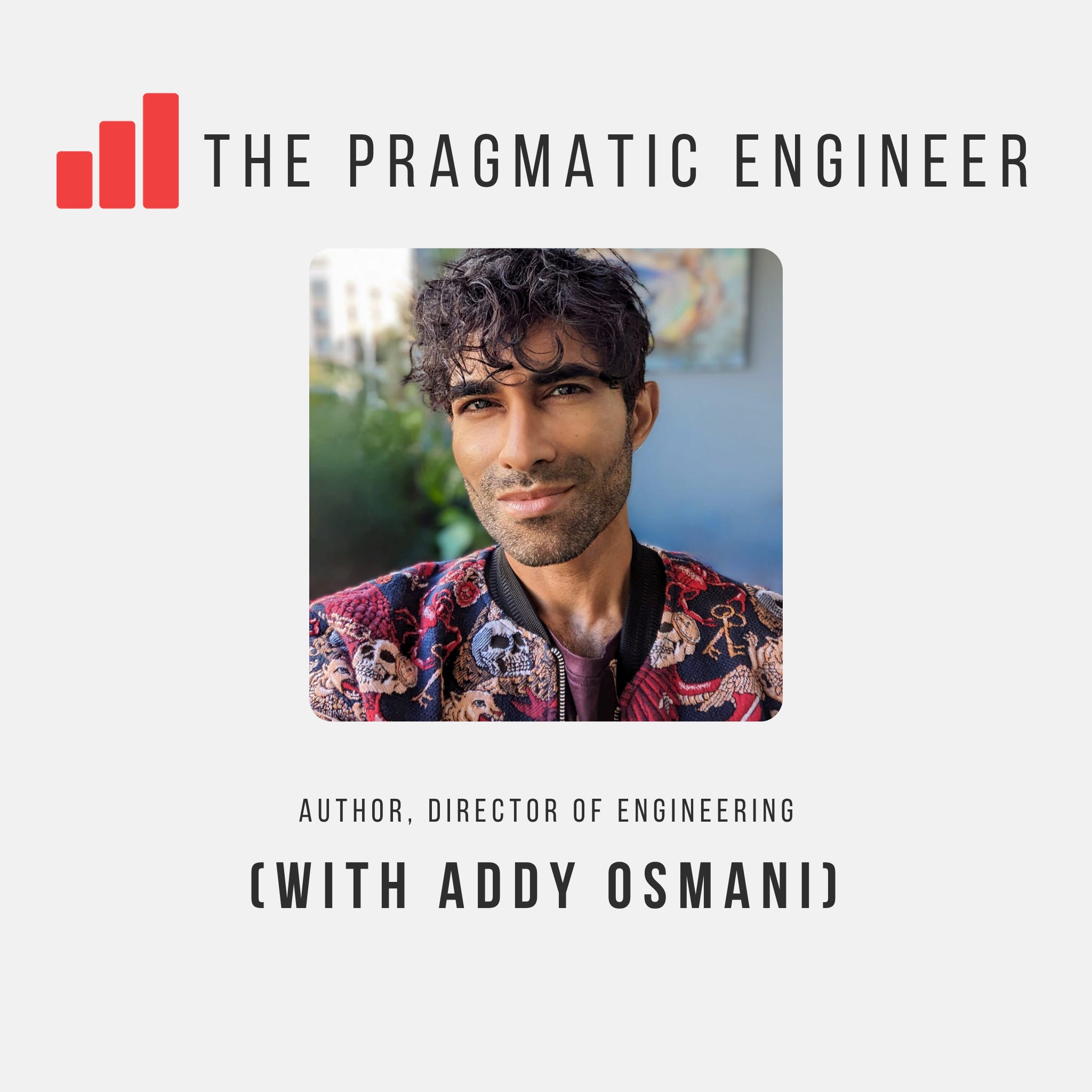
Overview of From Chrome DevTools to AI Engineering, with Addy Osmani
This episode traces Addy Osmani’s path from a curious teenager in rural Ireland building a web browser from scratch to becoming a longtime Google engineering leader shaping Chrome, DevTools, and web performance. The conversation covers the evolution of browser tooling, the origin of core web vitals, how Google’s engineering culture works at scale, and how AI is changing software development through agents, loop engineering, and new expectations around judgment and accountability.
Addy Osmani’s Early Journey
How it started
- Grew up in rural Ireland with limited internet access, which made the web feel both magical and frustrating.
- Learned programming young, starting with Pascal and later C++.
- Built a custom web browser as a teenager by studying HTML, CSS, JavaScript, and browser behavior from specs.
What drove him
- A deep curiosity about how systems work under the hood.
- A practical motivation: faster browsing and better access to the web despite slow connections.
- Winning a national science competition with his browser project gave him early visibility and reinforced his love of building.
From Open Source to Google
jQuery and ToDoMVC
- Contributed to jQuery, his first major open source collaboration, and learned how large communities shape software.
- Created ToDoMVC to compare JavaScript frameworks by implementing the same app across multiple stacks.
- ToDoMVC became a widely used reference point for framework tutorials and comparisons.
- Helped co-create Speedometer, now a major browser responsiveness benchmark.
Joining Google
- Google reached out after noticing his educational work in the front-end ecosystem.
- Joined first in a developer relations / builder-focused role and later moved deeper into engineering.
- His work continued to center on helping developers understand the web and build better tools.
Chrome DevTools: Building the Browser’s Developer Experience
Why DevTools mattered
- Chrome DevTools evolved into something close to an IDE inside the browser.
- The team’s goal was not to replace your editor, but to meet developers where they already worked.
- DevTools became especially strong at:
- Performance profiling
- Debugging JavaScript
- Mobile simulation
- Inspecting app behavior and browser state
Key technical themes
- DevTools improved because the team listened closely to real developers and builders.
- Several hard problems stood out:
- Memory debugging remains especially difficult
- Source maps helped bridge compiled code and original source
- Blackboxing let developers hide framework internals and focus on their own code
- Device mode helped simulate mobile viewports and behaviors
- Application panel supported debugging service workers, caches, and PWA features
Main insight
- DevTools succeeded by treating the browser as the primary work surface for web debugging, while still staying adaptable to different workflows and eventually to AI agents.
Core Web Vitals: Turning UX Into Metrics
Why they were needed
- Before core web vitals, “page load” was too vague to be useful.
- Google wanted metrics that reflected how users actually experience a page.
The important shift
- The team focused on user-centered moments such as:
- Is something visible?
- Is the page useful?
- Is it interactive?
- Is the layout stable?
The metrics discussed
- LCP (Largest Contentful Paint): when the main visible content appears
- CLS (Cumulative Layout Shift): how much the page unexpectedly moves
- FID (First Input Delay): how quickly the page responds to the first interaction
- INP (Interaction to Next Paint): a more complete measure of interaction responsiveness
Why it mattered
- These metrics gave developers a shared language for page experience.
- They also created a more nuanced conversation between product teams, engineers, and browser vendors about what “good” performance actually means.
Google Engineering Culture and Career Growth
What was unique about Google
- Extremely large-scale experimentation and A/B testing culture
- Strong emphasis on developer goodwill and ecosystem collaboration
- A willingness to share learnings across teams and products
- Deep attention to rigor, measurement, and operational accountability
Addy’s path inside Google
- Started around a mid-level engineering level in DevRel
- Grew into management, then engineering leadership
- Eventually became a director, responsible for larger org-level goals and cross-functional coordination
What changed at director level
- More accountability for business outcomes
- More time spent aligning teams and surfacing blockers
- More focus on strategic decisions and organizational health
- Still required staying technically grounded and close to the work
AI Engineering: Cognitive Depth vs. Cognitive Surrender
Addy’s framing
- Cognitive debt: overreliance on AI can erode your own understanding
- Cognitive surrender: blindly accepting model output without critical thought
His main concern
- AI should amplify an engineer’s understanding, not replace it.
- Engineers still need enough context to debug, verify, and make good decisions.
Mutual amplification
- A better approach is to use agents while preserving learning:
- Have agents summarize decisions
- Log reasoning and friction points
- Capture what was learned in each session
- Stay curious about how the system works
Loop Engineering and Software Factories
What “loops” mean
- Addy sees loops as systems that connect:
- Production signals
- Errors and logs
- Analytics
- Bug reports
- Prioritization
- Implementation
- Verification
Why it matters
- Instead of asking an agent to simply “write code,” the idea is to build a system that can:
- Detect problems
- Decide what to fix
- Generate and test changes
- Feed results back into the product cycle
Important caution
- Full automation without guardrails is risky.
- Human review still matters, especially for high-impact changes and critical systems.
The Future of Software Engineers
Addy’s view
- Writing syntax directly is becoming a smaller part of the job.
- The enduring value of engineers is shifting toward:
- Judgment
- Taste
- Accountability
- Verification
- Product sense
What still makes engineers essential
- Someone must own the system.
- In large codebases like Chromium, owners are accountable for areas even if they didn’t write every line.
- AI may change the tools, but not the need for humans who can decide what should ship and what should be blocked.
Writing, Publishing, and Using AI
How his writing workflow changed
- Uses AI heavily for research:
- Scanning discourse on Hacker News, X, and elsewhere
- Identifying what people care about or struggle with
- Still starts with his own thesis and handwritten draft
- Uses models to improve clarity and readability, but not to replace the core idea
The challenge
- AI can make writing more polished, but also more homogenous.
- He is still figuring out how to preserve his own voice while benefiting from the tools.
Final Takeaways
- Curiosity and systems thinking can compound over decades.
- Browser tooling and web performance have improved enormously because people like Addy kept pushing on hard, often invisible problems.
- AI is making software creation faster, but it raises the bar for understanding, verification, and accountability.
- The most durable skill set for the next era is not just coding ability, but the ability to think across product, engineering, and user experience.