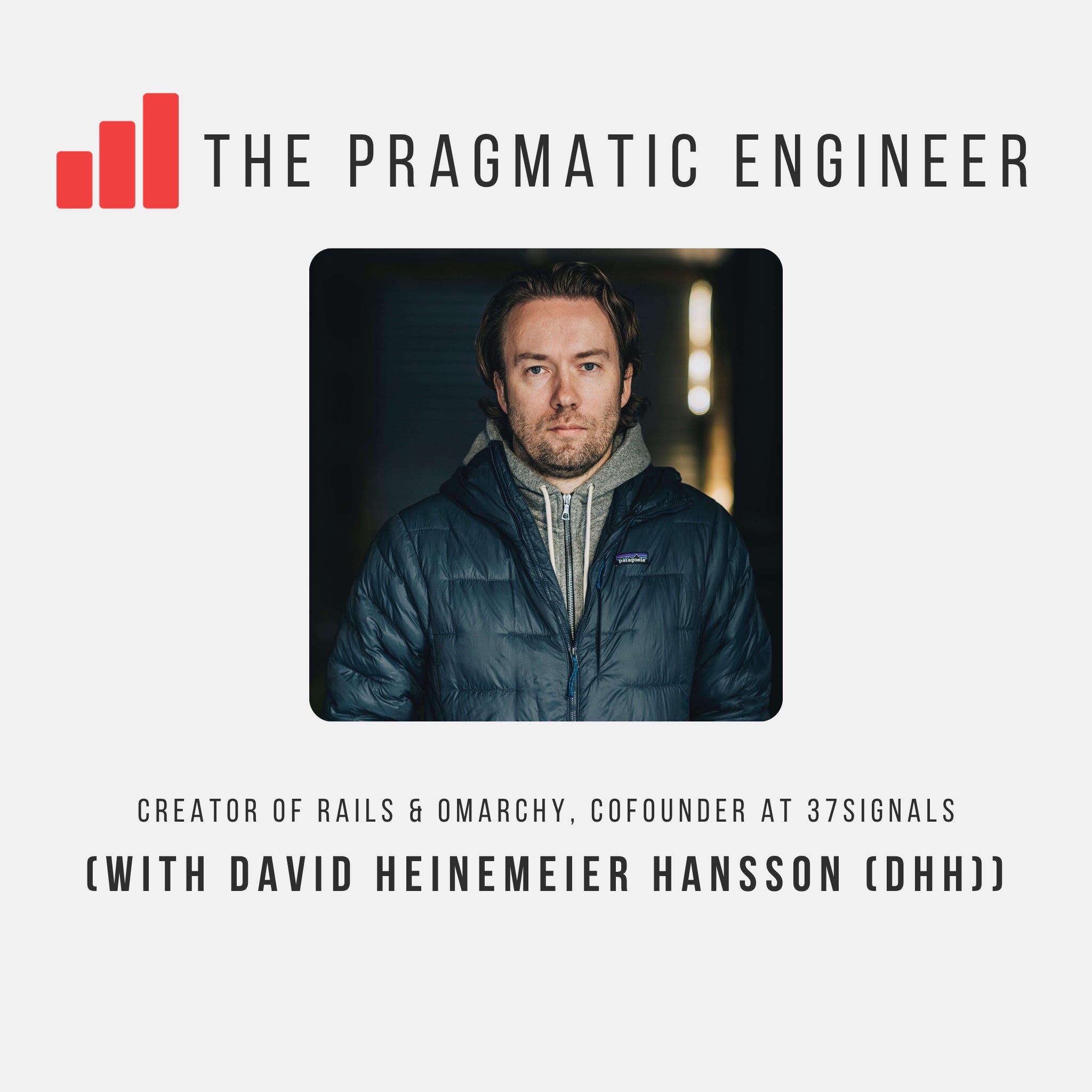
Overview of DHH’s new way of writing code
This episode (hosted by Gergely Orosz) features David Heinemeier Hansson (DHH) — creator of Ruby on Rails, co‑founder of 37signals, and author of the Umachi Linux distribution — describing his rapid shift from AI skeptic to “agent‑first” builder. DHH explains how agent-based tools and frontier models (e.g., Opus/Claude family) have changed his daily workflow, made small teams massively more productive, and pushed 37signals to lean into Linux, CLIs and design-led product craft. He emphasizes taste, code quality, and senior judgment as central to safely gaining leverage from AI.
Key takeaways
The practical shift: agent‑first workflow
- DHH now starts many projects with an AI agent (agents that can run Bash, browse, use tools), reviews drafts in his editor, tweaks, then commits. Agents deliver initial implementations quickly; humans validate and refine.
- Tooling used frequently: Opus (Claude), OpenCode/CloudCode harnesses, OpenClaw for autonomous browser actions, NeoVim with tmux layout for parallel agent panes.
- Agents can perform surprisingly autonomous tasks (signups, joining services, PR reviews) — sometimes one-shot — which unlocks new classes of work.
Productivity and who benefits most
- Biggest short‑term gains accrue to senior engineers: they can validate/focus agent output and scale their impact (5x–10x reported).
- Junior developers face mixed pressures: some tasks get automated; their roles may shift toward oversight, product judgement, and higher‑level systems work.
- The net result is an explosion of feasible projects — teams take on many small/high‑ambition tasks they previously wouldn’t.
Product philosophy and craft
- Taste, aesthetics and “beautiful” code/UI remain paramount. DHH insists agent output must meet the team’s style and quality bar before merging.
- Designers at 37signals act as product architects: they determine what to build, how it should work, and often implement HTML/CSS/JS — a blended role (design + product + front‑end).
- Ruby on Rails and Linux are well suited to current agent workflows because of token efficiency and close parity with deployed environments.
Architecture & platform choices
- 37signals standardized on a custom Linux distro (Umachi) and shifted many devs to Linux machines to match production and make tooling consistent for agents.
- Emphasis on CLIs and Unix philosophy: small interoperable tools + feature flags make agent orchestration and cross‑service automations practical.
Safety, process and security
- Agents are not yet safe to deploy blindly in mission‑critical systems; senior review remains necessary.
- Organizations need verification and security tooling (e.g., Sonar for code quality/security, WorkOS for enterprise auth, Statsig for experimentation/feature flags).
- Release cadence and product development methodologies (e.g., Shape Up two‑month cycles) will change — faster iterations require robust experiment/flagging and deployment controls.
Topics discussed
- DHH’s background: Rails, Basecamp, Hey.com, and launching Umachi.
- The moment of inflection: why late‑2023/early‑2024 frontier models + agent harnesses were a game changer.
- Concrete agent uses: PR reviews at scale, autonomous browser signups, P1 performance optimization, drafting and implementing CLI tools.
- Design as a product role: designers as owners of the how/why and partial implementers.
- Hiring and the changing value of programmers: who wins, who’s at risk, and hiring practices at 37signals.
- Mental model & wellbeing: how to stay productive without burning out (sleep, health, pacing).
Notable quotes & insights
- “When the models got good enough the ergonomics changed — agent harnesses + frontier models was the unlock.”
- “Designers at 37signals are product managers in many ways — they find the how and the why, and implement.”
- “Agent acceleration feels less like managing projects and more like stepping into a super mech suit — you have 12 arms instead of two.”
- “The biggest benefits are accruing to senior engineers because they can validate and redirect agents.”
- “Taste is truth — beautiful things are usually correct. I expect agent output to meet that aesthetic and craft bar.”
Tools, models and products mentioned
- Models & harnesses: Opus (Anthropic/Claude family), OpenCode, CloudCode, OpenClaw
- Editors & dev tools: NeoVim, tmux, Ruby on Rails
- Products & projects: Umachi (Linux distro), Basecamp, Hey.com, Fizzy
- Sponsor/infra tools: Sonar (SonarQube), WorkOS, Statsig
- Process concepts: CLIs, Unix philosophy, Shape Up
Actionable recommendations (for different roles)
For individual developers
- Try agent‑first on a small side project. Use a frontier model + terminal harness to see the “aha” moment for yourself.
- Focus on review skills: learn to evaluate and redirect agent output, enforce style and safety.
- Deepen system and product knowledge (architecture, deployment, observability) — senior judgment is currently high leverage.
For designers
- Expand skills beyond visuals: own the how/why, learn HTML/CSS/JS and prototype end‑to‑end. Agents will empower designers who can shape implementation.
For engineering leaders & managers
- Invest in CLIs, APIs, and small interoperable tools that agents can call; make systems agent‑friendly.
- Strengthen code quality and security tooling (static analysis, malicious package detection, feature flags, experiment platforms) to handle increased agent speed.
- Revisit release controls, experimentation, and deployment guardrails (feature flags & observability).
For hiring & careers
- Demonstrate craft: public projects, polished take‑home tests, strong references and real examples matter more than resumes alone.
- If you want to “ride the wave,” lean into higher‑level skills (product judgement, system knowledge, design taste) and agent oversight capabilities.
Risks & future considerations
- Short term: outages and erroneous agent changes (need for senior review and better CI/security checks).
- Medium term: redistribution of value — senior engineers and hybrid designer‑engineers become more valuable; some rote implementation roles could decline.
- Long term: agents may approach or exceed senior reliability, but timing/inflection points are uncertain; organizations should prepare but avoid speculative panic.
- Wellbeing: new tooling is intoxicating; maintain sleep, health, and sustainable pacing.
Final summary
DHH’s shift to agent‑first development demonstrates a pragmatic, craft‑focused adoption of AI: use agents to amplify curiosity, remove friction, and explore ideas that were previously uneconomical — but keep a high bar for taste, correctness, and safety. The immediate winners are teams and senior engineers who can validate agent output; companies should adopt CLIs, enforce code quality/security, and rethink processes to capture the upside while managing risk.