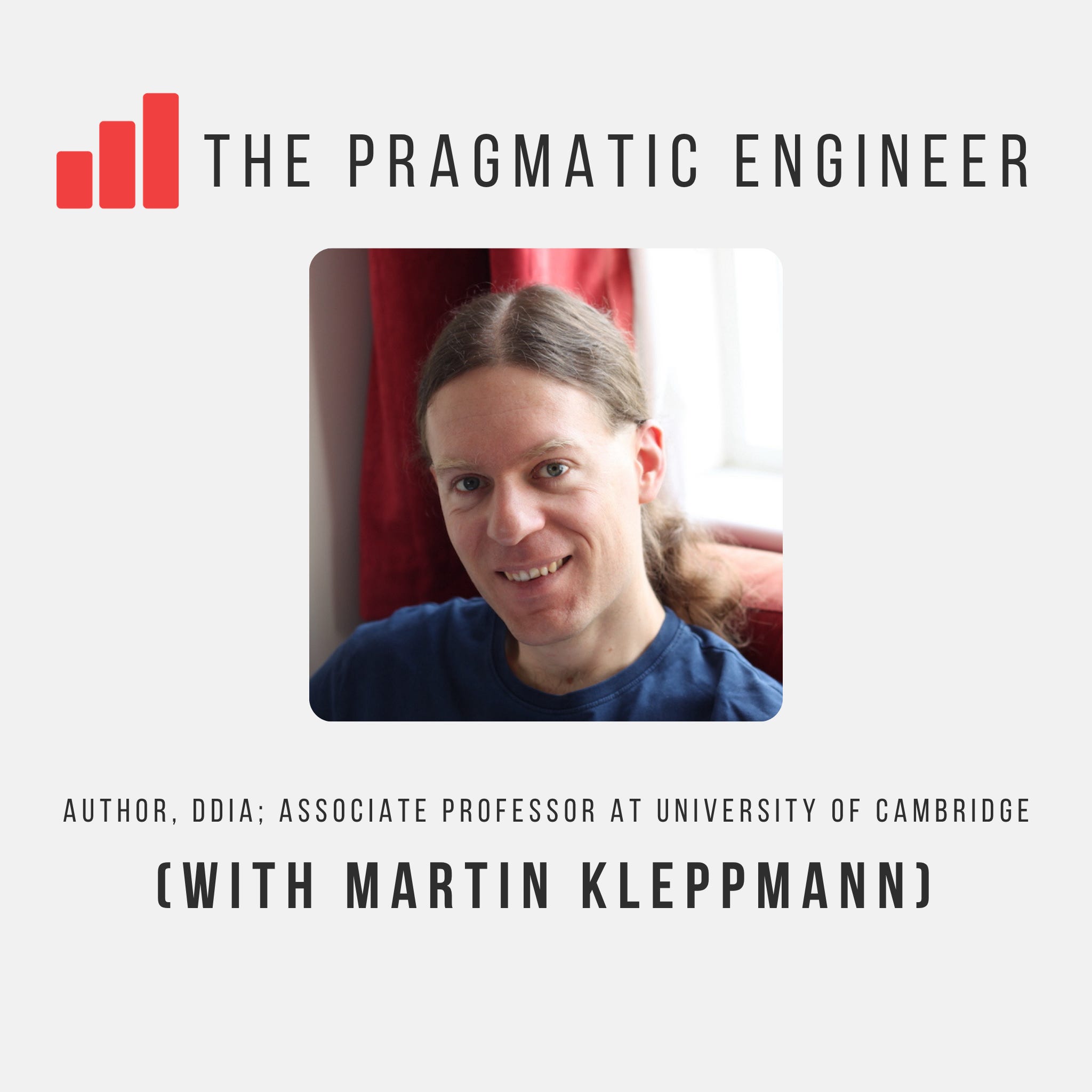
Overview of Designing Data-Intensive Applications with Martin Kleppmann
This episode of the Pragmatic Engineer podcast (host Gergely Orosz) is a wide-ranging conversation with Martin Kleppmann — author of Designing Data-Intensive Applications — about the origins of the book, lessons learned at LinkedIn (Kafka, Samza), what changed in the second edition, and research directions he’s pursuing in academia (local-first software, formal methods, cryptographic proofs for supply chains). If you build or operate backend/data systems, this episode covers enduring fundamentals, cloud-native shifts, and emerging engineering problems worth knowing.
Key topics covered
- Martin’s path: two startups (GoTestIt, Reportive), Y Combinator, LinkedIn acquisition, then writing the first edition and moving into academia.
- Origins of Kafka and stream processing at LinkedIn, and how that influenced the first edition of the book.
- Why the second edition was needed: cloud-native primitives (object stores like S3), managed services, and new data patterns (dataframes, vector indexes).
- Core engineering objectives defined: reliability (fault tolerance), scalability (principally horizontal scaling), maintainability.
- Trade-offs when using cloud/managed services: abstraction benefits vs. need for deep understanding when debugging or optimizing.
- Changes in scale and sharding: hardware improvements and managed services reduce some sharding pressure but parallelism and partitioning remain relevant at scale.
- The classic distributed-systems failure modes (network timing, crashes, clocks) and why designers must assume and plan for weird failures.
- Ethics and “Doing the Right Thing”: engineers’ responsibility to think about societal impacts, data protection, and intentional trade-offs.
- Formal methods and verification: model checking (TLA+) and proof assistants (Isabelle, Lean, etc.) — why formal verification becomes more important as AI-generated code scales.
- Local-first / decentralized collaborative software: CRDTs (Automerge), decentralized access-control challenges, and the engineering trade-offs vs. centralized SaaS.
- New research direction: cryptographically proving physical-world claims (e.g., supply-chain emissions) while protecting business-sensitive data.
What’s new in the second edition
- Stronger emphasis on cloud-native architectures: designing with object stores, managed services, and the implications for replication and storage.
- Reduced/updated coverage of technologies that faded (MapReduce) and more coverage of modern tools (Spark/Flink-style systems).
- Additional material relevant to AI workflows: vector indexes, dataframes, and storage/indexing techniques used in machine learning workloads.
- Expanded discussion of multi-region and multi-cloud trade-offs, and stronger treatment of ethics and long-term societal impacts.
Major takeaways and actionable points
- Understand abstractions you rely on: If you build on managed services, knowing the essentials of how they work (storage engine types, index choices, column vs row stores) gives you a huge advantage diagnosing cost/latency/availability issues.
- Trade-offs are core: Reliability, scalability and maintainability require explicit trade-offs. Multi-region/multi-cloud or decentralization increases availability but complicates consistency and cost.
- The “troubles with distributed systems” are real: assume timing uncertainty, partial failures, clock issues, and that these edge cases will eventually happen at scale — design and test accordingly.
- Formal methods are moving from niche to practical: start with model checking (TLA+) for high-assurance distributed protocols; consider heavier proof tools for high-stakes algorithms. AI may make formal methods more accessible and more necessary.
- For decentralized/local-first systems, expect harder engineering problems (offline-first, revocation vs concurrent edits, malicious devices). Solving them yields important optionality beyond centralized SaaS.
- Ethics matters: engineers should surface societal and business risks (privacy, reputational risk, misuse) as part of architectural trade-offs.
Notable insights / quotes (paraphrased)
- “Reliability essentially means fault tolerance — designing so the system keeps working when parts fail.”
- “Scalability is about mechanisms for coping with changing load — often horizontal scaling and sharding — but scaling down (cost proportional to load) is equally important.”
- “Cloud pushes abstraction up the stack — that’s generally good, but somebody still needs to build and understand the lower layers.”
- “Engineers have a responsibility to think beyond just ‘does this ship’; they must consider effects on users and society.”
- “Formal verification may become more important as LLMs generate more code, because proofs can guarantee properties tests can’t.”
Practical recommendations / “Where to start”
- Read (or re-read) Designing Data-Intensive Applications — get the second edition for cloud-native and AI-related updates.
- Learn the essentials of storage engines: B-trees vs LSM trees, column vs row storage, and index trade-offs.
- Get hands-on with cloud primitives: object storage semantics (S3) vs block devices (EBS) and how they change replication/consistency assumptions.
- Study distributed-systems failure modes and run chaos/failure tests that simulate timing, partitions, and clock skews.
- For correctness of distributed protocols:
- Start with model-checking languages/tools such as TLA+ (good entry point).
- Explore proof assistants (Isabelle, Coq, Lean) if you need high-assurance proofs.
- If you’re interested in decentralized collaboration: investigate CRDTs/Automerge, and focus on how to handle concurrent revocation and synchronization without a single authoritative server.
- For academic/learning resources: watch Martin’s distributed systems course on YouTube for deeper algorithmic coverage (Raft, consensus, etc.).
Resources & further reading
- Designing Data-Intensive Applications (Martin Kleppmann) — 2nd edition.
- Jay Kreps — “The Log” blog post (origin of Kafka motivations).
- Kafka, Samza (stream processing history at LinkedIn).
- TLA+ (model checking) — entry point for reasoning about distributed protocols.
- Isabelle, Coq, Lean — examples of proof assistants used for formal verification.
- Automerge (CRDT library) — for local-first collaborative data.
- Chris Riccomini — The Missing README (newsletter/book referenced by Martin) — industry perspectives on modern data systems.
- Martin Kleppmann’s distributed systems lectures (available on YouTube).
Closing summary
Martin Kleppmann’s conversation bridges industry and academia: the first edition of his book codified durable distributed-systems fundamentals; the second edition updates those foundations for a cloud-native, AI-influenced world. The episode emphasizes that abstractions (cloud, managed services, LLMs) change how engineers work but do not remove the need for deep reasoning about trade-offs, failure modes, and societal impact. For engineers and technical leaders, the practical path is to learn the essential internals that matter for your systems, adopt appropriate verification and testing strategies, and intentionally weigh the ethical and operational trade-offs of the architectures you choose.