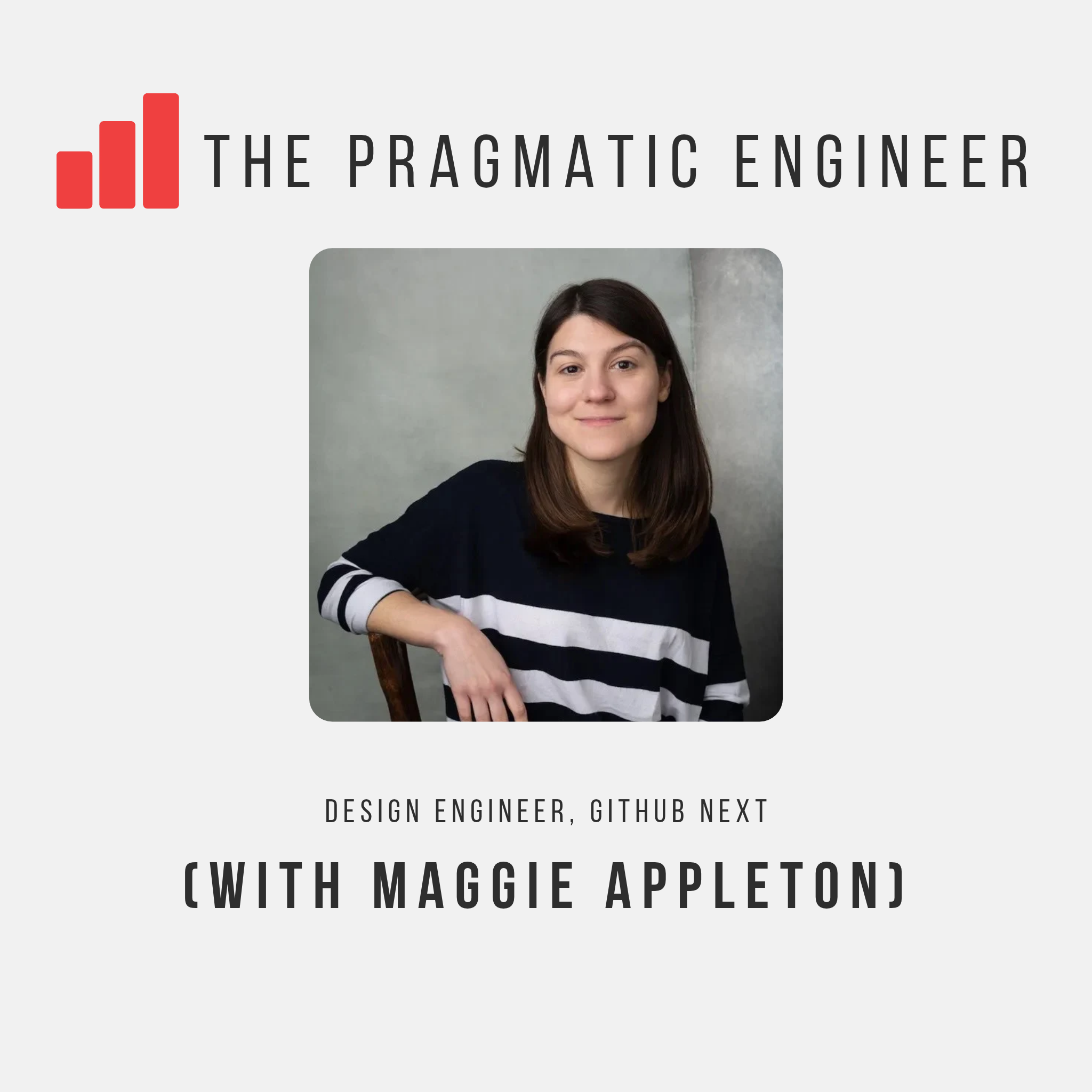
Overview of Design Engineering with Maggie Appleton
This episode explores what “design engineering” really means through a conversation with Maggie Appleton, a design engineer and prototyper at GitHub Next. Maggie explains how her background in cultural anthropology, illustration, and front-end work shaped her approach to product design, and why great design often requires deep understanding of engineering constraints, user context, and the underlying system—not just visuals. The discussion also covers how AI is changing prototyping, why paper notebooks and whiteboards still matter, and why design craft still has a big role even as agents get better at generating interfaces.
Who Maggie Appleton Is and How She Got Into Tech
From anthropology to web design
- Maggie studied cultural anthropology, which taught her to think about humans as adaptable and culturally shaped rather than fixed.
- Growing up as an expat and learning HTML/CSS as a teenager through MySpace, Neopets, and early web customization made her naturally comfortable with digital creation.
- She entered design and tech through freelance web design and illustration, then moved steadily closer to front-end engineering.
Career path
- Illustrator / art direction at Egghead, where she learned JavaScript and React by having to understand and explain developer concepts visually.
- Designer at Elicit, an early AI startup, where she was the sole designer and learned end-to-end product design in a fast-moving, high-feedback environment.
- Prototyper at GitHub Next, where she now experiments with future-facing product ideas and agentic workflows.
What Design Engineering Means
Maggie’s definition
Maggie sees design engineering as design that deeply engages with engineering reality:
- It is still problem-solving.
- The difference is in the materials: code, data, APIs, architecture, interfaces, motion, spacing, and language.
- A design engineer understands not just how something should look, but how it actually works.
The key distinction
- Traditional product design can focus more on user needs, flows, and visual clarity.
- Design engineering becomes especially important when the product is:
- technically constrained,
- highly abstract,
- built for power users,
- or in a new domain like AI.
Nouns, verbs, and system design
- A large part of design is defining the product’s primitives:
- What are the nouns?
- What actions can users take on them?
- What is the simplest coherent structure that makes sense?
- In agentic tools especially, these primitives are still being invented, which makes design unusually hard.
Tools and Workflow
What she uses now
Maggie’s tools are a blend of old and new:
- Paper notebooks and pen/pencil for early thinking and sketching.
- Figma for rough-to-medium fidelity interface exploration.
- Agents and coding tools like Codex and Claude for implementation and iteration.
- Live browser prototypes when the design needs to be felt in real time.
Why paper still matters
- Paper is fast, low-friction, and visual.
- It helps her externalize thoughts before they become language.
- Agents are still weaker at visual reasoning, so paper remains better for early-stage design thinking.
“Build your own Figma”
- A major part of her current process is creating jigs: live prototypes with sliders and controls for variables like speed, contrast, color, spacing, and motion.
- This lets her tune the experience directly in the browser instead of manually tweaking static mockups.
AI, Prototyping, and Design
What AI has changed
- AI has made prototyping much faster and more ambitious.
- She can now:
- sketch an idea,
- generate a working prototype,
- adjust variables live,
- and have agents iterate until the result matches her intent.
What AI still struggles with
- Agents are still weak at:
- spatial reasoning,
- subtle visual composition,
- context-sensitive design decisions,
- and understanding nuanced taste.
- They often over-explain interfaces with too much text or produce designs that feel generic or obviously AI-generated.
Her critique of AI-generated design
- AI can generate many high-fidelity options, but that doesn’t replace the deeper work of:
- defining the right problem,
- testing with users,
- understanding tradeoffs,
- and making the design coherent.
- For simple UIs, AI is fine.
- For new primitives or hard product problems, a designer is still essential.
Collaboration Between Designers and Engineers
Why tension often happens
- Tension usually comes from a mismatch in understanding:
- designers working from Figma-like abstractions,
- engineers dealing with performance, data flow, browser constraints, and implementation realities.
- Good collaboration requires shared understanding of constraints.
What great collaboration looks like
- Designers and engineers work from the same mental model.
- Designers understand enough technical reality to avoid impossible or costly designs.
- Engineers understand enough design intent to preserve user experience and polish.
Her experience
- As a design engineer, she often avoids the classic designer-engineer friction because she handles much of the front-end and implementation herself.
- Engineers often appreciate this because it lets them focus on harder backend and system problems.
GitHub Next and Collaborative Agentic Work
The problem she’s trying to solve
Maggie and her team are exploring a major gap in today’s AI tools:
- Agents speed up individual work,
- but they do not yet support collaborative planning well.
Her current focus
- Prototyping interfaces for:
- shared planning,
- decision-making,
- multiplayer agent workflows,
- and proactive agents that don’t overwhelm users.
Why this matters
- As agents take over more implementation, teams need better tools for:
- upfront alignment,
- decision tracking,
- and shared context.
- The “hand-off” to an agent becomes a critical moment, so teams must agree earlier and more clearly than before.
Thoughts on Craft, Taste, and the Future of Design
Will agents replace designers?
Maggie’s view is nuanced:
- Agents can help a lot with speed and exploration.
- But they don’t yet have the taste, context, and judgment needed for good design at a high level.
- She worries that AI-generated interfaces can feel bland, repetitive, or culturally behind the times.
Design as culture, not just utility
- Good design is not only about usability.
- It also signals:
- taste,
- cultural timing,
- care,
- and identity.
- If everyone uses AI to generate similar-looking interfaces, the distinctiveness of human-designed products may become even more valuable.
Her own craft
- She admits she still cares deeply about the details.
- She’s not ready to give up the parts of design that feel tactile, precise, and personally satisfying.
Concepts Maggie Shared Beyond AI
Digital gardens
- A digital garden is a blog where posts can evolve over time.
- Posts have stages like:
- seedling,
- budding,
- evergreen.
- This helps fight perfectionism and makes it easier to publish in-progress thinking.
Home-cooked software
- Inspired by Robin Sloan, this is software made for yourself and your family rather than a mass market.
- AI makes this much more accessible, because people can build small custom tools for their own needs.
Barefoot developers
- Her version of this idea extends to people who aren’t professional engineers but have enough skill and context to build useful software for their communities.
- She argues for stronger local-first tools and frameworks to support them.
Key Takeaways for Engineers
What engineers can learn from designers
- Think visually and structurally before coding.
- Use notebooks or whiteboards to work through ideas.
- Learn the basics of typography, layout, and user flows.
- Use agents as teachers and prototyping partners, not just code generators.
What anthropological thinking adds
- Every product exists in a cultural context.
- Users bring assumptions about trust, timing, notation, and interaction patterns.
- Understanding the real-world environment of use can improve product decisions dramatically.
Notable Insights
- “The materials are different” — design and engineering share a problem-solving process, but operate on different inputs.
- “Agents are good at outputting text; humans are not optimized for consuming reams of it.”
- “The hard bit of product design is reducing complexity into the simplest coherent system.”
- “Notebooks aren’t dead.”
- “AI is making prototyping faster, but not making taste irrelevant.”
Final Impression
This was a highly visual, practical conversation about the future of software design. Maggie Appleton argues that design engineers sit at the intersection of aesthetics, systems thinking, and implementation, and that the best work happens when design, engineering, and user understanding are tightly connected. Even as AI accelerates prototyping and implementation, the episode makes a strong case that human judgment, cultural awareness, and hands-on sketching still matter a lot.