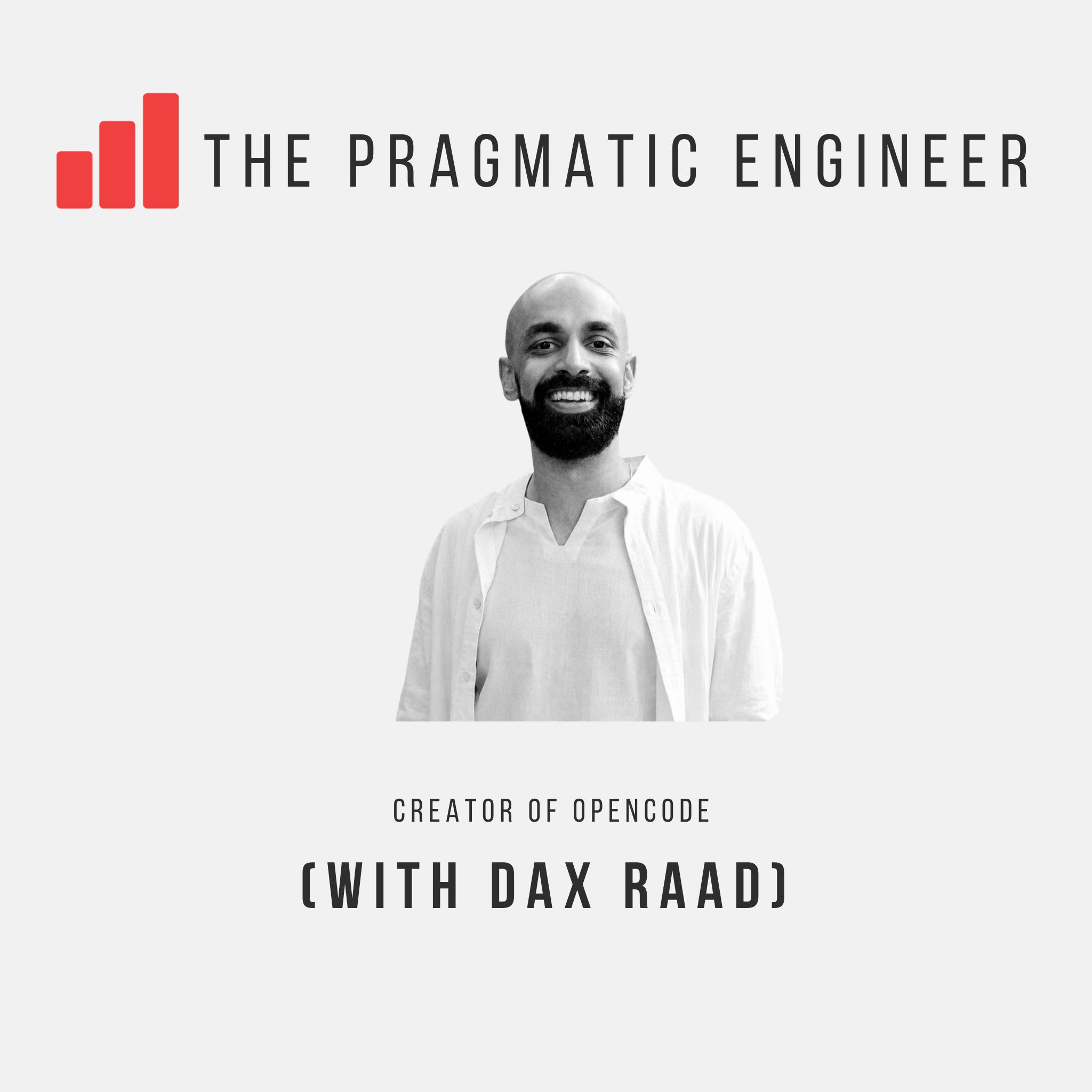
Overview of Building OpenCode with Dax Raad
This episode features Gergely Orosz talking with Dax Raad, co-founder of OpenCode, one of the fastest-growing open-source AI coding tools. The conversation centers on OpenCode’s explosive growth, the realities of building AI-powered dev tools, and why Dax believes AI has made some parts of software development easier while leaving the hardest parts essentially unchanged. A major theme is that AI can speed up code generation, but it does not automatically improve product judgment, team motivation, or software quality.
Key Themes and Takeaways
-
OpenCode grew extremely fast
- Launched in mid-2025 and scaled from roughly 650k monthly active users in December to 2.5M in January, then to around 6.5M–8M shortly after.
- The company started with just 3 co-founders, later growing to about 20+ people.
-
AI makes shipping easier, but not necessarily better
- Dax says AI helps with execution, but the biggest challenges in product work remain:
- deciding what to build,
- avoiding unnecessary features,
- maintaining quality,
- and not accumulating technical debt.
- His core feeling: “I’m working as hard as ever” despite faster tooling.
- Dax says AI helps with execution, but the biggest challenges in product work remain:
-
The team had to slow down intentionally
- Dax sent a memo to the team warning that they were:
- shipping too many features,
- accepting too many hacks,
- and not spending enough time cleaning things up.
- His point: AI can make teams feel faster without actually improving output or direction.
- Dax sent a memo to the team warning that they were:
-
Positioning matters more than raw speed
- OpenCode succeeded partly because it claimed the open-source coding agent territory before anyone else.
- Dax views open source as a strong long-term wedge in dev tools, especially when major model vendors are competing aggressively.
-
Inference and GPU access are major businesses and bottlenecks
- Dax argues inference can be highly profitable because the marginal cost is largely electricity plus hardware amortization.
- But the industry is constrained by GPU supply, and even fast-growing startups can hit capacity limits.
- Large cloud and AI firms are consuming enormous amounts of supply, tightening the market.
-
AI tools do not automatically increase organizational productivity
- In many companies, engineers use AI to do the same amount of work with less effort, not to produce 10x more output.
- Motivation, incentives, and organizational culture still determine whether productivity gains translate into business gains.
OpenCode’s Business Model
Dax described two main revenue lines:
1. OpenCode Zen (Inference / model access)
- Built initially to reduce onboarding friction.
- Lets users access models without setting up their own accounts and rate limits.
- Has grown into a major business for:
- hosted inference,
- open-source model access,
- and aggregated model support.
- Dax said this side of the business hit a $50M run rate surprisingly quickly.
2. Enterprise control plane
- For companies with many engineers, OpenCode needs admin tooling:
- permissions,
- SSO,
- budgets,
- rate limits,
- and provider management.
- This is the “boring” but necessary enterprise layer.
- Dax suggested they may eventually charge primarily for inference rather than the control plane itself.
Why OpenCode Won Early
Dax credits several product choices:
-
Fast path to value
- The first experience had to feel great immediately.
- OpenCode focused on removing friction from installation and first use.
-
Terminal experience mattered
- The team built their own terminal rendering framework instead of using an off-the-shelf one.
- This was an “irrational” quality decision, but it helped distinguish OpenCode from competitors.
-
Open source as a strategic wedge
- Dax believes dev tools often become standardized through open source adoption from the bottom up.
- He sees OpenCode as benefiting from being the neutral, open alternative in a competitive model ecosystem.
-
Quality as differentiation
- He argues that quality is one of the last meaningful advantages small companies still have.
- A product a year old can already start to “rot” if quality is neglected.
Dax’s View on AI, Teams, and Engineering
AI changes workflows, not fundamentals
- AI may reduce coding effort, but it does not remove the need for:
- thinking,
- product judgment,
- architecture,
- and careful system design.
- He said his time breakdown has barely changed:
- before AI: 95% thinking, 5% doing
- after AI: 96% thinking, 4% doing
Agents can hide bad judgment
- A major concern is that AI makes it too easy to ship:
- hacks,
- brittle fixes,
- and short-term patches.
- The “muted prickle” idea: before AI, engineers felt the pain of writing hacky code. Now, agents absorb that pain for them, which can weaken judgment.
Engineering leadership is becoming more about guardrails
- Dax thinks the role of engineers is shifting toward:
- building safe patterns,
- conventions,
- tests,
- and systems that let less experienced humans or AI agents ship without breaking things.
- He sees this as less a new idea and more a return to old software engineering principles.
Product Philosophy
Dax emphasized a few durable principles:
- Solve one thing well
- A strong product usually has one core idea that users can reach quickly.
- Feedback loops matter
- Everyone on the team should feel the consequences of poor decisions.
- Clean-up is worth it
- Even if refactoring doesn’t directly increase revenue, it preserves long-term product health.
- Taste still matters
- He believes “taste” is real, but only if you genuinely care about quality.
- If you say quality matters but don’t act like it does, it shows.
Notable Opinions and Observations
-
On viral AI predictions
- Dax is skeptical of social-media narratives like “24–29-year-old engineers will dominate because they have pre-AI principles and post-AI speed.”
- He sees most of these predictions as people trying to reassure themselves during a time of rapid change.
-
On startup culture
- He’s more skeptical now of very young teams because he believes emotional maturity matters a lot in intense, intimate startup environments.
-
On product quality vs. business logic
- He pushes back on the idea that rational business decisions alone make great products.
- Some of the best decisions are “irrational” quality investments that compound over time.
Dax’s Personal Background
- Grew up programming, with a software engineer father.
- Started building projects as a kid, including Minecraft servers and mods.
- Worked on early startups, then moved into open source full-time.
- Previously worked on:
- Serverless Stack (SST)
- OpenNext
- His experience across dev tools and open source clearly informs OpenCode’s strategy.
Final Takeaway
Dax’s message is that AI is real, powerful, and useful — but it does not remove the hardest parts of software building. OpenCode’s success came not just from using AI well, but from strong positioning, quality-focused product design, and a willingness to say no to superficial speed. In his view, the best teams will still need judgment, restraint, and craftsmanship, even in an AI-native world.